


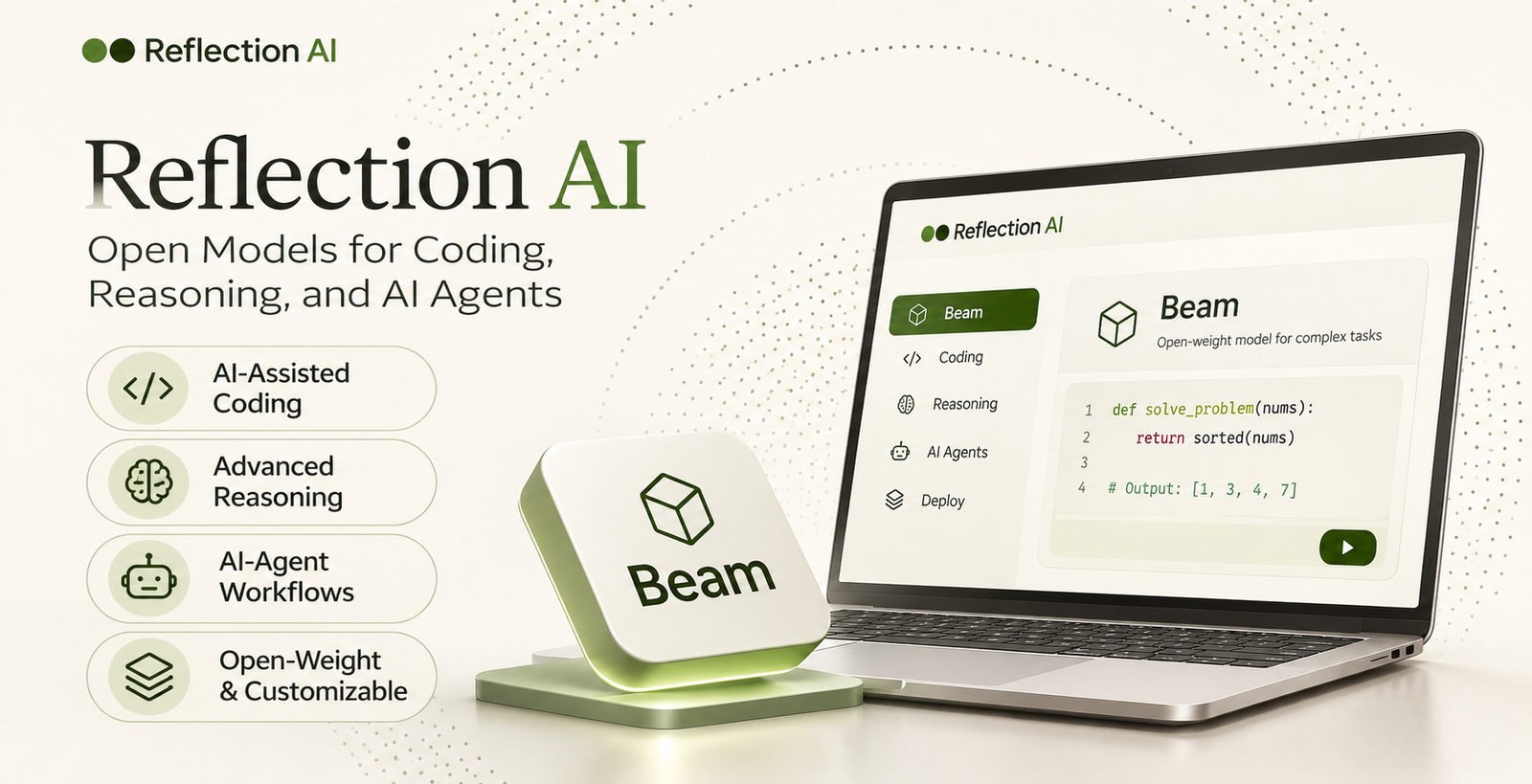
Reflection AI is an artificial intelligence company focused on developing advanced AI systems, particularly open models and technologies that can support complex reasoning, coding, and problem-solving tasks. The company has attracted attention in the AI industry because of its interest in building powerful AI models that can compete with leading proprietary systems while giving developers more flexibility.
Understanding Reflection AI requires looking beyond the company name. Its work connects to important developments in large language models (LLMs), open-weight AI, model training, and AI reasoning. These technologies are changing how developers and businesses build intelligent applications. However, it is important to distinguish between the company’s publicly announced goals, its available products, and the broader possibilities of open AI development. This guide explores what Reflection AI is, how its technology fits into the AI landscape, its potential applications, and what users should consider before adopting it.
What Is Reflection AI?
Reflection AI is an AI research company founded in 2024 by researchers with experience developing advanced AI systems. Its mission is to make powerful artificial intelligence more accessible by building models, software, and infrastructure that developers and organizations can inspect, customize, and deploy.
Unlike companies that primarily offer AI through closed services, Reflection emphasizes open-weight AI models. These models allow users to access trained model parameters and run the software in their own environments, subject to the applicable license.
The company introduced its first major model, Beam, in October 2026. Designed for coding, reasoning, and AI-agent workloads, Beam represents Reflection’s effort to make advanced AI capabilities available to a wider developer community.
Reflection’s work covers several connected areas:
- AI models: Developing large language models for complex tasks.
- Open-source software: Providing tools that help developers customize and use AI systems.
- AI infrastructure: Supporting model deployment through APIs, cloud services, and private environments.
- Enterprise AI: Helping organizations integrate AI into their existing operations.
The distinction matters because Reflection is not simply another chatbot. It is building technology that other developers can use as a foundation for their own AI applications.

How Does Reflection AI Work?
Reflection AI develops models that learn patterns from large collections of training data. These models can then generate responses, write code, solve problems, and perform other tasks based on the information they have learned.
Its Beam model combines several important AI techniques.
1. Large Language Models
A large language model, or LLM, processes text and generates responses based on learned relationships between words, concepts, and other information.
For example, a developer might ask an AI model to identify a problem in a Python application. The model can examine the supplied code, explain a possible error, and suggest a correction.
The quality of the answer depends on the model’s training, the instructions it receives, and the complexity of the task.
Reflection uses this general approach to develop models capable of handling coding and reasoning challenges.
2. Mixture-of-Experts Architecture
Beam uses a sparse Mixture-of-Experts (MoE) architecture. Instead of activating every part of the model for every token it processes, an MoE system routes information through selected groups of specialized neural network components, known as experts.
Reflection’s published specifications describe Beam as having 501 billion total parameters, with approximately 23 billion active for a given token.
This architecture has an important practical advantage: a model can have a large overall capacity without requiring all its parameters to participate in every calculation.
However, active parameters are not the only factor that determines operating cost. Memory requirements, hardware, context length, response generation, and serving infrastructure also matter.
3. Pretraining and Reinforcement Learning
Training an advanced AI model involves more than feeding it information.
Reflection reports using large-scale pretraining followed by substantial reinforcement learning to develop Beam.
Pretraining helps the model learn language, programming concepts, technical information, and patterns found in its training data. Reinforcement learning can then improve its ability to solve tasks by learning from feedback about the quality of its attempts.
For example, a model working on a coding challenge might generate a solution, run tests in an appropriate environment, observe the results, and improve its approach.
Reflection’s published account describes using coding environments, tool-based tasks, and large-scale reinforcement learning during Beam’s development. These are company-reported training details, rather than independent proof that the model will solve every similar problem successfully.
What Is Beam, and Why Is It Important?
Beam is Reflection AI’s first open-weight model. The company introduced it on October 5, 2026, and announced the release of its model weights on October 16, 2026, under the Apache 2.0 license.
Its main focus is not just generating text. Beam is designed for tasks that involve writing code, reasoning through problems, and working with tools over multiple steps.
Key Characteristics of Beam
| Characteristic | Details |
|---|---|
| Model name | Beam |
| Developer | Reflection AI |
| Architecture | Sparse Mixture of Experts |
| Total parameters | 501 billion |
| Active parameters | Approximately 23 billion per token |
| Main applications | Coding, reasoning, and AI agents |
| Model access | Open weights and hosted access options |
| License | Apache 2.0, as announced for the released weights |
| Primary audience | Developers, researchers, and businesses |
These specifications are based on Reflection’s published model announcements.
Why Does Beam Matter?
Many AI products provide access only through a hosted interface or API. Although this approach is convenient, it can limit how much control users have over model deployment and customization.
Beam offers another approach. Developers can obtain the model weights, run the model using compatible infrastructure, evaluate its performance, and customize it for particular applications.
For instance, a software company could investigate whether Beam can assist with its internal development workflow. It could test the model against existing programming tasks, compare the results with other models, and decide whether self-hosting makes sense.
The model’s size means that deployment still requires careful planning. Open weights do not automatically make a frontier-scale model inexpensive or easy to run on an ordinary computer.
Main Features and Capabilities of Reflection AI
Reflection’s technology is aimed at developers who want more control over how AI systems are built and used.
1. AI-Assisted Coding
Coding is one of Beam’s main intended applications.
A capable coding model can help developers understand unfamiliar code, identify potential bugs, generate functions, write tests, and investigate software problems.
Consider a developer maintaining a WordPress website. The developer might provide a PHP function and explain that it returns an empty result when a post author is displayed.
An AI model could examine the supplied code, suggest possible causes, and propose a revised function. The developer would still need to test the solution in a safe environment before deploying it.
This distinction is important. AI-generated code can contain errors, introduce security weaknesses, or fail when it encounters conditions that were not included in the prompt.
2. Reasoning Through Complex Problems
Reflection developed Beam with an emphasis on reasoning performance.
Reasoning tasks often require more than recalling information. They involve breaking a problem into smaller steps, checking assumptions, and producing a solution that satisfies specific requirements.
For example, an analyst could use a reasoning model to examine a spreadsheet’s structure, identify inconsistent formulas, and suggest ways to reconcile conflicting figures.
The model can help organize the investigation, but important calculations should be checked against the underlying data.
3. AI-Agent Workflows
An AI agent is a system that uses a model to pursue a goal through multiple actions. Depending on its configuration, it may call tools, execute code, inspect results, and decide what to do next.
Beam is designed to support agentic workloads, including tasks involving coding and tool use. Reflection also describes providing software and integrations that help developers connect its models to agent systems.
Imagine asking a coding agent to create a simple task-management application. A connected system might:
- Interpret the requested application requirements.
- Generate the initial code.
- Run the application in a controlled environment.
- Inspect errors and test results.
- Modify the code to address identified problems.
- Present the resulting application for review.
This is a hypothetical example of an agent workflow, not a guarantee that Beam will complete every step successfully without human intervention.
The agent’s reliability depends on the model, available tools, permissions, test coverage, and surrounding software.
4. Model Customization
Open-weight models give developers greater flexibility to adapt AI to their needs.
Depending on the model, infrastructure, and available training tools, customization may involve fine-tuning, adapters, changes to inference settings, or integration with an external knowledge source.
For example, a business could evaluate whether a customized model performs better on its internal programming conventions or technical documentation.
Fine-tuning is not always necessary. A well-designed prompt or a retrieval-augmented generation (RAG) system may be a simpler solution when the main problem is providing current or company-specific information.
5. Flexible Deployment
Reflection’s stated strategy includes providing access through APIs and supporting deployment in environments such as private cloud and on-premises infrastructure. Its Beam release announcement also describes integrations with multiple model-serving and development platforms.
This flexibility may be useful for organizations that need more control over where their AI workloads run.
However, deployment options differ from one provider to another. Before selecting a service, developers should verify the supported hardware, software compatibility, availability, and terms of use for their intended setup.
Practical Uses of Reflection AI
Reflection AI’s technology may be useful in several professional settings. The most suitable application depends on the model’s actual performance, the available infrastructure, and the task’s requirements.
Software Development
Developers can evaluate coding models for tasks such as:
- Generating and explaining code.
- Identifying potential bugs.
- Creating unit tests.
- Understanding unfamiliar repositories.
- Assisting with repetitive programming tasks.
- Supporting software agents that use development tools.
For production software, generated code should go through the same testing, review, and security checks as code written by a human developer.
Business Process Automation
Businesses often handle repetitive tasks involving documents, structured information, and internal systems.
An AI application built around an open-weight model could help classify documents, extract information, draft internal reports, or route support requests to the appropriate team.
For example, a company could build a document-processing workflow that extracts invoice details and flags missing information. A separate validation step would check the extracted values before they enter an accounting system.
Reflection provides the underlying model technology rather than automatically supplying every business workflow. Developers must build or configure the additional components needed for a particular use case.
Research and Technical Analysis
Researchers and technical teams can investigate whether an AI model can assist with literature reviews, coding experiments, data preparation, or summarizing technical documents.
A useful workflow would involve giving the model access to relevant material, asking focused questions, and checking important conclusions against the original sources.
This is particularly important when working with scientific or technical information. A fluent explanation is not necessarily a correct explanation.
Content and SEO Work
Content teams may also experiment with AI models for routine writing and analysis tasks.
Potential applications include:
- Creating article outlines.
- Grouping keywords by search intent.
- Drafting meta descriptions.
- Reviewing heading structures.
- Generating structured content briefs.
- Helping developers create scripts for SEO audits.
For a WordPress publisher, a model could help prepare an article brief based on a list of target keywords and editorial requirements.
However, a model’s usefulness for SEO depends on the task. It should not be assumed to have current search results, live website access, or verified keyword metrics unless the application explicitly provides those capabilities.
For factual articles, editors should independently verify important claims. For technical SEO, they should also test generated code and inspect the actual website before publishing changes.
Advantages of Reflection AI
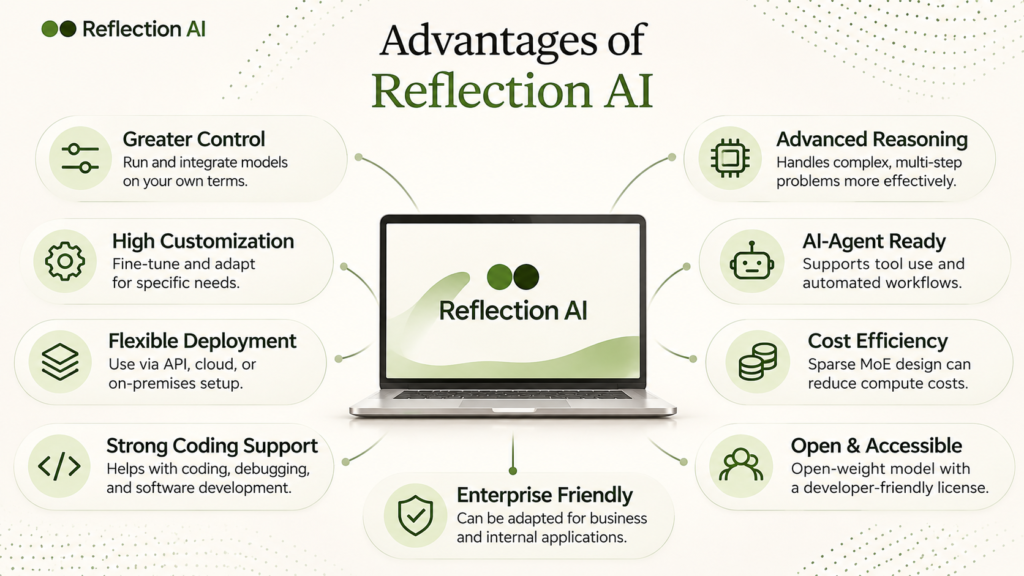
Reflection’s open-weight approach offers several potential benefits, particularly for technical users.
Greater control: Developers can choose how to integrate a supported model into their applications and deployment environments.
Customization opportunities: Access to model weights can enable fine-tuning and other forms of adaptation, subject to technical requirements and licensing terms.
Deployment flexibility: Organizations may be able to use supported models through hosted services or their own infrastructure.
Developer integration: Connections to existing model-serving and development tools can reduce the work needed to incorporate AI into a project.
Potential cost optimization: Sparse MoE architectures can reduce the amount of model computation required per token compared with activating every parameter, although actual costs depend on the complete deployment.
More opportunities for evaluation: Developers can test model behavior against their own tasks rather than relying exclusively on general demonstrations.
These advantages are not equally important to every user. A small business that needs occasional text generation may prefer a managed chatbot, while a software company building a customized AI system may benefit more from open-weight access.
Limitations and Risks to Consider
Reflection AI’s approach has clear advantages, but open-weight models are not automatically the best choice for every application.
Hardware and Infrastructure Requirements
Beam’s 501-billion-parameter architecture makes infrastructure an important consideration.
Even though approximately 23 billion parameters are active per token, the model’s total weights and associated runtime requirements can still create substantial memory and deployment demands.
Quantization can reduce the memory required to represent model weights, while optimized inference software can improve serving efficiency. However, the exact requirements depend on the chosen precision, implementation, context length, and workload.
A developer should review the model’s deployment documentation before purchasing hardware or committing to a hosting arrangement.
AI Hallucinations
An AI hallucination occurs when a model produces information that appears credible but is incorrect or unsupported.
For example, a model might generate a PHP function that looks correct but uses a nonexistent WordPress hook. It might also describe an API parameter that does not exist.
The appropriate response is to test generated code, verify factual claims, and use authoritative documentation for important technical decisions.
No model should be assumed to eliminate hallucinations entirely.
Privacy and Security
Self-hosting can give organizations greater control over their data, but it does not guarantee privacy or security by itself.
A secure deployment also requires suitable access controls, encryption, logging practices, network configuration, and data-handling procedures.
Hosted APIs have different considerations. Organizations should review the provider’s data retention, logging, training, and privacy policies before sending confidential information.
Open weights also introduce security considerations when models are connected to tools. An agent with permission to modify files, execute commands, or access business systems can cause harm if its instructions or safeguards fail.
Benchmark Results Require Context
Reflection publishes benchmark results to demonstrate Beam’s capabilities. These results are useful for understanding the company’s claims, but they should not be treated as a complete measure of real-world performance.
Benchmark outcomes depend on the task, evaluation method, tool access, reasoning settings, and other conditions.
The company has reported competitive results in coding and reasoning evaluations, including comparisons with other open-weight models. Those claims should be distinguished from independent testing.
Before adopting Beam, a business should test it on representative tasks and compare accuracy, latency, resource consumption, and operating cost.
Reflection AI vs. Other AI Models
Reflection AI belongs to a broader ecosystem of models that differ in accessibility, deployment options, and intended uses.
The following comparison focuses on the general characteristics of each approach rather than claiming that one model is universally better than another.
| AI model or approach | Main distinction | Suitable use cases |
|---|---|---|
| Reflection AI’s Beam | Open-weight model focused on coding, reasoning, and agentic workloads | Customized AI applications and software development |
| OpenAI’s GPT models | Proprietary models available through supported ChatGPT and API offerings | General assistance, writing, coding, and application development |
| Anthropic’s Claude models | Proprietary models available through supported products and APIs | Writing, analysis, coding, and complex knowledge work |
| DeepSeek open-weight models | Open-weight options with varying architectures and capabilities | Developer experimentation and self-hosted AI applications |
| Alibaba’s Qwen models | Model families with different sizes, capabilities, and deployment options | Coding, multilingual tasks, and customized applications |
The capabilities and terms of access differ across individual models and versions. A product family may include models with different licenses, hardware requirements, and performance characteristics.
Is Reflection AI Better Than ChatGPT?
There is no single answer because the products serve different purposes.
ChatGPT provides a ready-to-use assistant with capabilities determined by the selected model and enabled tools. Beam provides an open-weight model that developers can integrate into their own systems.
Reflection may be attractive when model customization, self-hosting, or control over deployment is a priority. ChatGPT may be more convenient for people who want to write, research, analyze information, or solve everyday problems without managing AI infrastructure.
For a fair comparison, users should evaluate the exact models and workflows they intend to use. Coding accuracy, response quality, latency, privacy, and total cost are more useful measures than brand reputation alone.
How to Get Started With Reflection AI
Getting started depends on whether you want to use an existing model or build an application around it.
Step 1: Explore the Official Platform
Visit the Reflection AI platform to learn about the company’s models, services, and current offerings.
Developers interested in hosted access can explore its developer platform.
Availability, account requirements, and usage terms should be checked directly on the relevant service.
Step 2: Choose Hosted Access or Self-Hosting
Hosted access is generally simpler for an initial experiment because the provider manages the underlying infrastructure.
Self-hosting offers more control but requires compatible hardware, model-serving software, and technical knowledge.
Before deciding, consider:
- How frequently you will use the model.
- Whether your data is confidential.
- Your available computing resources.
- Expected response speed and workload size.
- Whether customization is necessary.
- Your budget for hosting and maintenance.
For occasional experimentation, a supported hosted endpoint may be easier than setting up a large model locally.
Step 3: Read the Model Documentation
The Reflection AI developer documentation is a useful starting point for API integration, deployment guidance, and customization workflows.
Check the model card for details about capabilities, limitations, evaluation results, and intended use.
Also review the applicable license before using the model in a commercial application.
Step 4: Test a Small, Specific Task
Avoid starting with a complex production project.
Instead, select a task that has a clear success criterion. For example, a developer could test whether the model generates a valid Python function for a known input and output specification.
Compare its results against a baseline and repeat the test with different examples.
For an agentic application, test not only whether the model produces a good answer but also whether it uses tools correctly, handles errors, and avoids unauthorized actions.
Step 5: Measure Results Before Scaling
Once the initial test works, measure performance across a representative set of tasks.
Useful metrics include:
- Task success rate.
- Accuracy and error frequency.
- Response latency.
- Token consumption.
- Infrastructure costs.
- Human review requirements.
This process helps establish whether Reflection AI is genuinely useful for your project rather than simply impressive in a demonstration.
What Is the Future of Reflection AI?
Reflection’s longer-term direction centers on making advanced AI more accessible through open models, software, and deployment infrastructure.
The release of Beam is an important step toward that goal. It gives developers a model they can obtain and adapt instead of relying exclusively on a closed service. The company has also described plans to expand its software ecosystem and support more ways to deploy and customize its models.
Several developments will influence how useful this approach becomes.
First, model efficiency will remain important. More efficient inference can help reduce the resources needed to serve complex AI applications.
Second, agent reliability will matter as developers connect models to tools and real business systems. Better coding performance alone is insufficient if an agent cannot handle unexpected results or follow appropriate permissions.
Third, open-weight AI will need strong evaluation and security practices. Greater access creates opportunities for research and customization, but organizations must also assess how models behave under realistic conditions.
Reflection’s future success will depend on measurable performance, practical deployment costs, ecosystem adoption, and the reliability of its technology. Its ambitions are significant, but long-term results should be judged by what users can verify and accomplish.
Frequently Asked Questions About Reflection AI
1. What is Reflection AI used for?
Reflection AI develops open-weight models and supporting technology for applications such as coding, reasoning, AI agents, and customized enterprise AI systems.
2. Is Reflection AI free to use?
Beam’s model weights were released under the Apache 2.0 license. Hosted services may have different access conditions, usage limits, or charges, so check the relevant provider’s current terms.
3. What is Beam in Reflection AI?
Beam is Reflection AI’s first open-weight model. It uses a sparse Mixture-of-Experts architecture and is designed for coding, reasoning, and agentic workloads.
4. Can developers run Reflection AI locally?
Developers can download Beam’s weights and self-host the model, but its substantial resource requirements mean that compatible hardware and suitable inference software are necessary.
5. Is Reflection AI better than ChatGPT?
Neither is automatically better for every task. Reflection’s open-weight approach supports customization and self-hosting, while ChatGPT offers a managed assistant experience. The right choice depends on your requirements.
6. Can Reflection AI write code?
Yes. Coding is one of Beam’s primary intended applications. However, generated code should be tested and reviewed before it is used in production.
7. Is Reflection AI suitable for businesses?
It can be suitable for businesses that need customized AI, coding assistance, or controlled deployment environments. Organizations should evaluate security, infrastructure costs, performance, and integration requirements before adoption.
Conclusion
Reflection AI is an important company to watch in the development of open-weight artificial intelligence. Its Beam model combines a large Mixture-of-Experts architecture with a focus on coding, reasoning, and AI-agent workloads. By making model weights available under the Apache 2.0 license, Reflection gives developers more options for building and customizing AI applications.
However, access to an advanced model does not automatically translate into a reliable or affordable solution. Hardware requirements, model accuracy, privacy controls, and the quality of connected tools all influence practical results.
For developers, the most useful next step is to examine Beam’s documentation and test it against real tasks. Businesses should compare those results with alternative models and calculate the total cost of deployment. Reflection AI’s open approach offers meaningful opportunities, but its value ultimately depends on how well its technology performs in real-world applications.





























1 comment on “Reflection AI: Features, Technology, Uses and Future”