


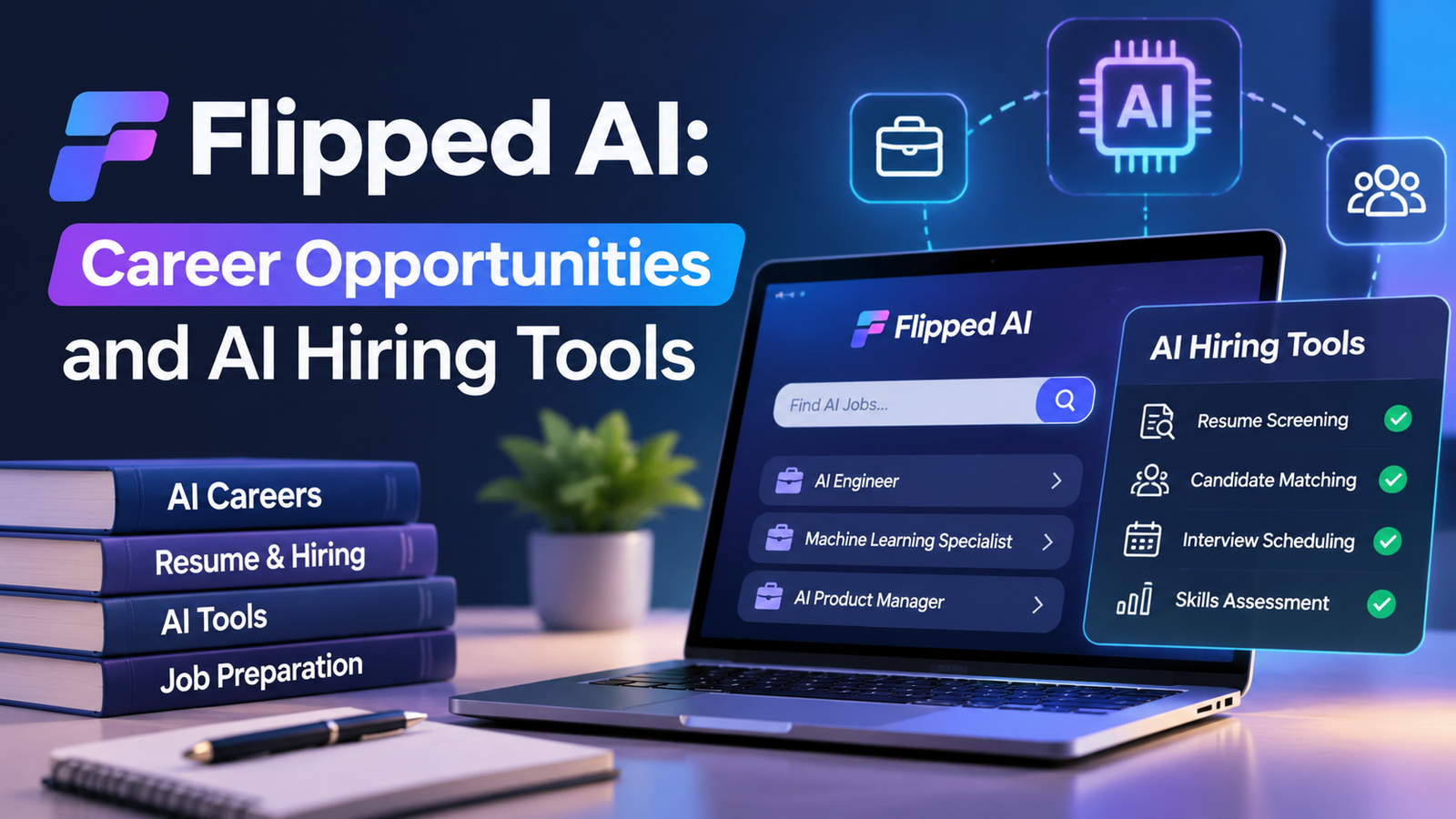
Flipped AI is an artificial intelligence-powered recruitment and career development platform that connects professional learning, skill assessments, and employment opportunities. Available through its official website, Flipped.ai aims to help job seekers demonstrate their abilities while enabling employers to identify and evaluate suitable candidates. Unlike general-purpose AI chatbots that primarily generate text or answer questions, this platform focuses on practical career development and recruitment. Its services include professional courses, AI-assisted job creation, semantic candidate matching, automated assessments, and interview tools. These features can help candidates present their skills more effectively and allow recruiters to organize parts of the hiring process in one place. However, understanding the platform’s actual capabilities, pricing arrangements, and limitations is important before signing up. This guide explores how Flipped AI works, who can benefit from it, what it offers, and what users should consider before relying on it.
What Is Flipped AI?
Flipped AI, accessible at Flipped.ai, is an AI-native recruitment and career growth platform. It combines hiring technology with professional learning to help organizations find talent and help individuals develop skills relevant to employment opportunities.
The platform addresses a common problem in recruitment: a résumé does not always provide a complete picture of someone’s abilities. Two applicants might have similar qualifications but different practical skills. Conversely, a capable applicant might be overlooked because their résumé uses different terminology from an employer’s job description.
Flipped.ai aims to address this problem through skills-based assessments, résumé analysis, and semantic candidate matching. Rather than relying exclusively on job titles or exact keyword matches, its recruitment approach considers relationships between candidate information and job requirements.
The platform also offers career development services, including courses, assessments, and job discovery features. This creates a connection between learning a skill, demonstrating it, and becoming discoverable to potential employers.
Who Owns and Operates Flipped AI?
Flipped.ai identifies Gaius Networks Inc. in New York and Gaius Hyperlocal Pvt Ltd in Chennai, India, in its company information. Its operations and services are described through the official Flipped.ai website.
The company presents itself as a provider of recruitment technology, talent intelligence, and career development services.
When researching any employment platform, it is worth checking the current company information, terms of service, and contact details rather than relying exclusively on third-party descriptions.
Who Should Use Flipped AI?
Flipped AI is designed for several types of users.
Job seekers can explore employment opportunities, develop professional skills, complete assessments, and build a profile that reflects their qualifications.
Employers and recruiters can use AI-assisted job creation, candidate matching, assessments, and recruitment analytics to organize their hiring processes.
Recent graduates may find the skills-based approach useful when they have limited employment experience but can demonstrate relevant technical or professional abilities.
Organizations hiring at scale may benefit from structured candidate screening and assessment workflows, particularly when recruiting for multiple positions.
The platform’s suitability depends on the user’s goals, the services currently available, and whether those services meet their specific needs.
How Does Flipped AI Work?
Flipped AI connects several stages of recruitment and career development. The exact process differs depending on whether someone is looking for employment or hiring candidates.
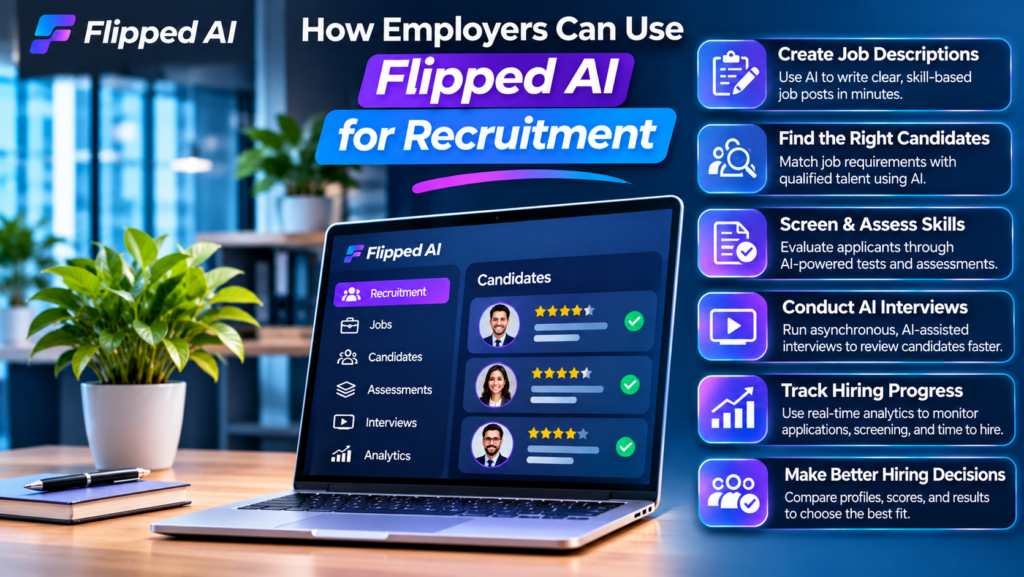
1. AI-Powered Job Creation
Employers need clear job descriptions that explain responsibilities, essential skills, and qualifications.
Flipped.ai offers AI-assisted job creation designed to help recruiters prepare structured job descriptions and identify relevant screening criteria.
For example, a company hiring a cloud engineer might specify experience with cloud infrastructure, deployment processes, security practices, and troubleshooting. An AI-assisted system can help organize these requirements into a clearer description of the position.
The recruiter should review the final description to ensure that the requirements are realistic, relevant, and free from unnecessary restrictions.
AI can make job creation faster, but it cannot independently determine every detail of what a particular organization needs.
2. Semantic Candidate Matching
Semantic matching is a technique that compares the meaning of information rather than looking only for identical words.
Suppose an employer wants a candidate with experience developing web applications. One applicant describes themselves as a frontend developer, while another emphasizes building interactive websites using JavaScript and modern frameworks.
A basic keyword search might treat these descriptions differently. Semantic matching attempts to identify their relationship to the actual job requirements.
Flipped.ai describes using résumé parsing and intelligent matching to help recruiters identify relevant candidates.
This can make candidate discovery more flexible. However, a strong match does not automatically establish that an applicant is qualified for every responsibility of the role. Recruiters still need to examine work experience, technical skills, and other relevant evidence.
3. Automated Skills Assessments
Flipped.ai offers assessment formats that include multiple-choice questions, video, and voice-based evaluations. Its website also describes AI-assisted grading and interview workflows.
These tools can help employers collect structured information about candidates before arranging individual interviews.
For instance, a company hiring a customer support specialist might evaluate applicants using questions about customer communication, problem-solving, and handling difficult situations.
A software company might use technical questions to assess programming knowledge.
The quality of the results depends on the assessment design. Tests should measure skills relevant to the actual job rather than simply producing a score that looks precise.
4. AI-Assisted Interviews
The platform describes asynchronous interview tools that allow candidates to respond to questions without necessarily participating in a live interview at the same time as a recruiter.
This format can help hiring teams collect responses from multiple applicants and review them according to a structured process.
For example, a recruiter hiring for a remote sales position could ask candidates to explain how they would handle a customer objection.
However, an automated interview cannot capture every important quality. Nervousness, accessibility needs, technical difficulties, or unfamiliarity with recorded interviews may affect performance.
Employers should therefore use interview results as one source of information rather than treating an AI-generated evaluation as a final hiring decision.
5. Learning, Assessment, and Job Discovery
Flipped.ai also connects professional training with recruitment.
Its career platform offers courses in areas such as artificial intelligence, cloud computing, DevOps, and frontend development. The company describes a process in which candidates learn relevant skills, complete assessments, and use their professional profiles to connect with suitable opportunities.
Consider a graduate who wants to work in frontend development. They might study programming fundamentals, practice building websites, complete relevant assessments, and present their projects to potential employers.
This approach can help candidates demonstrate practical knowledge rather than relying entirely on educational qualifications.
Nevertheless, completing a course does not guarantee a job. Employers may still require professional experience, technical interviews, portfolios, or additional qualifications.
Main Features of Flipped AI
Flipped AI combines several recruitment and career development functions. The most relevant features depend on whether a user is an employer or a job seeker.
| Feature | Main Purpose | Potential Benefit |
|---|---|---|
| AI-assisted job creation | Helps employers prepare structured job descriptions | Reduces repetitive recruitment writing |
| Résumé parsing | Extracts relevant information from candidate documents | Makes applicant information easier to review |
| Semantic candidate matching | Compares candidate profiles with job requirements | Helps identify potentially suitable applicants |
| Automated assessments | Supports structured evaluation of professional skills | Provides additional evidence about candidates |
| AI-assisted interviews | Organizes asynchronous candidate interviews | Helps recruiters review responses efficiently |
| Recruiter analytics | Tracks recruitment activity and hiring pipeline performance | Helps teams evaluate their processes |
| Professional courses | Supports learning in selected technical and career-related areas | Helps candidates develop relevant skills |
| Job discovery | Helps candidates explore available employment opportunities | Connects professional profiles with potential roles |
The availability of individual features may depend on the service being used. Users should check the official platform for current details.
What Makes Flipped AI Different?
Many recruitment platforms focus primarily on managing job applications, storing résumés, or organizing interviews.
Flipped.ai emphasizes the connection between recruitment and professional development. Its model brings learning, assessment, candidate matching, and job discovery into a broader career workflow.
This approach can be useful when employers want to assess demonstrated skills and candidates want to make their abilities more visible.
However, the presence of AI features does not automatically make one platform better than another. A company should compare actual functionality, integration options, privacy practices, and costs before choosing recruitment software.
How to Use Flipped AI to Find a Job
Job seekers can approach Flipped AI as a career development resource rather than treating it as a guaranteed route to employment.
Step 1: Explore Available Jobs and Courses
Visit the official website and examine the current job listings, courses, and assessment opportunities.
Choose a professional direction that matches your interests, existing abilities, and realistic employment goals.
For example, someone interested in data analysis might focus on spreadsheet skills, SQL, data interpretation, and visualization rather than enrolling in unrelated courses.
Step 2: Develop Relevant Skills
Complete appropriate training and practice what you learn.
Practical projects can be particularly useful because they show how you apply knowledge. A beginner in web development, for instance, could build a simple website and explain the technologies used.
A certificate can document course completion, but demonstrable ability often provides additional evidence of competence.
Step 3: Complete Suitable Assessments
If relevant assessments are available, review their instructions and complete them carefully.
Assessments can help you identify strengths and areas that need improvement. Their usefulness depends on whether they accurately measure the skills required for your chosen career.
Avoid assuming that a high score guarantees employment or that one weaker result defines your overall ability.
Step 4: Create an Accurate Professional Profile
Present your education, work experience, skills, and projects honestly.
Use clear descriptions that explain what you have actually accomplished. For technical positions, relevant projects and practical experience can help employers understand your capabilities.
Do not exaggerate qualifications or list skills you cannot demonstrate.
Step 5: Apply for Relevant Opportunities
Explore positions that match your experience and career goals.
Review the job description, location, work arrangement, and required qualifications before applying.
You should also continue using other appropriate job-search channels. Relying on a single platform can limit the range of opportunities available to you.
How Employers Can Use Flipped AI for Recruitment
For employers, the platform is intended to organize recruitment activities and support candidate evaluation.
A practical implementation should begin with a clearly defined hiring need.
Define the Role Properly
Before using AI-assisted recruitment, determine the essential responsibilities and skills required for the position.
Separate mandatory qualifications from preferred ones. This can help prevent the screening process from excluding capable applicants for irrelevant reasons.
Set Relevant Screening Criteria
Use criteria that relate directly to the job.
For example, a technical role might require demonstrated programming ability, while a customer service position may emphasize communication and problem-solving.
The criteria should be consistent across applicants and appropriate for the level of the position.
Review Candidate Matches
Use AI-generated matches or rankings to organize the applicant pool, not to replace professional judgment.
Recruiters should examine supporting information and verify whether a candidate’s experience meets the actual requirements.
A ranked list is useful only when the underlying criteria are meaningful.
Measure Recruitment Outcomes
Employers can compare the results of an AI-assisted process with their existing recruitment workflow.
Useful measures include:
- Time spent reviewing applications.
- Time required to produce a shortlist.
- Percentage of shortlisted candidates who meet essential requirements.
- Candidate withdrawal rates.
- Interview-to-offer conversion.
- Candidate experience and satisfaction.
These measurements help employers determine whether the platform provides practical value. Improvements should be demonstrated through the organization’s own results rather than assumed from advertised claims.
Is Flipped AI Free?
Flipped.ai advertises free assessments and provides access to job discovery and career-related services. However, users should not assume that every course, assessment, or employer service is free.
The cost depends on the particular offering and its current terms.
| Service | What to Verify |
|---|---|
| Free assessments | Which assessments are available without payment |
| Professional courses | Whether enrollment requires a fee |
| Certifications | Whether certificates have separate charges or conditions |
| Employer recruitment tools | Whether pricing depends on hiring volume or selected services |
| Managed recruitment | Which recruitment activities are included in the agreement |
The company does not provide one universal public price that can safely be applied to every employer service.
Job seekers should review course details before enrolling. Employers should request current pricing and a clear breakdown of any software, assessment, or managed recruitment charges.
The most reliable source for current information is the official Flipped.ai website.
Is Flipped AI Legitimate and Safe to Use?
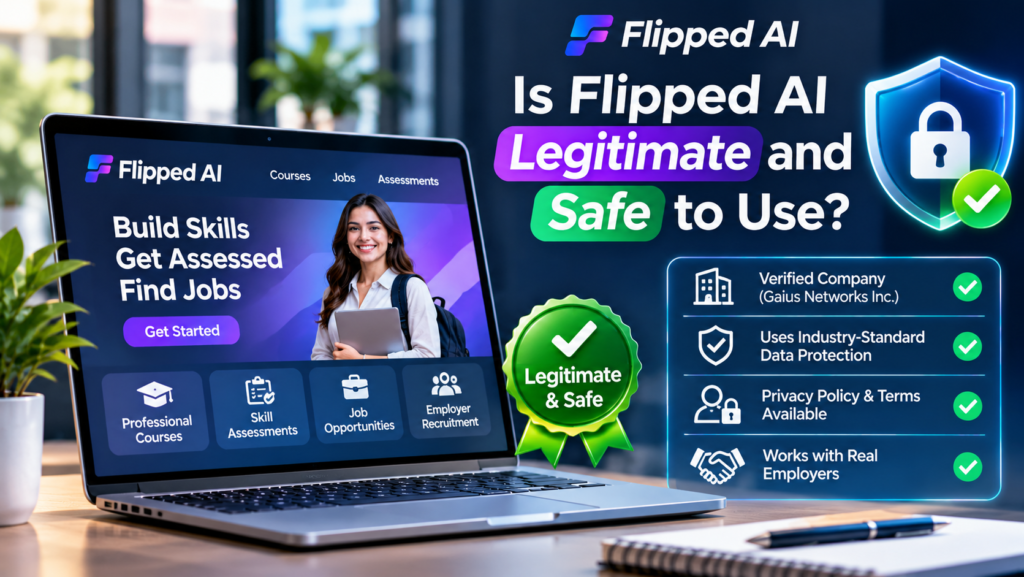
Flipped.ai has an official website, published company information, recruitment services, and career development offerings. These are useful starting points when assessing the platform, but they do not independently establish the quality of every service or guarantee particular employment outcomes.
Users should evaluate legitimacy and safety separately.
Check Job and Course Details
Before applying for a position or enrolling in a program, verify the employer, role, course requirements, and relevant terms.
Be cautious of anyone claiming that a job is guaranteed in exchange for an unexplained payment or requesting sensitive financial information without a clear and legitimate reason.
Understand How Your Information Is Used
Recruitment platforms may process personal information such as:
- Name and contact details.
- Résumé and employment history.
- Educational qualifications.
- Professional skills and job preferences.
- Assessment responses and results.
- Information generated during platform use.
Flipped.ai’s published privacy documentation describes collecting personal, professional, and assessment-related information.
Its terms have also addressed sharing professional profiles and assessment results with potential employers. Candidates should review the current policy to understand the applicable arrangements.
Before submitting information, check who can access your profile, how assessment results may be shared, what retention rules apply, and what options are available for correcting or deleting information.
Understand the Limitations of AI Recruitment
AI systems can produce inaccurate or unfair results.
A matching system may overlook a qualified candidate because their profile lacks relevant details. An assessment may measure a narrow set of skills while missing abilities that matter in the workplace.
Employers should maintain appropriate human oversight and regularly review whether their screening methods are fair, relevant, and effective.
Candidates should also remember that AI-generated feedback is not an unquestionable assessment of their professional potential.
Flipped AI vs. Other AI Recruitment Tools
Flipped AI is one option among several approaches to recruitment automation. The best alternative depends on what a company actually needs.
| Option | Primary Purpose | Best For |
|---|---|---|
| Flipped.ai | Recruitment, candidate matching, assessments, and career development | Organizations seeking connected hiring and skills-development workflows |
| Applicant tracking systems | Organizing applications, candidate records, and recruitment stages | Companies that need structured hiring administration |
| General-purpose AI assistants | Drafting job descriptions, summarizing résumés, and preparing interview questions | Recruiters who need flexible assistance with individual tasks |
| Dedicated assessment platforms | Evaluating technical or professional competencies | Employers that need specialized testing |
| Professional job platforms | Publishing vacancies and connecting with applicants | Organizations seeking candidate reach and job visibility |
These categories overlap. Some applicant tracking systems already include AI-assisted screening, while other recruitment products combine sourcing, interviews, and assessments.
Before choosing a platform, employers should compare:
- Matching accuracy: Can it identify suitable candidates for the actual roles being filled?
- Assessment quality: Do the tests measure job-related skills?
- Privacy and security: How is candidate information collected, stored, and shared?
- Integration: Does it work with the organization’s existing hiring software?
- Human oversight: Can recruiters review and challenge automated results?
- Total cost: Are the expected benefits worth the expense?
- Reporting: Can the organization measure whether recruitment quality improves?
For a small company with occasional vacancies, a conventional job platform and a simple screening process may be sufficient. An organization recruiting hundreds of candidates may have different needs.
Advantages and Disadvantages of Flipped AI
Flipped AI’s potential value becomes clearer when its benefits are considered alongside its limitations.
Advantages
Connected recruitment and learning: The platform links professional development with assessments and job discovery.
Structured screening: AI-assisted tools can help organize job requirements and candidate information.
Skills-based evaluation: Assessments provide another source of information beyond résumés.
Support for larger hiring campaigns: Structured workflows may help recruitment teams manage multiple roles and applicants.
Career development opportunities: Courses and assessments can help candidates develop and demonstrate relevant skills.
Disadvantages
Results depend on data quality: Incomplete candidate profiles or poorly defined job requirements can reduce matching quality.
Automated assessments have limits: Test results may not capture every important professional ability.
Privacy requires attention: Candidates should understand how their information and assessment results may be shared.
Pricing may require clarification: Employer costs and individual course fees should be confirmed for the specific service.
Employment is not guaranteed: Completing courses or assessments does not ensure interviews, offers, or salary increases.
These considerations do not automatically make the platform unsuitable. They show why users should evaluate it according to their own needs rather than relying on marketing claims alone.
Frequently Asked Questions About Flipped AI
1. What is Flipped AI?
Flipped AI is an AI-powered recruitment and career development platform that combines candidate matching, skills assessments, professional learning, and job discovery.
2. Can I find jobs on Flipped AI?
Yes. The platform provides a job discovery section where users can explore listings and apply for suitable opportunities. Availability depends on the current listings and eligibility requirements.
3. Does Flipped AI offer free courses?
The platform advertises professional learning opportunities, but course prices and enrollment conditions can vary. Check the individual course page before enrolling.
4. Does Flipped AI guarantee employment?
No general employment guarantee should be assumed. Courses and assessments may help candidates demonstrate their abilities, but hiring decisions depend on employers and individual circumstances.
5. How does Flipped AI match candidates?
The platform describes semantic candidate matching, which compares candidate profiles and résumé information with job requirements to identify potentially suitable applicants.
6. Is Flipped AI suitable for beginners?
It may be useful for beginners exploring career development, professional courses, and entry-level opportunities. The most appropriate starting point depends on the skills and jobs available.
7. How can employers start using Flipped AI?
Employers can explore the platform’s recruitment services, review the available features, and contact the company for a demonstration or current pricing information.
Conclusion
Flipped AI combines recruitment technology with professional learning, giving employers tools for candidate matching and assessment while helping job seekers develop and demonstrate their skills. Its approach is particularly relevant to organizations looking for a more structured hiring process and individuals seeking to connect their learning with employment opportunities.
However, the platform should be evaluated on its practical results, not simply on the number of AI features it offers. Employers need to consider matching quality, assessment validity, integration, privacy, and overall costs. Job seekers should review course conditions, understand how their information may be shared, and continue exploring opportunities beyond a single platform.
Before committing to Flipped AI, examine its current offerings and choose the services that fit your goals. A careful evaluation will help you determine whether its recruitment and career development tools provide meaningful value.












1 comment on “Flipped AI: Career Opportunities and AI Hiring Tools”