


GPTHuman AI is an online writing tool designed to rewrite AI-generated content into more natural-sounding text. It targets people who use tools such as ChatGPT and Claude but want their drafts to have smoother sentences, more varied wording and a more conversational tone. The platform also advertises features designed to reduce the likelihood of AI detection, making it relevant to bloggers, students, marketers and content creators. However, there is an important difference between improving the quality of AI-assisted writing and proving that something was written by a human. GPTHuman AI can help with rewriting, but its results still require careful review. In this guide, we explore how the platform works, its main features, pricing, practical applications, privacy considerations and limitations.
What Is GPTHuman AI?
GPTHuman AI is a web-based artificial intelligence writing platform that focuses on rewriting, generating and reviewing text. Its main purpose is to make AI-assisted writing sound more natural while giving users additional tools to improve their drafts.
The platform is designed for people who regularly work with AI-generated content. Instead of using separate websites for rewriting, paraphrasing and checking text, users can access several writing tools through one service.
The main components include:
- AI Humanizer: Rewrites existing text to improve sentence structure, tone and readability.
- AI Detector: Analyzes text for patterns associated with AI-generated writing.
- AI Paraphraser: Rephrases sentences while attempting to preserve their original meaning.
- Human Content Generator: Helps users create new written content.
- AI Humanizer API: Provides a way for developers to integrate text humanization into their own applications.
These features are advertised as part of the GPTHuman platform. Their availability and usage limits depend on the selected subscription.

How Does GPTHuman AI Work?
GPTHuman AI works by processing submitted text and producing a revised version with different wording and sentence structures.
The technology belongs to the broader category of generative AI and natural language processing (NLP). These technologies help computer systems understand, analyze and generate human language.
When someone submits a passage, the system processes the text and generates an alternative version based on the selected writing settings.
For example, consider this AI-generated sentence:
Original: Artificial intelligence provides businesses with opportunities to improve productivity and automate repetitive tasks.
Rewritten: Businesses can use artificial intelligence to save time, work more efficiently and handle repetitive tasks automatically.
The main idea remains similar, but the sentence structure and wording change.
Understanding the Humanization Process
The general workflow involves several stages:
- Text input: The user pastes an existing AI-generated passage into the humanizer.
- Text processing: The system analyzes the submitted language and its structure.
- Content rewriting: The system produces an alternative version with adjusted wording and sentence patterns.
- Quality review: The user examines the rewritten content for clarity and accuracy.
- Final editing: The user makes additional changes before publishing or submitting the material.
One important point is that rewriting does not automatically improve factual accuracy. If the original text contains an incorrect statistic, the rewritten version may preserve that mistake.
Main Features of GPTHuman AI
GPTHuman AI offers several tools that address different writing requirements. Understanding their individual purposes helps users decide which features are actually useful.
1. AI Humanizer
The AI Humanizer is the platform’s central feature. It focuses on improving the natural flow of AI-generated writing.
It can be useful when a draft contains repetitive expressions, predictable sentence structures or unnecessarily formal language.
For example, a blogger might generate an article outline using ChatGPT and then use a humanizer to improve selected paragraphs.
However, the final result should always be reviewed. A rewriting system can replace appropriate technical terms, remove important qualifications or introduce awkward expressions.
2. AI Detector
The built-in AI Detector analyzes submitted writing and provides an indication of patterns associated with AI-generated text.
This feature can help writers identify passages that may require additional editing.
However, an AI detection score should never be treated as definitive proof of authorship.
Different detection systems use different models and evaluation methods. Consequently, the same paragraph can receive different results across multiple platforms.
3. AI Paraphraser
The paraphrasing feature provides alternative ways to express existing information.
It can help users:
- Improve repetitive sentences.
- Find alternative expressions.
- Simplify complicated paragraphs.
- Adjust sentence structure.
- Improve the overall flow of a draft.
A paraphraser is particularly useful when the original wording is unnecessarily complicated. Nevertheless, paraphrasing does not remove the need for proper citations when using someone else’s ideas or research.
4. Human Content Generator
GPTHuman also advertises a content generation feature.
Instead of starting with an existing paragraph, users can provide instructions and generate a new draft.
For instance, a small business owner could request an introductory paragraph for a plumbing service page. The generated draft could then be edited to include actual services, locations and business information.
Generated material should not be treated as verified business information without checking the details.
5. Multiple Language Support
GPTHuman advertises support for more than 50 languages.
This can make the platform relevant to international writers, publishers and content teams working with different audiences.
However, multilingual support does not necessarily mean identical writing quality across every language. Idioms, grammar, sentence structure and technical terminology require additional attention.
For important publications, native-language review can help identify unnatural expressions and translation problems.
Who Can Benefit From GPTHuman AI?
GPTHuman AI may be useful for several types of users, particularly those who regularly work with written content.
Bloggers and Website Owners
Bloggers often use AI tools to develop outlines, organize information and prepare initial drafts.
A humanizer can help improve awkward sentences and make the writing easier to follow.
For example, someone managing a technology magazine could use it to revise a draft about cloud computing. However, technical explanations, product specifications and statistics should be checked independently.
SEO Specialists and Content Marketers
SEO professionals regularly prepare website articles, landing pages, product descriptions and marketing content.
GPTHuman AI may help them revise repetitive passages and improve readability.
However, changing the wording of an article does not automatically improve its Google rankings.
High-quality SEO content still requires:
- Accurate and useful information.
- Relevant search intent coverage.
- Original explanations and examples.
- Appropriate keyword placement.
- Clear headings and organization.
- Reliable sources where factual claims require evidence.
Human editing and subject knowledge remain essential.
Students and Researchers
Students may find rewriting and paraphrasing tools useful when improving their own notes or simplifying difficult explanations.
Researchers may also use language tools to improve sentence clarity.
However, students must follow their institution’s academic integrity requirements. Using a humanizer to disguise unauthorized AI-generated assignments does not make the work acceptable or genuinely original.
Freelancers and Business Owners
Freelancers often prepare proposals, emails, website content and client documents.
A writing assistant can help improve the tone of these materials.
For example, a freelancer could revise an overly formal client email to make it more direct and conversational without changing the intended message.
How to Use GPTHuman AI
Getting started with an AI humanizer is generally straightforward. Users can follow this practical workflow when working with GPTHuman.
Step 1: Open the Platform
Visit the official GPTHuman website and navigate to its writing tools.
Check the available free access and subscription requirements before using the platform.
Step 2: Prepare Your Original Text
Copy the paragraph or article section you want to improve.
It is better to work with complete paragraphs rather than isolated sentences because additional context can help preserve meaning.
Step 3: Submit the Content
Paste the text into the appropriate humanizer interface.
Review the available settings and select the writing approach that best matches your intended audience.
Step 4: Generate the Revised Version
Start the rewriting process and wait for the platform to generate its output.
Read the result carefully instead of immediately copying it into your website or document.
Step 5: Review and Correct the Content
Compare the original and rewritten versions.
Pay particular attention to:
- Names and company details.
- Dates and statistics.
- Technical explanations.
- Important keywords.
- Quotations and citations.
- Sentence meaning and context.
Step 6: Complete the Final Edit
Make any necessary corrections and ensure the content sounds appropriate for its intended audience.
For website articles, also check headings, internal links, formatting and search intent before publishing.
GPTHuman AI Pricing and Plans
Pricing is an important consideration when choosing an AI writing platform.
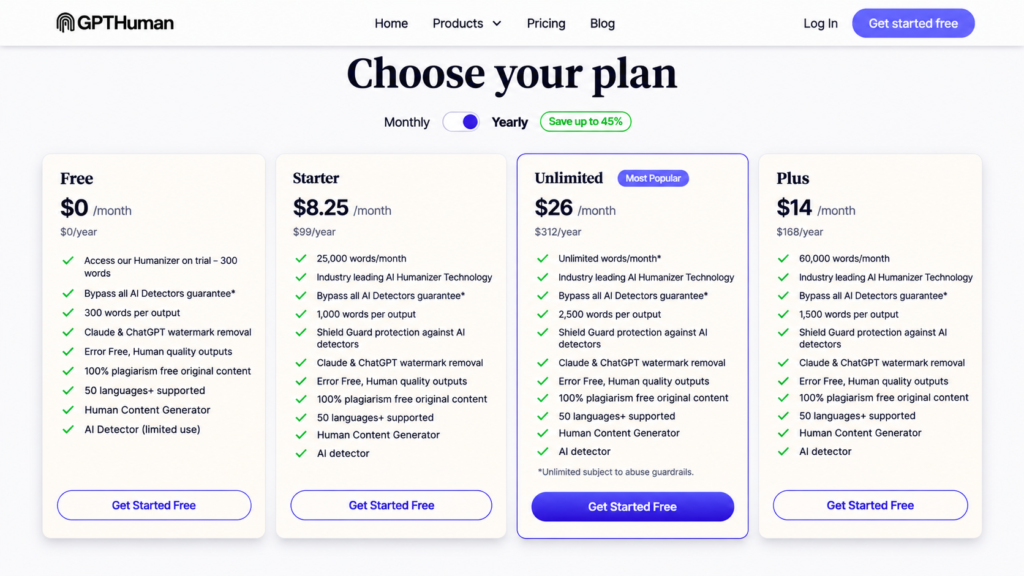
The published GPTHuman pricing information lists a free trial and three paid subscription options. Prices differ depending on whether users choose monthly or yearly billing.
Published pricing reviewed for November 2026. Prices are in USD.
| Plan | Monthly billing | Annual billing equivalent | Monthly word allowance |
|---|---|---|---|
| Free | $0 | $0 | 300-word trial |
| Starter | $15/month | $8.25/month | 25,000 |
| Plus | $25/month | $14/month | 60,000 |
| Unlimited | $49/month | $26/month | Unlimited* |
*The Unlimited plan is subject to abuse guardrails. Annual prices are billed as $99, $168 and $312 respectively. Per-output limits also apply.
What Does Each Plan Include?
Free Plan
The free option provides a 300-word humanizer trial and limited AI Detector access. It is suitable for exploring the basic functionality before purchasing a subscription.
Starter Plan
The Starter plan provides 25,000 words per month, with a maximum of 1,000 words per output. It may suit individuals with regular but moderate writing requirements.
Plus Plan
The Plus subscription includes 60,000 words per month and supports outputs of up to 1,500 words. It is intended for users with higher monthly writing needs.
Unlimited Plan
The Unlimited plan advertises unlimited monthly usage, subject to its abuse guardrails. Individual outputs are still limited to 2,500 words.
The distinction between monthly allowances and individual output limits is important. A subscription with a large monthly allowance does not necessarily allow users to process an entire long article in one request.
Advantages and Disadvantages of GPTHuman AI
Like other AI writing applications, GPTHuman has strengths and limitations. Its usefulness depends on how someone plans to use it.
Advantages
- Multiple writing tools: Humanization, paraphrasing and AI detection are available within one platform.
- Free trial: Users can explore the humanizer before committing to a paid subscription.
- Multilingual support: The platform advertises support for more than 50 languages.
- Different usage levels: Several subscription options accommodate different monthly writing volumes.
- API availability: Developers can explore programmatic integration through the advertised AI Humanizer API.
- Writing assistance: Rewriting can help improve repetitive or awkward passages.
Disadvantages
- No guaranteed detector results: External AI detectors may produce different assessments.
- Meaning can change: Rewriting may alter important details or remove useful context.
- Output restrictions: Every subscription has an individual output limit.
- Subscription costs: Regular use requires a paid plan once the trial allowance is exhausted.
- Human review remains necessary: Generated text can contain grammatical, contextual or factual problems.
- Privacy considerations: Users should understand how submitted content is handled before uploading sensitive information.
Overall, the platform offers a useful collection of writing features, but it should be viewed as an editing assistant rather than a replacement for professional writing and research.
Can GPTHuman AI Really Bypass AI Detectors?
This is one of the most important questions surrounding AI humanization tools.
GPTHuman advertises the ability to bypass AI detectors. However, its terms and conditions explain that third-party detection systems may still classify generated content as AI-written.
The company acknowledges that it cannot guarantee every output will be regarded as human-written by external detection tools.
There are several reasons why this matters.
Different Detectors Produce Different Results
AI detection systems do not all use the same algorithms, datasets or classification thresholds.
One system might classify a paragraph as predominantly human-written, while another may identify similar text as AI-generated.
A score from one detector therefore cannot establish how every other detector will evaluate the same material.
Human-Written Content Can Receive False Positives
AI detectors can sometimes incorrectly flag genuine human writing.
A 2023 study published in Patterns by researchers affiliated with Stanford University examined this problem. The researchers found that several AI detectors frequently misclassified writing by non-native English speakers as AI-generated.
This demonstrates why detection scores should not be treated as reliable evidence of authorship.
Better Writing Is More Important Than Detector Scores
Instead of focusing entirely on detector results, writers should prioritize:
- Clear explanations.
- Accurate information.
- Original examples.
- Natural sentence structure.
- Consistent tone.
- Proper citations.
- Genuine subject knowledge.
A well-written article should provide value to its readers regardless of what an automated detection score says.
GPTHuman AI for SEO and Website Content
Website owners often explore humanizers because they want their AI-assisted articles to sound more natural.
GPTHuman can potentially help with selected editing tasks, but it is important to understand its role in an SEO workflow.
Google’s approach to content quality is not simply based on whether a writer used artificial intelligence. The usefulness, reliability and originality of the finished material are much more important considerations.
Does Humanizing Content Improve Google Rankings?
There is no reliable basis for claiming that running an article through GPTHuman automatically improves its Google rankings.
Changing sentence structure does not create new research, original experience or useful information.
For example, imagine a website publishing an article about WordPress website security.
Simply rewriting generic information about security plugins will not necessarily make the article more valuable.
A stronger article would explain:
- How website vulnerabilities occur.
- Which security settings matter.
- How website owners can protect administrator accounts.
- How backups help with recovery.
- What to do after discovering suspicious activity.
These details provide practical value that basic paraphrasing cannot replace.
A Better Workflow for SEO Writers
Website owners can use the following approach:
- Research the topic using trustworthy sources.
- Identify the reader’s main search intent.
- Create an organized article outline.
- Prepare the first draft.
- Use GPTHuman selectively to improve awkward passages.
- Check facts and technical details.
- Add original explanations and practical examples.
- Optimize headings, keywords and internal links.
- Review the finished article before publishing.
For WordPress websites using Yoast SEO, the final review should also include the SEO title, meta description, keyphrase placement, readability and relevant internal linking.
The important distinction is that an AI humanizer supports editing. It does not replace SEO research, editorial judgment or subject expertise.
GPTHuman AI Privacy and Data Security
Privacy deserves attention when using any online AI writing service.
Users sometimes paste unpublished articles, business documents, client information or academic material into these platforms. Before doing so, they should understand how the provider handles submitted information.
GPTHuman’s published Privacy Policy explains that the information it collects can include account details, payment information, prompts, uploaded files and technical usage data.
It also states that submitted content may be used to improve its services and train its models. Users can opt out of this model-training use through their account settings.
This means users should take a few precautions:
- Avoid submitting passwords or confidential business information.
- Remove personal details from documents when they are unnecessary.
- Review the privacy policy before uploading client materials.
- Check the model-training preference in account settings.
- Follow workplace or client rules regarding third-party AI services.
For sensitive professional, financial, legal or medical documents, a general-purpose writing platform should not be assumed to provide the required regulatory protections.
GPTHuman AI Alternatives
GPTHuman is not the only option for improving AI-assisted writing. Different tools address different writing problems, so the right choice depends on the user’s requirements.
| Tool | Main purpose | Suitable for |
|---|---|---|
| QuillBot | Paraphrasing and rewriting | Sentence improvement |
| Grammarly | Grammar, clarity and writing suggestions | Proofreading |
| ChatGPT | Drafting, research assistance and editing | General writing tasks |
| Claude | Writing, analysis and document assistance | Longer-form writing |
Which Alternative Should You Choose?
Choose GPTHuman if you want several rewriting and text-analysis features in one platform.
QuillBot may be more appropriate if your main requirement is paraphrasing existing sentences.
Grammarly is worth considering when grammar, spelling and clarity are your main concerns.
ChatGPT and Claude can help with outlining, drafting, explaining complicated subjects and revising documents.
None of these tools should be considered a substitute for fact-checking, original research or responsible editorial decisions.
Common Mistakes to Avoid When Using GPTHuman AI
An AI humanizer can save editing time, but poor usage can create additional problems.
Here are some common mistakes worth avoiding.
1. Rewriting an Entire Article Without Reviewing It
Large-scale rewriting can change the meaning of important paragraphs. Review the original and revised versions rather than assuming every change is correct.
2. Trusting Every AI Detector Score
A detector score is an estimate, not proof of who created a piece of writing. Avoid making important academic or professional decisions based on one automated result.
3. Ignoring Original Sources
Rewriting a statistic or research finding does not remove the need to verify and cite its original source.
4. Publishing Generic Content
Changing words does not make an article original in terms of research or insight. Add relevant examples, explanations and information that genuinely help readers.
5. Ignoring Privacy Settings
Review the provider’s data policies and model-training options before submitting unpublished or confidential material.
6. Using Humanization to Hide Unauthorized AI Use
If a university, employer or publisher requires disclosure of AI assistance, rewriting the content does not remove that obligation.
Frequently Asked Questions About GPTHuman AI
1. What is GPTHuman AI used for?
GPTHuman AI is used to rewrite, paraphrase, generate and analyze text. Its main purpose is to improve the natural flow and readability of AI-assisted writing.
2. Is GPTHuman AI free?
Yes. Its free option offers a 300-word humanizer trial with limited AI Detector access. Paid subscriptions provide higher usage allowances.
3. Does GPTHuman AI guarantee 100% human-written content?
No. Its marketing advertises detector bypass, but its terms acknowledge that external AI detectors may still classify its output as AI-generated.
4. Can GPTHuman AI help with SEO articles?
Yes. It can help revise sentences and improve readability. However, keyword research, factual accuracy, search intent and original information still require human attention.
5. Does GPTHuman AI support multiple languages?
Yes. Its platform advertises support for more than 50 languages.
6. Is GPTHuman AI safe for confidential documents?
Users should exercise caution. Its privacy policy explains that submitted content may be used for service improvement and model training unless users opt out through their account settings.
7. Is GPTHuman AI better than QuillBot?
It depends on the task. GPTHuman combines humanization, paraphrasing and detection features, while QuillBot is commonly used for paraphrasing and rewriting. Neither is automatically better for every writing requirement.
Conclusion
GPTHuman AI provides a collection of writing tools for people who want to improve AI-assisted content. Its humanizer, paraphraser, detector and content generator make it a potentially useful option for bloggers, marketers, freelancers and other regular writers. Its free trial also gives beginners an opportunity to explore the platform before choosing a subscription.
However, its advertised ability to bypass AI detectors should be viewed cautiously. No tool can guarantee universal detection results, and rewritten content can still contain factual errors or changes in meaning. Privacy settings and subscription limits also deserve attention.
For website owners and content professionals, the best approach is to use GPTHuman as an additional editing tool. Original research, accurate information, useful examples and thoughtful human review should remain the foundation of every published article.





1 comment on “GPTHuman AI: Features, Pricing, Benefits and Complete Review”