


OpenAI models are artificial intelligence systems designed for different types of digital work. They can understand text, analyze images, write code, solve problems, search information, use tools, and support business workflows. The OpenAI model catalog now includes general-purpose models alongside specialized systems for images, audio, transcription, embeddings, and other tasks. As of September 2026, OpenAI lists GPT-6 Astra as its most capable model, while the GPT-5.6 family includes models focused on professional work, balanced performance, and cost-sensitive workloads. For users, this means choosing a model depends heavily on the task, speed requirements, budget, and level of reasoning needed.
The range of OpenAI models can seem confusing because model names change over time. Some models are built for complex reasoning, while others are designed for speed, lower costs, coding, image creation, voice conversations, or data processing. OpenAI also retires older models as newer systems become available. For example, GPT-5.1 models were retired from ChatGPT in March 2026, with users moved toward newer model options. Therefore, it is useful to understand model families rather than memorizing individual names. This guide explains the current landscape in simple terms and shows where different models can fit into everyday and professional workflows.
Latest OpenAI Models in 2026
The current OpenAI catalog contains several major model families. GPT-6 Astra is listed as the flagship model for difficult end-to-end work, including reasoning, coding, computer use, browsing, science, and professional tasks. The GPT-5.6 family is divided into Sol, Terra, and Luna, giving developers different balances between intelligence and cost. OpenAI also lists GPT-5.5 and GPT-5.5 Pro for coding and professional work, along with GPT-5.4, GPT-5.4 Mini, and GPT-5.4 nano. This variety allows developers to select a model based on the complexity of their application rather than using one model for every situation.
OpenAI Models Comparison Chart
| Model | Main Focus | Best Fit |
|---|---|---|
| GPT-6 Astra | Advanced reasoning and agents | Complex professional work |
| GPT-5.6 Sol | High-end professional work | Complex tasks |
| GPT-5.6 Terra | Intelligence and cost balance | General applications |
| GPT-5.6 Luna | Cost-efficient workloads | High-volume applications |
| GPT-5.5 | Coding and professional work | Developers |
| GPT-5.4 | Reasoning and computer use | Agents and workflows |
| GPT-5.4 Mini | Smaller high-performance model | Coding and subagents |
| GPT-5.4 nano | Speed and low cost | Classification and extraction |
These models should not be treated as identical products with different names. Their intended workloads, pricing, context limits, and supported capabilities can vary. For example, OpenAI lists GPT-5.6 Sol with a 1.05 million-token context window, while GPT-5.6 Luna is positioned toward cost-sensitive workloads and has the same listed context size. GPT-5.4 nano, meanwhile, is designed for simple, high-volume tasks such as classification, extraction, ranking, and sub-agents. Before selecting a model, developers should therefore check current documentation instead of relying on older comparisons found online.
GPT-6 Astra and Advanced Reasoning
GPT-6 Astra currently sits at the top of OpenAI’s published model catalog. OpenAI describes it as its most capable model for difficult end-to-end work, with applications covering computer use, browsing, software engineering, science, and professional workflows. The model is listed with low, medium, high, xhigh, and max reasoning levels, giving developers control over how much computational effort is used. It also supports tools such as functions, web search, file search, and computer use. These capabilities make advanced models increasingly useful for tasks that require several connected steps rather than a simple question-and-answer response.
For example, a business application could use a high-end reasoning model to examine documents, identify important information, compare data, and prepare a structured result. A software team could use it to understand a large codebase and work through complicated development tasks. However, the most capable model is not automatically the right choice for every request. Simple classification, short summaries, or repetitive extraction may not require maximum reasoning. In those situations, a smaller model can reduce cost and latency. This is one of the most important ideas behind the modern OpenAI models ecosystem: match model capability to the actual difficulty of the work.
GPT-5.6: Sol, Terra, and Luna
The GPT-5.6 family gives developers three different performance and cost profiles. OpenAI lists GPT-5.6 Sol as a flagship model for complex professional work, GPT-5.6 Terra as a model balancing intelligence and cost, and GPT-5.6 Luna as an option optimized for cost-sensitive workloads. All three are listed with reasoning controls and large context windows, while their token prices differ substantially. This structure can be useful for companies that need several AI workloads at once. Instead of paying for the highest-cost model everywhere, teams can assign more demanding tasks to stronger models and routine workloads to less expensive options.
The practical difference becomes clearer when looking at application design. A research assistant may need stronger reasoning for complicated analysis, while a customer-support system may handle thousands of shorter requests. A content workflow could also use different models for drafting, classification, extraction, and quality checks. GPT-5.6 Luna is specifically positioned for cost-sensitive, high-volume workloads, while GPT-5.6 Sol targets more demanding professional tasks. Developers should test their own prompts because real performance depends on the task, instructions, context, tools, and required output. Model selection should be based on measured results rather than name recognition alone.
GPT-5.4 and Computer-Using AI
GPT-5.4 is another important part of the current OpenAI models landscape. OpenAI introduced it in March 2026 for ChatGPT, the API, and Codex, describing it as a model designed for professional work. It combines reasoning, coding, tool use, and computer-use capabilities. The API documentation lists support for web search, file search, image generation, code interpreter, hosted shell, computer use, MCP, and other tools. This makes GPT-5.4 particularly relevant for applications that need an AI system to perform multiple connected actions instead of simply generating text.
OpenAI also offers GPT-5.4 Pro and GPT-5.4 nano for different requirements. GPT-5.4 Pro uses more computational resources and is intended for difficult problems where stronger responses are worth additional cost and processing time. GPT-5.4 nano takes the opposite approach, focusing on speed and affordability for tasks such as classification, extraction, ranking, and sub-agents. This range shows how modern AI systems are becoming more specialized. Businesses can choose between deeper reasoning, balanced performance, and inexpensive high-volume processing.
Specialized OpenAI Models for Images and Audio
Not every AI task requires a general-purpose language model. OpenAI’s catalog also includes specialized models for image generation, realtime conversations, speech, transcription, translation, and embeddings. The current catalog lists GPT-Image-2.5 Sunburst and GPT-Image-2.5 Flare for image generation and editing, while GPT-Live 1 is positioned for natural voice conversations. Other models support realtime reasoning, translation, transcription, and speech-to-text workflows. These specialized systems can be useful when an application needs a particular input or output format rather than general text generation.
For instance, a marketing platform could combine a text model with an image model to create campaign material. A voice application could use realtime or transcription models to process spoken conversations. A search system could use embedding models to turn text into vector representations for retrieval. OpenAI also lists specialized models for life sciences and cybersecurity workloads, alongside open-weight models such as gpt-oss-120b and gpt-oss-20b. If you are building an AI application, understanding these categories can help you avoid forcing one general model to perform every possible task.
OpenAI Models for Coding and Business
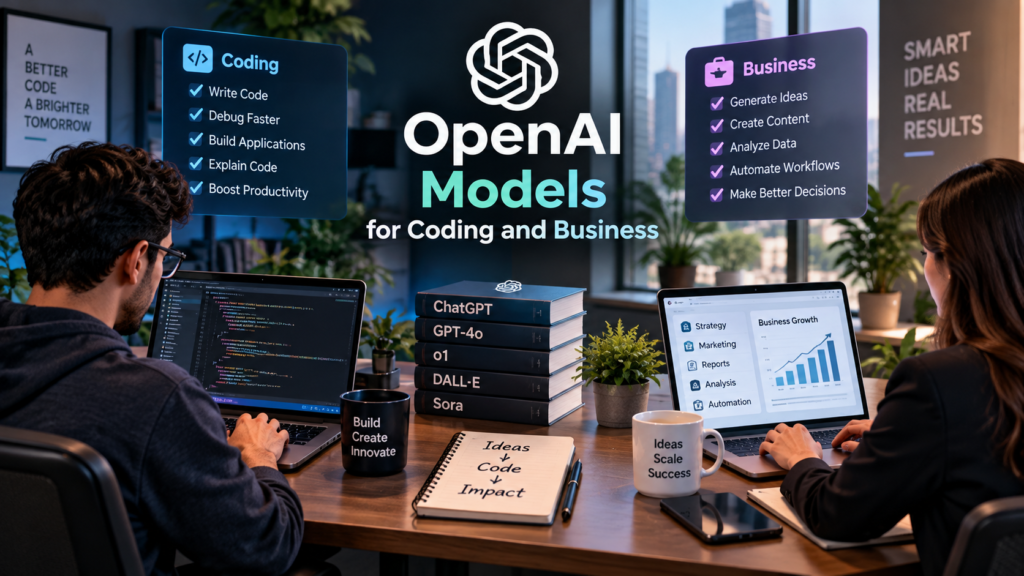
Coding is one of the major areas where OpenAI models are used. Current offerings include models designed for professional programming, agentic coding, computer interaction, and software workflows. OpenAI’s GPT-5.4 announcement highlights improvements across coding, tool use, spreadsheets, presentations, documents, and longer-running computer workflows. Earlier GPT-5 documentation also described capabilities for fixing bugs, editing code, answering questions about complex codebases, and supporting frontend development. These capabilities can help developers move from simple code generation toward broader AI-assisted development.
Businesses can also use OpenAI models for document analysis, customer support, data extraction, research assistance, content operations, and workflow automation. However, successful deployment requires more than choosing a powerful model. Teams should define the task, provide useful context, test accuracy, protect sensitive information, and create checks for important outputs. For more practical AI ideas, readers can explore our internal guide on AI tools for business and our ChatGPT productivity tips. These resources can help connect model capabilities with everyday workflows. The goal should be reliable automation where appropriate, while keeping human review for decisions that require judgment or carry meaningful consequences.
How to Choose the Right OpenAI Model
Choosing among OpenAI models starts with identifying what the application actually needs. Ask whether the task requires deep reasoning, coding, vision, tool use, voice, image generation, or simple text processing. Next, consider response speed, expected request volume, context size, output requirements, and budget. OpenAI’s current guidance recommends GPT-6 Astra for the hardest reasoning and coding workloads, GPT-5.6 Terra when balancing intelligence and cost, and GPT-5.6 Luna for cost-sensitive, high-volume workloads. These recommendations provide a starting point, but developers should still evaluate models using their own real-world tasks.
Simple Model Selection Chart
| Your Need | Model Type to Consider |
|---|---|
| Hard reasoning and complex workflows | Flagship reasoning model |
| Professional coding | Advanced GPT-5.x or newer flagship |
| Balanced cost and performance | GPT-5.6 Terra |
| High-volume processing | GPT-5.6 Luna or smaller model |
| Classification and extraction | GPT-5.4 nano |
| Image creation or editing | GPT-Image family |
| Voice conversations | GPT-Live or realtime models |
| Speech transcription | Transcription models |
| Vector search | Embedding models |
The best model can change as OpenAI releases new versions, retires older systems, or updates model capabilities. Developers should therefore check the official model catalog and documentation before launching a production application. It is also useful to run a small evaluation using real examples from the intended workflow. Measure accuracy, latency, cost, tool reliability, and output quality. A smaller model that consistently handles a simple task may be more practical than a larger model that costs significantly more. In other words, model selection should be an engineering decision based on requirements and testing, not simply the newest model name.
Frequently Asked Questions
What are OpenAI models used for?
OpenAI models can support writing, reasoning, coding, image analysis, image generation, voice conversations, transcription, search, data extraction, and automated workflows. Different models are designed for different workloads, so the appropriate choice depends on the task, required quality, speed, tools, and budget.
Which OpenAI model is the most capable?
As of September 2026, OpenAI’s API catalog lists GPT-6 Astra as its most capable model. OpenAI describes it as designed for difficult end-to-end work involving reasoning, coding, computer use, browsing, science, and professional workflows.
Which OpenAI model is best for low-cost workloads?
OpenAI currently positions GPT-5.6 Luna for cost-sensitive workloads. GPT-5.4 nano is another low-cost option designed for simple, high-volume tasks such as classification, extraction, ranking, and sub-agents.
Are OpenAI models only for text?
No. The OpenAI catalog includes models for images, realtime voice, speech transcription, translation, embeddings, and other specialized workloads. General-purpose models can also accept image inputs, depending on the model and API configuration.
Do OpenAI models change over time?
Yes. OpenAI regularly introduces new models, updates existing systems, and retires older models. For example, GPT-5.1 models were retired from ChatGPT in March 2026. Developers should check current documentation before selecting models for new applications.
Conclusion: Understanding the OpenAI Models Landscape
OpenAI models now cover a broad range of AI needs, from advanced reasoning and coding to image creation, voice, transcription, embeddings, and high-volume automation. The current catalog includes GPT-6 Astra, the GPT-5.6 family, GPT-5.5, GPT-5.4 variants, specialized models, and open-weight options. This variety gives developers more control over performance, speed, capabilities, and cost. However, choosing a model should begin with the task rather than the model name. Start with clear requirements, test representative examples, compare results, and monitor production performance. As the AI ecosystem continues to change, checking official model documentation remains an important part of building reliable AI workflows.



























1 comment on “OpenAI Models: Complete Guide to the Latest AI Models”