


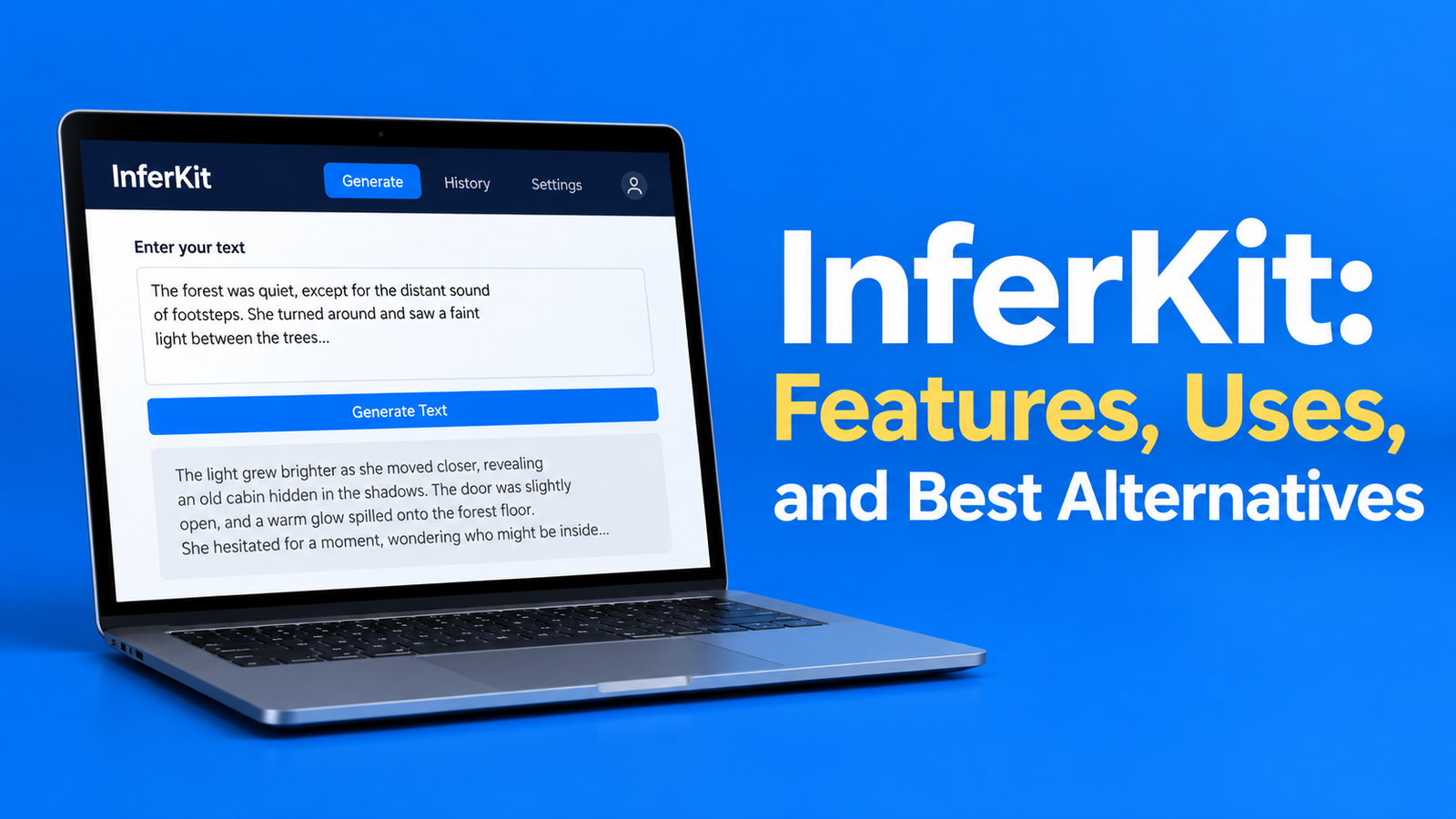
InferKit was an AI-powered writing tool that helped users generate text by continuing a passage they had already written. The InferKit AI text generator was designed for creative writers, content creators, and developers who wanted to experiment with automated writing or integrate text generation into their applications. Unlike modern conversational AI assistants, it focused primarily on predicting what words and sentences should come next.
However, there is an important update for anyone researching InferKit in 2026: the original service has been discontinued. Its official website displays a closure notice explaining that the writing application was discontinued as AI technology advanced. The notice also addressed paid subscriptions and refunds.
Although InferKit is no longer available as an active service, understanding its technology remains useful. This guide explains how the InferKit text generator worked, what made it useful, its limitations, and which alternatives are worth considering today.
What Is InferKit?
InferKit was an online AI text generation platform that turned a short passage into a longer piece of text. Users supplied an opening sentence, paragraph, or other writing sample, and the system generated a continuation based on the text it received.
For example, someone writing a science-fiction story could enter a paragraph about a spacecraft approaching an unfamiliar planet. The generator might continue the scene with a description of the planet, a conversation between crew members, or an unexpected development.
The generated content depended on the supplied text and the model’s learned language patterns. It was not necessarily a carefully planned continuation of the author’s intended storyline.
The platform served two main audiences:
- Writers and content creators: People looking for story ideas, draft material, writing inspiration, or help overcoming writer’s block.
- Developers: People interested in incorporating automated text generation into their applications, games, websites, and other software through an API.
InferKit grew out of the earlier Talk to Transformer project, which introduced users to AI-generated text through a simple browser-based experience. Its approach reflected an important stage in the development of accessible language-generation technology.
Is InferKit Still Available in 2026?
No. The original InferKit writing service has been discontinued, and its website displays a closure announcement instead of an active text-generation application.
This means prospective users should not expect to register for a new account, purchase a subscription, or access the original service as they once could.
The closure also matters to developers. Software that relied on InferKit’s original API needs a replacement provider if it is expected to continue generating text.
Be cautious when reading older reviews that describe InferKit as an active writing platform. Historical feature descriptions may explain what the product offered, but they do not establish that those features remain accessible today.
How Did the InferKit Text Generator Work?
InferKit used neural language-generation technology to predict likely continuations of supplied text. Rather than understanding a writing prompt exactly as a human would, a language model learned patterns from text and used those patterns to generate new sequences.
This approach is associated with generative AI, a field of artificial intelligence focused on producing new content, including text, images, audio, and other forms of media.
1. The User Supplied an Opening Passage
The process began with text entered into the writing interface. This could be the beginning of a story, an unfinished paragraph, a dialogue, or another piece of writing.
For example, a user might enter:
“The detective arrived at the abandoned station just before midnight. A faint light flickered behind the locked ticket office.”
The passage established the setting and gave the model a starting point for generating additional text.
2. The Model Predicted a Continuation
The language model processed the existing passage and generated a sequence of words that could plausibly follow it.
In language modeling, this involves estimating which tokens are likely to come next based on the preceding context. A token may represent a complete word, part of a word, punctuation, or another text unit.
The model then generates additional tokens, using the newly generated text as context for subsequent predictions.
This process can produce convincing prose, but plausible wording does not guarantee logical consistency or factual accuracy.
3. The User Reviewed and Extended the Output
The resulting passage could provide ideas or material for further writing. Users could review the output, keep useful sections, edit unsuitable sentences, and generate additional text where supported by the original interface.
The quality of the result depended on several factors, including the supplied context, the model’s capabilities, and the type of writing being attempted.
A strong opening passage could help establish a clearer direction. However, even a detailed prompt could not guarantee that every generated sentence would remain relevant.
The important distinction: InferKit generated likely text continuations. It was not primarily designed as a conversational assistant that follows complex instructions, researches sources, or independently verifies information.
Main Features of the InferKit AI Text Generator
InferKit’s main appeal was its straightforward approach to text generation. Instead of requiring users to learn complicated software, it offered a relatively simple way to experiment with AI-generated writing.
The following features describe the platform during its operational period. They should not be interpreted as features available for new users in 2026.
Text Continuation
Text continuation was the core function of the InferKit text generator. Users entered an existing passage, and the model produced additional content based on the context.
This approach was particularly useful for unfinished stories, dialogue, scene descriptions, and early drafts. A writer could begin with a basic idea and use the generated continuation to explore different directions.
However, generated text could also introduce unrelated events, repeat ideas, or change the intended meaning. Human editing remained important.
Creative Writing Assistance
InferKit could help writers explore ideas when they were unsure how to continue a passage. Its unpredictable output sometimes produced unusual combinations of words, situations, and narrative developments.
For fiction writers, that unpredictability could be useful. An unexpected sentence might inspire a new character, reveal a different perspective, or suggest an alternative plot direction.
The tool was better understood as a source of possibilities than as a replacement for an author’s judgment.
Web-Based Writing Interface
InferKit offered a browser-based interface, allowing users to experiment with text generation without having to build their own language model.
This made the technology more accessible to people who wanted to try AI writing without setting up a development environment.
The original interface is no longer available as an active service, so descriptions of its historical workflow should not be confused with current access.
API for Developers
InferKit also offered an API that allowed developers to connect text generation to their own software.
An API, or application programming interface, enables different software systems to communicate. In this case, a developer could build an application that submitted text to the service and received generated text in response.
Potential applications included:
- Interactive storytelling experiences.
- Experimental writing applications.
- Game dialogue prototypes.
- Automated text-completion features.
- Creative tools that extended user-written passages.
These were possible application areas, not evidence that InferKit provided dedicated, ready-made products for every use case.
Since the original service has been discontinued, developers need to choose another model provider or a locally hosted language model for new projects.
Who Could Benefit from InferKit?
Although InferKit is no longer operational, examining its intended audience helps explain the kind of problem it was designed to solve.
Fiction Writers and Novelists
Writers could use the generator to explore alternative ways of continuing a scene or developing a narrative.
For example, imagine an author writing a mystery about a missing painting. The author has introduced a locked gallery and an unexplained footprint but has not decided what happens next.
A text-continuation model might suggest another clue, introduce a suspicious visitor, or extend the scene with additional description. The author could use the suggestion as inspiration without accepting the generated plot.
The important limitation is that the model would not necessarily preserve the mystery’s established facts or character motivations.
Bloggers and Content Creators
Bloggers could experiment with AI-generated continuations when developing introductions, brainstorming article angles, or expanding rough notes.
For instance, someone writing about home energy efficiency might begin with a paragraph about rising electricity consumption and use a text generator to explore possible next sentences.
However, an unfinished passage is not the same as a complete editorial brief. A continuation model might produce plausible-sounding claims without reliable evidence.
For publication, writers should verify factual statements, check original sources, and ensure that the final article provides meaningful information rather than merely filling space.
Developers and Software Creators
Developers could use the historical InferKit API to experiment with text-generation features inside applications.
A simple interactive fiction game, for example, could send a player’s previous dialogue to a model and display the generated continuation.
This type of integration requires more than generating text. Developers also need to consider response time, operating costs, content moderation, data privacy, and the possibility of unpredictable outputs.
Because the original API is discontinued, anyone building a similar application must select a supported alternative.
Advantages and Limitations of InferKit
InferKit offered an accessible way to experiment with text generation, but its usefulness depended on the task.
Advantages
1. Simple creative workflow
Users could begin with a passage they had already written instead of constructing a complicated set of instructions.
2. Support for brainstorming
Generated continuations could introduce ideas that a writer had not considered, making the tool useful for exploratory writing.
3. Potential developer integration
The API provided a way to incorporate text generation into software rather than limiting experimentation to a browser interface.
4. Flexible writing applications
The continuation approach could be adapted to different kinds of text, including fictional scenes, dialogue, and early drafts.
These advantages describe the product’s historical design, not a currently accessible service.
Limitations
1. Inconsistent relevance
A continuation could move away from the original subject or introduce details that did not fit the surrounding passage.
2. No guarantee of factual accuracy
Language models generate plausible sequences rather than independently confirming every claim. A fluent paragraph can still contain fabricated information.
3. Limited instruction-following compared with modern assistants
A continuation-focused model was not designed primarily to interpret complex requests involving multiple constraints, structured research, or detailed editorial requirements.
4. Human editing remained necessary
Writers still needed to check grammar, tone, logic, originality, and consistency with the rest of their work.
5. Discontinued availability
This is the most important practical limitation today. The original service cannot be treated as an active writing tool, and its former API should not be assumed to work.

InferKit vs. Modern AI Writing Tools
The AI writing landscape has changed substantially since early text-continuation tools became popular. Many current assistants can draft, revise, summarize, and transform text in response to explicit instructions.
InferKit’s historical approach is still worth understanding, but selecting a replacement requires looking at the task rather than searching for an exact copy of the old interface.
| Tool | Main Purpose | Best Suited For | Important Consideration |
|---|---|---|---|
| InferKit | Historical AI text continuation | Experimental writing and text completion | Discontinued |
| ChatGPT | General-purpose conversational AI and writing | Drafting, editing, brainstorming, and research assistance | Generated facts require verification |
| Claude | Conversational AI and writing assistance | Long-form drafting, analysis, and revision | Capabilities and limits depend on the current model and plan |
| Google Gemini | General-purpose AI assistance | Writing, brainstorming, and supported connected workflows | Available features depend on the product and account |
| Sudowrite | AI-assisted fiction writing | Story development, character work, and creative revision | Primarily focused on fiction |
The alternative tools have different strengths, and their features, access conditions, and pricing can change.
ChatGPT: For General Writing and Research Assistance
ChatGPT is a practical option for people who want more control over the writing process. Instead of providing a passage and relying on automatic continuation, users can specify what they want the system to do.
For example, a blogger could ask it to continue an introduction in a conversational tone, maintain a specific point of view, avoid unsupported claims, and organize the remaining article under clear headings.
It can also help rewrite existing content, summarize material, explain technical concepts, and support research workflows. However, factual claims still require checking against reliable sources.
Claude: For Drafting and Detailed Text Analysis
Claude is another option for users seeking conversational assistance with writing and analysis.
A writer can provide an existing draft and request a continuation that preserves the original tone, or ask for feedback on structure, clarity, and consistency.
As with any generative AI system, users should check the current model’s capabilities, available integrations, and usage limits before choosing it for a particular workflow.
Google Gemini: For General-Purpose AI Assistance
Google Gemini can assist with drafting, brainstorming, summarization, and other supported AI tasks.
It may be a suitable choice for users who already work within Google’s ecosystem, although available integrations depend on the account, region, and product configuration.
Rather than treating it as a direct replacement for InferKit’s original interface, consider whether its instruction-following and supported tools match your actual writing needs.
Sudowrite: For Fiction and Story Development
Sudowrite focuses on creative writing, particularly fiction.
Its features are designed to help authors develop descriptions, explore story ideas, revise passages, and work on larger narrative projects. That makes it worth considering for novelists who previously used text continuation to overcome writer’s block.
However, writers should still evaluate whether the tool supports their preferred genre, workflow, and budget.
How to Choose an InferKit Alternative
The best replacement depends on why you used InferKit in the first place.
Step 1: Identify Your Main Writing Task
Start by deciding what you need the replacement to accomplish.
- For blog posts and general writing, choose an assistant that supports drafting, revision, and structured instructions.
- For fiction, look for tools that support characters, plot development, and scene-level editing.
- For software development, prioritize API reliability, documentation, usage limits, and integration options.
- For simple text completion, check whether the provider offers a supported text-generation API or a suitable local model.
This prevents you from paying for features you do not need.
Step 2: Test the Tool With a Realistic Prompt
Do not judge a replacement using only a generic request such as “write a paragraph.”
Instead, use a representative task from your actual workflow.
For example:
“Continue the following mystery scene in approximately 200 words. Keep the narrator’s first-person perspective, preserve all established facts, maintain a restrained tone, and do not reveal the identity of the suspect.”
Review the result for relevance, consistency, tone, and the amount of editing required.
For developers, run equivalent tests using realistic application inputs and measure response quality, latency, and cost.
Step 3: Review Pricing and Usage Limits
Do not assume that a modern replacement costs the same as InferKit’s historical subscription plans.
Check the provider’s current pricing information for the plan, included usage, API charges, rate limits, and any restrictions that could affect your project.
If you are generating large volumes of text, estimate costs using representative workloads rather than relying solely on introductory allowances.
Step 4: Check Privacy and Data Handling
Before uploading unpublished manuscripts, confidential documents, or customer information, review the provider’s data policies and available account controls.
For API-based projects, check how requests and outputs are handled, whether data may be retained, and what controls are available for your use case.
This is particularly important when text generation is part of a commercial application or involves personal information.
Can You Still Use InferKit for Free?
No. The original InferKit service has been discontinued, so its former free access and paid plans should be treated as historical offerings rather than current purchasing options.
Older articles may mention free character allowances, subscription prices, or account features. Those details do not establish that users can still access the platform.
If your goal is to generate text without paying, compare the current free access offered by supported AI writing tools. Read their official terms carefully because free usage may have limits on messages, generated text, available models, or daily requests.
For developers, distinguish between a free interactive interface and a free API. A tool that allows free experimentation in a browser does not necessarily provide free access for software integrations.
Is InferKit Safe and Reliable?
The answer requires separating the historical product from the risks associated with AI text generation generally.
InferKit’s discontinuation means that users should not treat its original website or API as an available, supported service. Be cautious of third-party pages claiming to provide active access unless they can establish exactly what they offer.
More broadly, AI-generated writing needs review even when it comes from a functioning provider.
Factual Reliability
Language models can generate convincing but incorrect statements, invented references, and details that were never established in the original passage.
For example, if an AI writing tool expands an article about renewable energy, it might introduce an inaccurate efficiency figure or attribute a claim to an organization that did not publish it.
Check important statements against primary sources before publishing.
Privacy and Confidential Information
Do not assume that text entered into an online AI service will automatically remain private.
Review the current provider’s privacy policy and data controls before submitting sensitive material. For businesses, establish rules for what employees may upload and which services they are allowed to use.
Security of Third-Party Integrations
Developers should avoid relying on undocumented or unsupported endpoints that claim to reproduce a discontinued service.
A safer approach is to choose a maintained provider, review its official documentation, store API credentials securely, and implement sensible error handling and usage limits.
These precautions apply to modern AI services as well as legacy text-generation systems.
Practical Example: Replacing InferKit in a Writing Workflow
Consider a blogger who previously used InferKit to extend unfinished paragraphs.
The blogger does not necessarily need another text-continuation tool. A modern writing assistant may offer a more flexible workflow.
Original passage:
“Urban gardens can help residents make better use of limited outdoor space. Even a small balcony can support a selection of herbs and vegetables.”
Example instruction for a modern AI writing assistant:
“Continue this passage with a practical explanation of choosing suitable containers, checking sunlight, and watering plants. Use beginner-friendly English, avoid unsupported statistics, and keep the continuation under 150 words.”
This instruction makes the desired outcome clearer than simply asking a model to continue the passage.
The writer can then check the advice, adjust the wording, and ensure the final section fits the rest of the article.
For technical or factual content, the workflow should also include source verification. A well-written continuation is not necessarily a well-researched one.
For fiction, the same principle applies differently: provide the scene’s context, character motivations, desired tone, and boundaries for what the continuation should avoid changing.
The broader lesson is that a clear instruction can make a general-purpose writing assistant more useful than an older tool built primarily for automatic text continuation.
Frequently Asked Questions About InferKit
1. What Is InferKit Used For?
InferKit was an AI text-generation tool that continued user-provided passages. It was used for creative writing, brainstorming, and developer experiments involving automated text generation.
2. Is InferKit Still Available in 2026?
No. The original service has been discontinued. Its website displays a closure announcement rather than an active writing application.
3. Was the InferKit AI Text Generator Free?
InferKit historically offered limited free access alongside paid plans. Those plans are no longer available for purchase because the service has closed.
4. Who Created InferKit?
InferKit grew out of the work associated with Talk to Transformer, an earlier text-generation project. The service is historically associated with developer Adam Daniel King.
5. What Is the Best Alternative to InferKit?
The right choice depends on your needs. ChatGPT, Claude, and Gemini are options for general writing assistance, while Sudowrite focuses on fiction writing. Developers should compare supported text-generation APIs and local models.
6. Can InferKit Generate Complete Articles?
Historically, its text-continuation approach could produce extended passages, but it could not guarantee a complete, accurate, or well-structured article. The original service is now discontinued.
7. Can Developers Still Use the InferKit API?
The original API should not be treated as an available service. Developers maintaining older integrations should migrate to a supported provider or a suitable locally hosted language model.
Conclusion
InferKit played a role in making AI text generation accessible to writers and developers who wanted to experiment with automatically generated prose. Its central idea was straightforward: provide an existing passage and let a language model predict what should come next.
That approach could help users explore creative possibilities, but it also had limitations involving relevance, consistency, and factual accuracy. More importantly, the original service has been discontinued, so it is no longer a practical choice for new writing projects or software integrations.
If you are researching the InferKit text generator today, focus on the problem you want to solve rather than trying to recreate its former workflow exactly. General-purpose AI assistants can support drafting and revision, fiction-focused tools can help develop stories, and supported model APIs can power custom applications. Whatever option you choose, review the output carefully, protect sensitive information, and verify important claims before publication.



2 comments on “InferKit: What It Was, How It Worked, and Alternatives”