


Open source AI is changing how developers, businesses, researchers, and everyday users access artificial intelligence. Instead of relying entirely on a company’s hosted AI service, people can use certain openly released AI models, inspect available code, customize model behavior, and run systems on their own computers or servers. This can provide greater flexibility, improve control over sensitive data, and reduce dependence on a single provider.
However, the term open source AI needs careful explanation. Some AI models provide downloadable weights but restrict certain uses, while others offer more extensive access to code, training information, and documentation. These differences matter when choosing a model for commercial projects, private applications, or research.
This guide explains how open source AI works, explores notable models and tools, and examines its practical benefits, limitations, costs, and security considerations. Whether you are a beginner, developer, or business owner, you will learn how to evaluate available options and choose an approach that fits your needs.
What Is Open Source AI?
Open source AI refers to artificial intelligence systems that people can use, study, modify, and share under terms that permit those activities. These systems can include language models, image generators, speech recognition tools, machine learning frameworks, and other AI technologies.
The important distinction is that an AI model being available for free does not automatically make it open source. A provider might let people download a model’s weights while keeping its training code, data information, or usage permissions restricted.
The Open Source Initiative published the Open Source AI Definition version 1.0 in October 2024. It describes the freedoms an AI system must provide and identifies the information needed to meaningfully study and modify machine learning systems.
For readers, this means checking the actual license and available components is more useful than relying on a product’s marketing label.
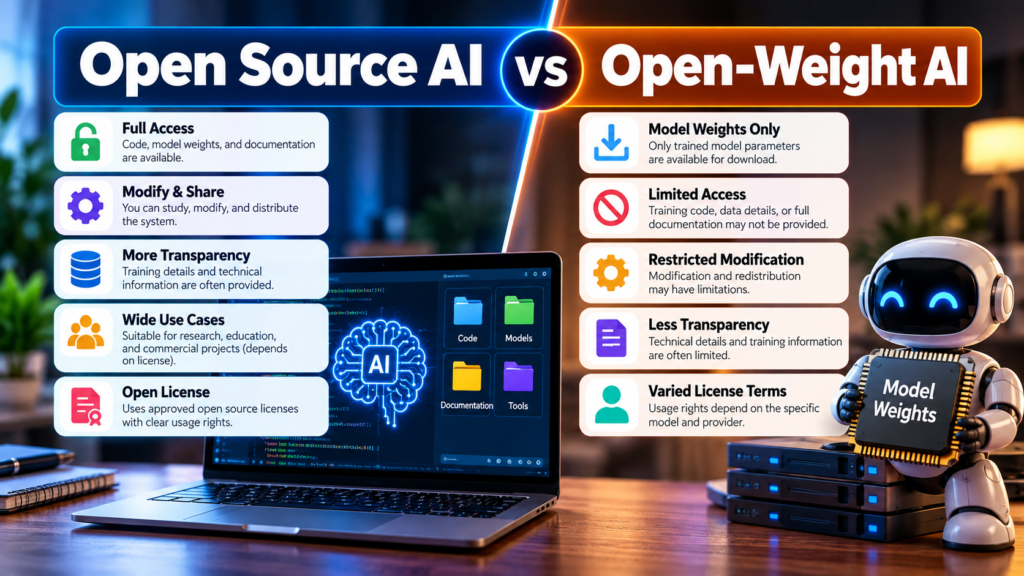
Open Source AI vs. Open-Weight AI
These terms are often used interchangeably, but they are not identical.
- Open source AI: Provides the rights and components needed to use, study, modify, and share the system under qualifying terms.
- Open-weight AI: Makes trained model parameters available for download, but may not provide the complete training data information or code required by the open source definition.
- Free AI tools: Allow people to use a service without paying, but may keep the model and underlying technology proprietary.
- Proprietary AI: Usually restricts access to internal model components and offers use through a hosted service, API, or licensed product.
A downloadable model may be useful even if it does not meet the strict definition of open source. The key is understanding what the provider actually makes available and what the license allows.
How Does Open Source AI Work?
Open source AI uses many of the same machine learning techniques as proprietary AI. The difference is primarily in how the technology is released, accessed, modified, and distributed.
Most modern generative AI tools rely on models trained on large datasets. During training, the system learns statistical patterns that help it generate text, interpret images, write code, or perform other tasks.
A typical open AI workflow involves several stages.
1. Training the Model
Developers train a neural network on selected data so it can learn patterns, relationships, and representations.
2. Releasing Model Components
The developers publish some or all of the model weights, code, documentation, and relevant training-data information under specified terms.
3. Running the Model
Users can run compatible models through local applications, command-line tools, private servers, or hosted inference services.
4. Customizing the System
Depending on the license and available resources, developers can connect the model to their own data, adjust prompts, fine-tune it, or integrate it into an application.
What Are Model Weights?
Model weights are numerical values learned during training. They influence how the model interprets an input and produces an output.
Think of a trained model as a complex instrument. Its weights represent what it has learned, while the inference software provides the mechanism for using that knowledge. Downloading the weights does not necessarily give you the original training dataset or the complete process used to create the model.
What Is Inference?
Inference is the process of using a trained model to produce a result. When you ask a language model to summarize a report, for example, the system processes your prompt and generates a response using its learned parameters.
Inference can happen on your own computer or on a remote server. Local inference can improve control over where prompts and documents are processed, while hosted inference may offer better performance without requiring powerful hardware.
Popular Open Source AI Models and Tools
There is no single model that works best for every task. Some are designed for general conversation, others for programming, research, document processing, or multimodal applications.
The following options are useful starting points, but their licensing terms and capabilities must be checked individually.
OLMo
OLMo is a language model family developed by the Allen Institute for AI. It is particularly relevant to researchers and developers interested in studying model development, training, and evaluation. Certain OLMo releases provide extensive supporting artifacts.
Pythia
Pythia is a research-focused model suite designed to help researchers investigate how language models develop during training. Its available training checkpoints and related artifacts make it useful for reproducibility and interpretability experiments.
Qwen
Qwen is a model family from Alibaba covering tasks such as text generation, coding, and, in selected models, multimodal understanding. Licensing varies by release, so check the specific model’s documentation before commercial use.
Mistral AI Models
Mistral AI publishes models with different sizes, capabilities, and licensing arrangements. Some are distributed under Apache 2.0, while others may use different terms. Review the individual model’s documentation rather than assuming every release has identical permissions.
Hugging Face
Hugging Face provides a platform for discovering, sharing, and working with machine learning models and datasets. It is not itself one AI model, and its repository contents have different licenses and levels of openness.
Ollama
Ollama helps users download and run supported language models locally. It is a practical entry point for people who want to experiment with AI on a personal computer without building an inference system from scratch. The openness and license of the model still depend on the particular model selected.
The Open Source Initiative’s validation work identified Pythia and OLMo among the systems that passed its validation process. This is a more specific claim than simply saying a model is downloadable or free.
Main Benefits of Open Source AI
Open source AI gives individuals and organizations more control over how they develop and deploy artificial intelligence. Its value depends on the model, license, hardware, and intended application, but several benefits are particularly important.
1. Greater Control and Customization
With an appropriately licensed model, developers can modify the system to suit a specific task. They can adjust prompts, fine-tune model weights, change the surrounding software, or connect the model to business databases.
For example, a company could adapt a language model to answer questions about its internal product manuals. Instead of relying entirely on a general-purpose chatbot, the company could build an assistant that uses its own terminology and documentation.
Customization does require testing. A model that performs well on general questions may still struggle with specialized vocabulary or industry-specific decisions.
2. Improved Data Control and Privacy
Running AI locally or on a privately managed server can help organizations control where their information is processed. This is useful when working with confidential business documents, unpublished research, or internal records.
However, open source does not automatically guarantee privacy. An application may still transmit prompts to external services, collect logs, or expose information through insecure storage. Organizations must examine the complete application, not just the model.
3. Reduced Dependence on a Single Provider
A business using a hosted AI API depends partly on that provider’s availability, pricing, rate limits, and service policies. A self-hosted model can reduce some of these dependencies.
It also gives developers more control over model versions and deployment schedules. The trade-off is responsibility: the organization must manage infrastructure, updates, monitoring, and technical failures itself.
4. Opportunities for Research and Innovation
Researchers can study model behavior, compare training approaches, examine available checkpoints, and build on existing work. Developers can also share improvements with other members of the community when their licenses permit it.
This collaborative approach can make experimentation more accessible. Nevertheless, training a large model from scratch can require substantial computing resources, specialist knowledge, and high-quality data.
How Is Open Source AI Used in Real Life?
Open source AI supports a wide range of practical applications. The best choice depends on whether the task requires text generation, code assistance, document retrieval, image creation, or another capability.
AI Coding Assistants
Developers can use suitable models to explain code, generate test cases, suggest functions, and help identify errors. Generated code still requires review for correctness, security, and performance.
Business Document Processing
A company can build a system that summarizes reports, classifies incoming documents, extracts relevant fields, or drafts responses. Structured validation is essential when the results affect financial or legal decisions.
Education and Research
Students and researchers can use language models to explain difficult concepts, organize notes, and summarize supplied material. Important claims should be checked against original research rather than accepted without verification.
Content Creation and SEO
Website owners can use AI to brainstorm article structures, classify keywords, draft outlines, and organize large collections of content. Human editing and factual checks remain necessary, particularly for health, finance, news, and biography topics.
Customer Support
A business can build a chatbot that searches approved product documentation before answering questions. Clear escalation rules help transfer complicated or sensitive cases to a human representative.
These are practical application patterns rather than claims about specific companies using a particular model. Each implementation needs to be evaluated for accuracy, reliability, and suitability.
Using Open Source AI With Your Own Documents
One useful technique is retrieval-augmented generation (RAG). It allows an AI model to retrieve relevant information from an external collection of documents before generating a response.
A simplified RAG workflow looks like this:
- Collect approved documents, manuals, or articles.
- Convert the documents into searchable text and create a retrieval index.
- Search that index when a user asks a question.
- Supply the relevant passages to the model as context.
- Generate an answer and, where possible, identify the supporting documents.
For example, a website owner could build an internal assistant that searches previously published articles and answers questions about existing content. This may reduce repetitive work, but retrieval quality and the model’s interpretation still need testing.
RAG is not the same as fine-tuning. RAG supplies relevant information at answer time, while fine-tuning changes model behavior through additional training.
Open Source AI vs. Closed Source AI
Both approaches can support capable AI applications. The main difference is how much control users have over the underlying technology and who is responsible for operating it.
| Factor | Open Source or Open-Weight AI | Closed Source AI |
|---|---|---|
| Access | Varies by release; some components can be downloaded | Usually accessed through a service or licensed product |
| Customization | Can be extensive when the license permits it | Depends on the provider’s supported options |
| Data control | Local or private deployment may be possible | Depends on the service and its data policies |
| Setup | May require technical skills and infrastructure | Often simpler for beginners |
| Costs | Hardware, hosting, maintenance, or API fees may apply | Subscription, usage, or enterprise fees may apply |
| Transparency | Depends on available code, data information, and documentation | Internal model details are generally restricted |
| Maintenance | The user may manage deployment and updates | The provider usually manages the hosted service |
Neither approach is automatically more accurate, secure, or economical. A hosted service may be the better choice for someone who wants convenience, while a self-hosted model may suit an organization that needs greater operational control.
The distinction between open source and open-weight releases is especially important when comparing these options.
Limitations and Risks of Open Source AI
Open source AI creates opportunities, but it also introduces challenges that users should understand before adopting a model.
Hardware and Performance Requirements
Running a model locally requires sufficient memory and processing capacity. Smaller models can run on many modern computers, while larger models may need substantial RAM, GPU memory, or dedicated server infrastructure.
Quantization can reduce a model’s memory requirements by representing its weights with lower numerical precision. This often makes local deployment more practical, although the effect on output quality varies.
Before downloading a model, check its recommended hardware, supported formats, context length, and expected inference speed.
Accuracy and Hallucinations
Language models can generate convincing but incorrect answers. They may invent references, misunderstand questions, or produce outdated information.
This problem is not limited to open source AI. Any generative AI system can make mistakes.
Useful safeguards include:
- Testing the model with realistic questions.
- Requiring supporting documents for important answers.
- Checking factual claims against reliable sources.
- Using deterministic validation for calculations and structured data.
- Sending high-risk decisions to qualified human reviewers.
Security and Misuse
Openly available models can be integrated into useful applications, but they can also be misused. Poorly secured deployments may expose private information or allow unauthorized access.
Applications that connect AI to email, databases, websites, or other tools need additional protections. Developers should restrict permissions, validate inputs, protect credentials, and prevent untrusted text from overriding system instructions.
A model’s safety behavior can also change after fine-tuning or other modifications. Safety testing should therefore cover the final deployed application rather than only the original model.
Licensing and Legal Questions
A model’s license can determine whether commercial use, redistribution, modification, or certain deployment arrangements are permitted. Some releases impose conditions that do not apply to others.
Training-data provenance and intellectual property can raise additional questions. Access to model weights does not, by itself, establish that every training input was licensed appropriately or that every intended use is legally permitted.
Organizations should review the model card, license, acceptable-use terms, and relevant local laws before building a commercial product.
How to Choose the Right Open Source AI Model
The most suitable model is the one that performs well on your actual tasks while meeting your technical, financial, and legal requirements.
Use this checklist before committing to a model.
- Define the main task: writing, coding, document search, image processing, or another use.
- Check the license and whether it permits your intended commercial or personal use.
- Review available model weights, documentation, training information, and inference code.
- Confirm hardware requirements, memory usage, and expected response speed.
- Test the model using representative prompts and compare results with a trusted baseline.
- Review privacy, security, update, and maintenance requirements.
Should You Run AI Locally or Use an API?
Choose local inference if you need greater control over data processing, want to experiment without sending every prompt to a third-party model service, or expect a stable workload that justifies managing your own infrastructure.
Choose an API if you want a simpler setup, need access to hosted computing resources, or prefer to avoid maintaining servers. Some APIs also provide access to open-weight models, so the model’s openness and the method of access are separate questions.
For many users, a sensible starting point is to test a small model locally and compare its output quality, speed, and operating costs with a hosted alternative.
How Much Does Open Source AI Cost?
Many model weights and supporting tools can be downloaded without a purchase fee. However, free access does not mean zero operating cost.
Potential expenses include:
- Hardware: A suitable computer, GPU, or server.
- Cloud computing: Charges for rented processing power and storage.
- Engineering: Time spent integrating, testing, and maintaining the system.
- Security: Monitoring, access controls, and infrastructure protection.
- Data preparation: Cleaning documents and creating reliable datasets.
- Fine-tuning: Additional computing resources and specialist work.
For light experimentation, an existing computer may be sufficient. A production application with many simultaneous users can require a much larger budget. Compare total operating costs rather than focusing only on whether the model is free to download.
The Future of Open Source AI
Open source AI is likely to remain important as more organizations look for flexible ways to build AI-powered products. Improvements in model efficiency, quantization, and inference software can make capable models easier to deploy on consumer hardware and private infrastructure.
Multimodal models are another significant area. Depending on the release, these models can process combinations of text, images, audio, or video. Open releases may allow developers to build specialized applications around those capabilities, although access and performance vary by model.
AI agents are also attracting attention. These systems can use models to plan tasks and interact with external tools, subject to their permissions and software design. Open models can serve as part of an agent, but reliable automation requires more than a capable language model.
Greater openness does not remove the need for safety, evaluation, licensing checks, or responsible deployment. The long-term value of open source AI will depend partly on whether developers can make these systems useful, reliable, and accessible without creating unnecessary risks.
Frequently Asked Questions
Is open source AI free?
Many open models are available without a download fee. However, hardware, cloud hosting, maintenance, and some licensing arrangements can create costs.
What is the best open source AI model?
There is no universal best model. Compare options based on your task, language requirements, hardware, performance, and license.
Can I use open source AI for commercial purposes?
Some models permit commercial use, while others impose conditions. Always review the license and usage terms for the specific release.
Can open source AI run without the internet?
Yes. A compatible model can run offline after the required files and software have been downloaded. Features that depend on external APIs will still require connectivity.
Is open source AI more private?
It can provide greater privacy when processing happens locally or on a properly managed private server. The complete application’s data handling must still be checked.
Can I train my own AI model?
Yes, but training a large model from scratch can be expensive and technically demanding. Fine-tuning an existing model is often a more practical starting point.
What is the difference between open source AI and open-weight AI?
Open source AI, under the Open Source AI Definition, includes the freedoms and components needed to study and modify the system. Open-weight AI makes trained parameters available but may omit other required components or impose restrictions.
Conclusion
Open source AI gives developers, businesses, researchers, and individuals new ways to build applications with greater flexibility and control. It can support local assistants, coding tools, document analysis, research workflows, and content creation without requiring every task to depend on a proprietary hosted service.
However, choosing a model requires more than checking its popularity or download availability. Licensing, hardware, output quality, data privacy, security, and long-term maintenance all influence whether a particular solution is suitable.
For beginners, starting with a small, well-documented model is often a practical approach. Test it on real tasks, verify its answers, and compare its performance with alternatives before investing in a larger deployment. Most importantly, distinguish genuine open source AI from models that simply make their weights available. That understanding will help you make better technical and business decisions as the technology develops.
1 comment on “Open Source AI: Models, Benefits, Risks, and How to Use It”