

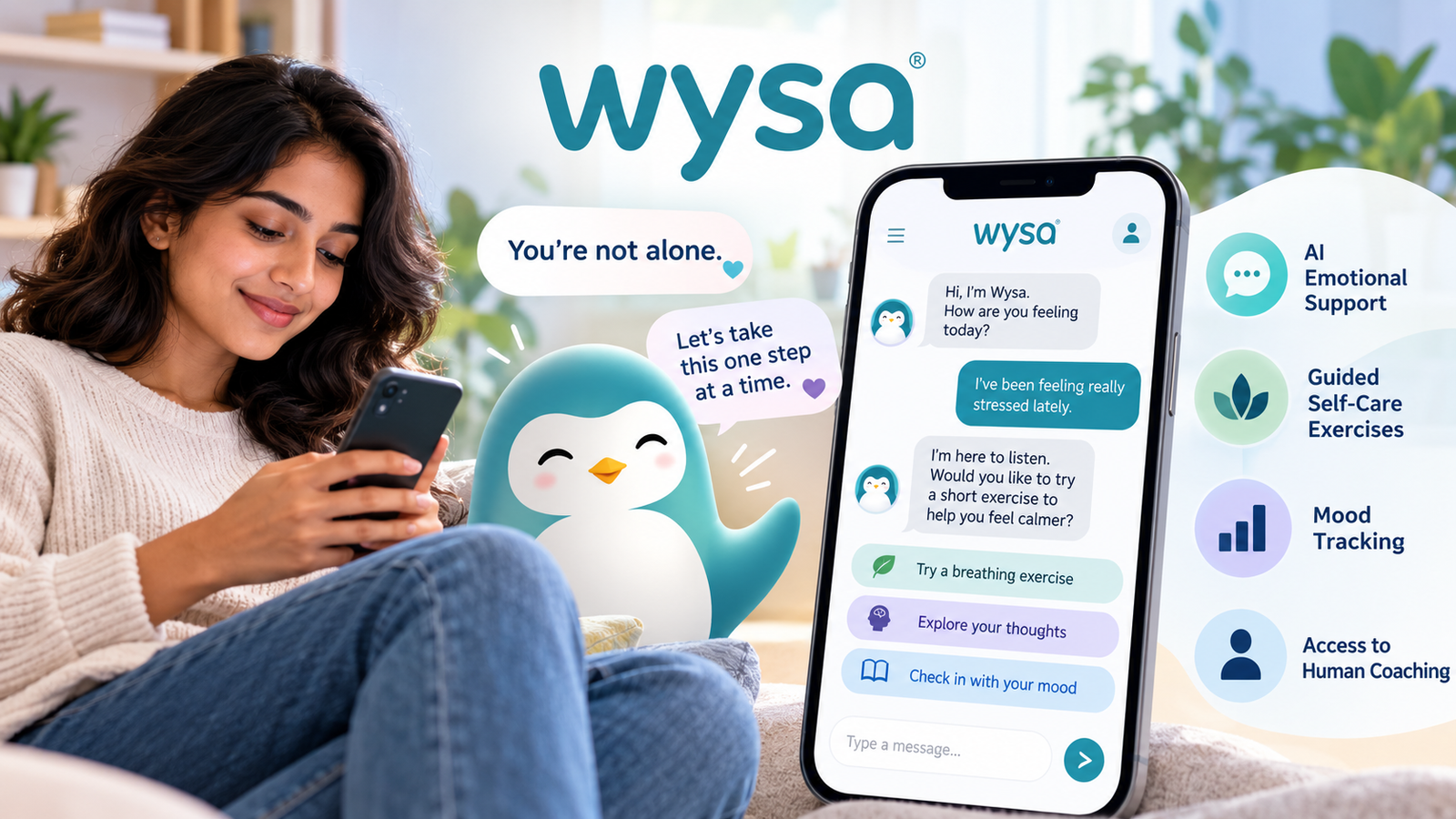
Wysa is an AI-powered mental wellness app designed to help people manage everyday stress, understand their emotions, and develop healthier coping habits. Instead of offering a traditional search interface, it lets users express their feelings through conversations with an AI chatbot and explore guided self-care exercises. Its approach combines conversational artificial intelligence with techniques drawn from established psychological approaches, including Cognitive Behavioral Therapy (CBT), mindfulness, and solution-focused techniques. The app is designed for people who want accessible emotional support without always needing to schedule an appointment.
However, Wysa is not a replacement for a psychologist, psychiatrist, or other qualified healthcare professional. Its purpose is to support emotional well-being through self-help tools, not to diagnose mental health conditions or manage emergencies. Understanding how the app works, what its features actually offer, and how it handles sensitive information can help you decide whether it fits your needs. This guide explores Wysa’s technology, practical applications, advantages, limitations, privacy considerations, and alternatives.
What Is Wysa?
Wysa is a digital mental wellness platform that uses artificial intelligence to provide conversational support and guided self-help activities. Developed by the company behind the Wysa platform, it has been available since 2016 and is designed to make basic emotional well-being support accessible through mobile and web-based experiences.
Users can describe their feelings, reflect on difficult situations, and explore exercises intended to help them manage emotional challenges. For example, someone experiencing stress before an important examination might use the chatbot to identify their worries and work through a guided relaxation or thought-reflection exercise.
The platform also offers a library of self-care activities. Depending on the version and service available to the user, these can include exercises related to mood management, mindfulness, and cognitive behavioral techniques. Some versions also offer access to human coaches.
Wysa serves both individual users and organizations, including employers and healthcare-related institutions. Consequently, the features, access arrangements, and available support can differ between versions.
The key distinction is that Wysa is an AI-supported mental wellness tool, not an autonomous mental health professional. It can help users reflect on their experiences and practise coping skills, but it cannot replace individualized clinical assessment or treatment.
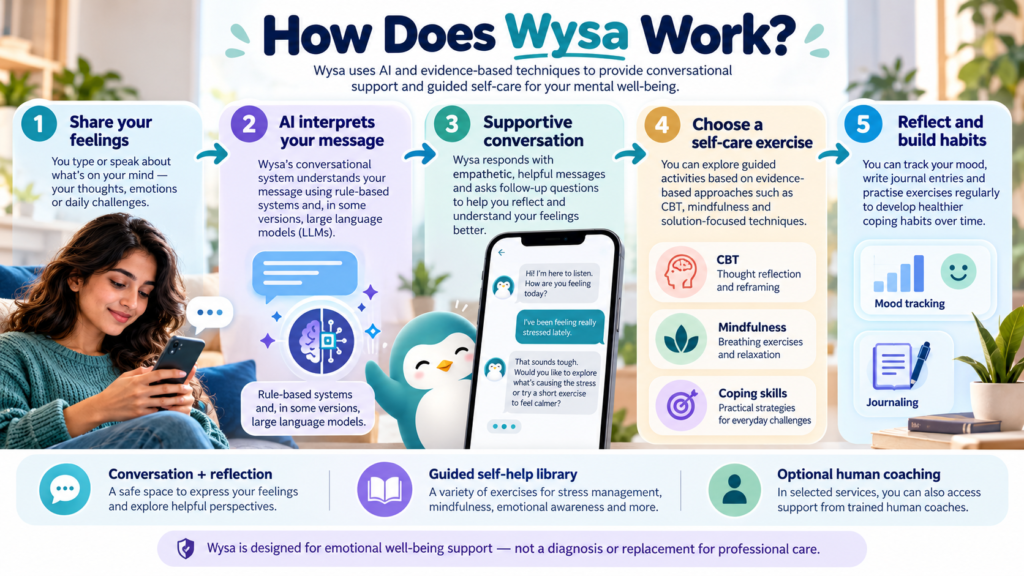
How Does Wysa Work?
Wysa combines conversational software with structured mental wellness activities. According to the company’s official FAQ, its conversational system can use rule-based algorithms and large language models (LLMs), depending on the version being offered.
These technologies serve related but different purposes.
AI-Powered Conversations
A rule-based system follows predefined conversational pathways. For example, if a user selects an exercise for managing anxiety, the software can guide them through a sequence of questions and activities designed for that situation.
An LLM-based system can interpret a wider range of natural-language responses and generate more flexible conversational replies. Rather than requiring users to select an exact option, it can respond to descriptions of their feelings in ordinary language.
For instance, a user might write:
“I’m overwhelmed because I have too many deadlines, and I don’t know where to start.”
The chatbot may help the user explore what feels most difficult, identify immediate priorities, or choose a structured coping exercise. The exact response depends on the system version and conversation.
However, a natural-sounding reply does not mean the AI fully understands the user’s circumstances. AI systems can misunderstand context, overlook important details, or produce inappropriate suggestions.
Evidence-Based Self-Help Exercises
Wysa also provides guided activities designed around established psychological techniques.
Common approaches include:
- Cognitive Behavioral Therapy (CBT): Helps people examine connections between thoughts, feelings, and behavior.
- Mindfulness: Encourages awareness of present experiences without immediately judging them.
- Solution-focused techniques: Help users identify practical steps toward a desired outcome.
- Emotional reflection: Encourages users to describe their experiences and recognize recurring concerns.
For example, someone who repeatedly thinks, “I always fail when something matters,” might use a structured reflection exercise to examine the evidence behind that thought and consider a more balanced interpretation.
This is different from simply receiving a motivational message. The goal is to practice a skill that the user can apply outside the app.
Importantly, the effectiveness of a technique in a particular therapeutic context does not automatically establish that every app interaction will be effective for every user.
What Are the Main Features of Wysa?
Wysa offers several tools for emotional well-being. The features available to you depend on whether you use the standard app, a premium service, or an institutional version provided through an organization.
AI Mental Wellness Chatbot
The chatbot is the central feature of Wysa. It provides a conversational space where users can discuss everyday worries, reflect on difficult experiences, and explore possible coping strategies.
Unlike a general-purpose AI assistant, Wysa is designed specifically around emotional well-being. Its conversations can direct users toward structured exercises rather than simply generating open-ended responses.
This makes it potentially useful when someone wants to organize their thoughts after a stressful day. However, the chatbot’s responses should be treated as supportive suggestions, not definitive psychological assessments.
Self-Care Library
Wysa includes a collection of guided exercises that users can explore according to their needs.
Depending on the version, these activities may cover:
- Stress management and relaxation.
- Mindfulness and breathing exercises.
- Recognizing unhelpful thought patterns.
- Emotional awareness and reflection.
- Developing practical coping habits.
For example, someone who feels nervous before a job interview could try a relaxation exercise and use a reflection activity to identify the thoughts contributing to their anxiety.
The value comes from practising these techniques consistently, rather than expecting a single exercise to resolve a persistent problem.
Mood Tracking and Journaling
Self-monitoring tools can help users record how they feel and reflect on experiences that affect their mood. Journaling can also help people notice recurring concerns, such as work pressure, sleep difficulties, or interpersonal conflict.
Consider someone who frequently feels overwhelmed in the evening. By recording their mood and describing what happened during the day, they may begin to recognize patterns worth addressing.
However, a pattern in a personal journal does not establish a medical diagnosis. Mood records are best treated as personal observations that may support self-reflection or conversations with a qualified professional.
Access to Human Coaching
Some Wysa services provide access to human mental health and well-being coaches through text or other communication formats. Availability and costs depend on the particular service and location.
This distinction matters because an AI conversation and a session with a human professional are not equivalent. Human support can offer individualized judgment, ask follow-up questions, and consider circumstances that automated software might miss.
For readers who want more than self-guided exercises, it is worth checking whether human coaching is included in their particular Wysa offering.
You can explore the available features on the official Wysa website.
Who Can Benefit From Using Wysa?
Wysa is primarily intended for people seeking accessible support with everyday emotional challenges. It may also help people who want to develop healthier habits or practise techniques between appointments with a mental health professional.
Here are several situations in which the app may be useful.
Managing Everyday Stress
Work deadlines, academic pressure, financial worries, and personal responsibilities can leave people feeling overwhelmed.
Wysa can provide a structured opportunity to describe these concerns and explore manageable next steps. For example, a student preparing for several examinations might use a reflection exercise to separate practical problems from anxious predictions about failure.
The student could then create a realistic study plan and use relaxation techniques before studying.
Understanding Emotional Patterns
Some people struggle to identify why they feel upset or anxious. Writing about an experience and responding to structured questions can help them examine what happened and how they interpreted it.
Wysa may support this process by encouraging reflection instead of immediate reactions.
However, emotional reflection is not always enough to resolve complex personal difficulties. If distress continues or interferes with everyday functioning, professional support may be more appropriate.
Building a Self-Care Routine
People who want to practise mindfulness, monitor their mood, or develop consistent coping habits may find guided digital exercises convenient.
Because the app is accessible outside conventional appointment hours, users can practise a short exercise when it fits their schedule.
For instance, someone might use a relaxation activity after work and write a brief journal entry before bed. Over time, this routine may help them become more aware of their emotional responses.
Supporting Existing Mental Health Care
Digital self-help tools can sometimes complement professional care by giving people activities to practise between appointments.
A person already working with a therapist might use a suitable exercise to reflect on a topic discussed during a session.
Nevertheless, the app should be used as a supplement only when appropriate. It should not replace a treatment plan or professional guidance, particularly when symptoms are severe or persistent.
Is Wysa Free to Use?
Wysa offers free AI conversations and paid options for additional features. The exact services available depend on the version, location, and subscription arrangement.
The company’s official FAQ distinguishes between free AI conversations and a premium offering that provides access to a wider selection of tools. Some services also offer human coaching at an additional cost.
Before subscribing, check what is included in the version available to you.
| Feature | General availability |
|---|---|
| AI chatbot conversations | Free access is available |
| Basic conversational exercises | Available through supported conversations |
| Expanded self-care library | May require premium access |
| Human coaching | Available through selected paid services |
| Employer or healthcare access | Depends on the organization |
| Specialized institutional features | Depends on the specific program |
This table describes general availability rather than guaranteeing that every feature is included in every version.
What Should You Check Before Paying?
Before purchasing a subscription, consider these questions:
- Which self-care exercises are included in the free version?
- Does the subscription cover human coaching, or is that charged separately?
- Is the subscription billed monthly or annually?
- Can you cancel easily through the relevant app store or account?
- Are the features available in your country?
- Does your employer, university, or healthcare provider already offer access?
Pricing tip: Check the current price shown in your app store or within the app before subscribing. Prices and subscription terms can change, so an older price quoted in an online article may no longer be accurate.
Is Wysa Safe, and How Private Are Your Conversations?
Privacy is particularly important for mental wellness applications because users may share sensitive information about their emotions, relationships, work, or personal circumstances.
Wysa states that it is designed to minimize personal data collection and protect information through security measures. However, its current global privacy policy also explains that it may collect information users provide, including conversation data, mood information, and responses to questionnaires.
That means users should not assume that everything they type is automatically anonymous simply because the app allows them to use a nickname.
Understanding Wysa’s Privacy Practices
Before sharing sensitive information, consider the following points:
1. Review the privacy policy. Understand what information the service collects, why it collects it, and how it may be used.
2. Avoid unnecessary identifying details. You can discuss a difficult situation without providing your full name, home address, phone number, employer’s name, or other identifying information.
3. Check institutional access arrangements. If your employer or healthcare organization provides Wysa, review the applicable institutional privacy notice. Data handling arrangements may differ from those for direct individual users.
4. Understand data deletion options. Check how to delete your information and whether any retention exceptions apply.
5. Use the official application. Download the app from an official app store or access the service through the company’s official website.
You can review the current Wysa Privacy Policy before deciding what information to share.
Can Wysa Replace a Therapist?
No. Wysa is intended to support self-help and emotional well-being, not replace professional mental health care.
The company explicitly states that its AI does not provide medical diagnoses and should not be treated as a substitute for a qualified health professional. Its standard app is also not recommended for crisis situations or severe, enduring mental health problems.
If you are experiencing severe distress, thoughts of self-harm, or an immediate safety concern, contact a qualified professional or local emergency service rather than relying on an AI chatbot.
What Does Research Say About Wysa?
Wysa is supported by a body of published research examining digital mental health interventions, conversational agents, and related self-help approaches. However, it is important to distinguish evidence about a specific intervention from evidence that every feature of an app works equally well for everyone.
The company maintains a research page listing clinical trials, service evaluations, and real-world studies. Its published research includes work examining the app’s use in connection with anxiety, depression symptoms, chronic pain, and other health-related concerns.
A Published Study on Digital Mental Health Support
A study published in JMIR Formative Research on January 26, 2026, examined how additional app features related to engagement with human mental health coaches.
Researchers analyzed historical app data from 1,213 users who had subscribed to text-based coaching sessions between February and July 2022. They compared users who accessed additional app features with those who did not.
The study found that users who accessed at least one additional feature completed more coaching sessions than users who did not use those features. However, the researchers also noted that the absence of demographic and clinical user data limited the generalizability of their findings.
This is useful evidence about engagement, but it should not be interpreted as proof that Wysa independently treats every mental health condition. The study was observational, and greater engagement does not automatically establish that the app caused better clinical outcomes.
What This Means for Potential Users
Research provides a reason to take digital mental health tools seriously, but individual results can vary.
When evaluating evidence for Wysa, look for:
- Whether a study was peer-reviewed.
- The number and characteristics of participants.
- Whether researchers used a comparison group.
- Which particular version or intervention they studied.
- Whether the measured outcome was engagement, symptom improvement, or another result.
- Whether the findings apply to people with needs similar to yours.
This approach helps separate meaningful research from broad promotional claims.
What Are the Limitations of Wysa?
Although Wysa can make self-help activities easier to access, several limitations are worth considering before using it regularly.
AI Can Misunderstand Context
Conversational AI processes language, but it does not possess human emotional understanding or clinical judgment.
A response may sound empathetic while overlooking an important detail. Users should be cautious about treating generated suggestions as unquestionably correct.
It Does Not Provide a Clinical Diagnosis
Wysa is not designed to determine whether someone has depression, an anxiety disorder, or another medical condition.
If symptoms are persistent, severe, or affecting your ability to work, study, sleep, or maintain relationships, seek an appropriate professional assessment.
The Experience May Feel Limited
Some people prefer speaking with another person, particularly when discussing grief, trauma, relationship difficulties, or complicated life circumstances.
An AI chatbot cannot fully reproduce the trust, individualized judgment, and human relationship involved in professional therapy.
Some Features May Cost Extra
Free AI conversations can make the app accessible to new users, but additional exercises and human coaching may involve payment.
Check the exact offering before assuming that all advertised features are available without a subscription.
Availability and Privacy Terms Can Differ
Different institutional and individual versions may use different conversational systems and offer different features. Privacy arrangements can also depend on the service being used.
Consequently, information about one version should not automatically be applied to every Wysa product.
Wysa vs. Other Mental Wellness Options
Wysa is one option among several ways to access emotional support. The most suitable choice depends on whether you want self-guided exercises, flexible AI conversations, or direct contact with a qualified professional.
| Option | Main purpose | Main advantage | Main limitation |
|---|---|---|---|
| Wysa | AI-supported emotional well-being | Convenient conversations and guided self-help | Cannot replace professional care |
| Meditation apps | Relaxation and mindfulness | Structured audio and meditation sessions | May not address complex emotional concerns |
| Journaling apps | Personal reflection and mood tracking | Helps organize thoughts and identify patterns | Usually requires users to interpret their own experiences |
| General AI chatbots | Broad conversational assistance | Flexible discussions across many subjects | Not necessarily designed around mental health safeguards |
| Licensed therapist | Individualized mental health care | Human judgment and professional assessment | May involve appointment scheduling and higher costs |
These options are not interchangeable. A meditation app may be enough for someone who wants a regular relaxation routine, while a person experiencing persistent emotional difficulties may need professional care.
Is Wysa Better Than a General AI Chatbot?
The answer depends on your goal.
Wysa is purpose-built for emotional well-being and provides structured self-help activities. A general AI chatbot can discuss a wider range of subjects but may not offer the same specialized experience.
However, a dedicated mental wellness app is not automatically more effective or appropriate in every situation. Users should consider the available safeguards, privacy terms, quality of the exercises, and the limits of AI-generated responses.
For mental health concerns that require assessment or treatment, neither type of chatbot should be considered a replacement for qualified professional care.
How to Get Started With Wysa
If you want to try Wysa, begin with a simple goal rather than expecting the app to solve every problem at once.
Step 1: Access the Official App
Visit the official Wysa website or find the application through a supported app store. Confirm that you are downloading the genuine service.
Step 2: Review the Terms and Privacy Policy
Before beginning a conversation, check the eligibility requirements, privacy information, and available features. Requirements can differ between versions and institutional programs.
Step 3: Describe a Specific Concern
Start with an everyday issue you want to understand or manage.
For example, you might explain that you feel overwhelmed by your workload or find it difficult to relax before an important event.
A specific description gives the conversation a clearer direction than a broad request to improve your entire life.
Step 4: Try a Relevant Exercise
If the app suggests a suitable activity, follow its instructions and assess whether the exercise feels useful.
You do not need to complete every available activity. Choose tools that match your goals and comfort level.
Step 5: Reflect on Your Experience
After using an exercise, consider whether it helped you identify a thought, manage a feeling, or decide on a practical next step.
If the app’s responses feel unhelpful or misunderstand your situation, you can stop using it. If your difficulties continue or worsen, consider seeking professional support.
Frequently Asked Questions About Wysa
Is Wysa a real person or an AI chatbot?
Wysa’s AI conversations are generated by software, not a human. Selected services also offer access to human coaches.
Is Wysa free?
Yes. Free AI conversations are available, while some additional self-care tools and coaching services require payment.
Can Wysa help with anxiety?
It offers self-help exercises designed to support emotional well-being and manage everyday anxiety. It does not diagnose anxiety disorders or replace professional treatment.
Is Wysa safe to use?
It includes privacy and safety measures, but users should review its current privacy policy and avoid sharing unnecessary identifying information.
Does Wysa replace therapy?
No. It can complement suitable self-help routines or existing care, but it does not replace assessment and treatment from a qualified professional.
Can I use Wysa anonymously?
The service allows users to use a nickname, but anonymity is not the same as collecting no data. Review the applicable privacy policy before sharing sensitive information.
Is Wysa available 24/7?
The AI service is designed to be accessible outside conventional appointment hours. However, human coaching availability depends on the specific service and arrangement.
Conclusion
Wysa offers a practical way to explore emotional well-being through AI conversations, guided self-care exercises, and structured reflection. It may suit people who want to manage everyday stress, practise mindfulness, or develop healthier coping habits without arranging a traditional appointment for every concern.
Its greatest value lies in making these activities accessible and encouraging users to practise useful skills. Its limitations are equally important: AI can misunderstand context, the app cannot provide a clinical diagnosis, and its responses should not replace professional judgment.
Before getting started, review the available features, subscription terms, and privacy policy. Try the app with a specific, manageable goal and evaluate whether its exercises genuinely help you. If emotional difficulties are persistent, severe, or interfere with daily life, seek support from a qualified mental health professional. Wysa can be a useful self-help resource, but it works best when its role and limitations are clearly understood.