


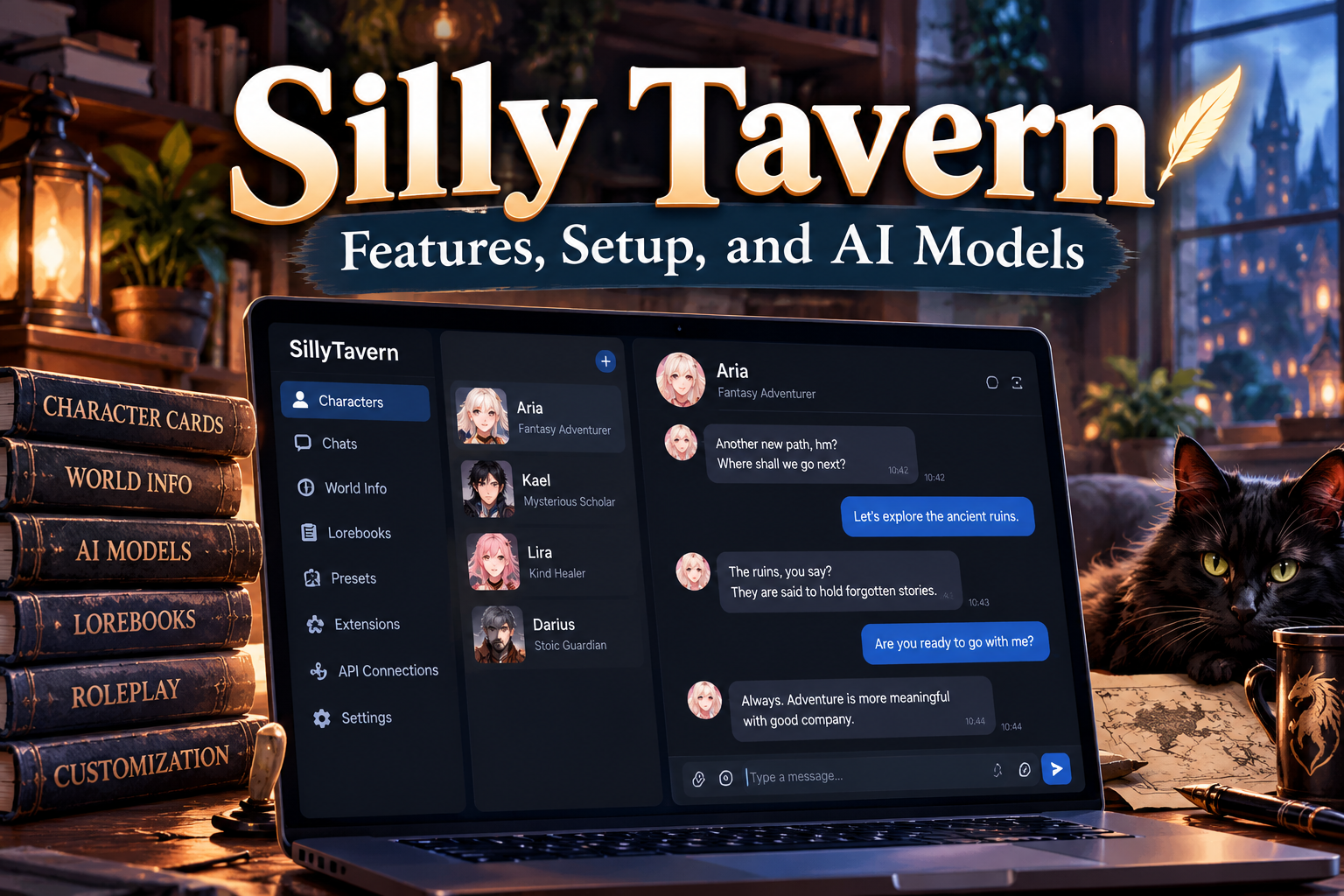
Silly Tavern is an open-source interface for chatting with AI models, creating fictional characters, developing interactive stories, and managing detailed roleplay conversations. Unlike a conventional AI chatbot, it gives users extensive control over character personalities, conversation history, prompts, and model settings. It can connect to different AI backends, including locally hosted language models and cloud-based AI services.
The important distinction is that Silly Tavern is not itself an AI model. It provides the interface and tools that help you interact with a model you choose. Your experience therefore depends on the connected model, its capabilities, your configuration, and the instructions you provide. Whether you are interested in creative writing, fantasy storytelling, character development, or experimenting with generative AI, understanding these differences will help you decide whether Silly Tavern is right for you. This guide explains its main features, setup requirements, costs, privacy considerations, and limitations.
What Is Silly Tavern?
Silly Tavern, commonly written as SillyTavern, is a free, open-source frontend for interacting with large language models (LLMs). It is designed for users who want more control over how an AI behaves during conversations.
Instead of offering only a standard chat box, SillyTavern lets you configure character descriptions, personalities, fictional settings, conversation instructions, and other details that influence the model’s responses. It also supports group chats, custom interfaces, extensions, and additional AI services.
For example, you could create a character who acts as a medieval fantasy guide. You might describe the character as cautious, knowledgeable about ancient kingdoms, and reluctant to reveal a secret. When you start a conversation, the connected AI model uses those instructions to shape its replies.
The result is an interactive storytelling experience rather than a conventional question-and-answer session.
One important point: SillyTavern does not provide the underlying AI intelligence by itself. You need a compatible AI service or a model running on your own computer to generate responses.
How Does SillyTavern Work?
SillyTavern works by combining a user interface, a collection of conversation instructions, and an AI backend. Each component has a different responsibility.
User input
A message, question, or roleplay action
SillyTavern prompt preparation
Character instructions, conversation history, and relevant context
Connected AI model
A local model or a cloud API generates the response
AI response
The reply appears in the conversation and can inform the next turn
This process is important because the model does not simply receive your latest message in isolation. SillyTavern can assemble the character’s description, previous messages, relevant world information, and other instructions into a prompt before sending it to the backend.
What Is an AI Backend?
An AI backend is the service or software that actually runs the language model and generates text.
There are two common approaches:
- Cloud-based AI: A provider processes your prompts through an API. Your computer mainly runs the SillyTavern interface.
- Local AI: A model runs on your own computer through compatible software such as Ollama or KoboldCpp. Your hardware handles some or all of the model’s inference work.
Your choice affects response quality, speed, costs, setup difficulty, and privacy. SillyTavern acts as the interface between your conversation and the selected backend.
3. Main Features of SillyTavern
SillyTavern’s appeal comes from its customization options. Rather than relying on a single preset chatbot, users can build different conversational experiences around different models and instructions.

Character Cards
Character cards define an AI character’s name, personality, background, description, and opening message. You can create original characters or import compatible cards made by other users. The model interprets these details as instructions rather than acquiring a genuinely new personality.
World Info and Lorebooks
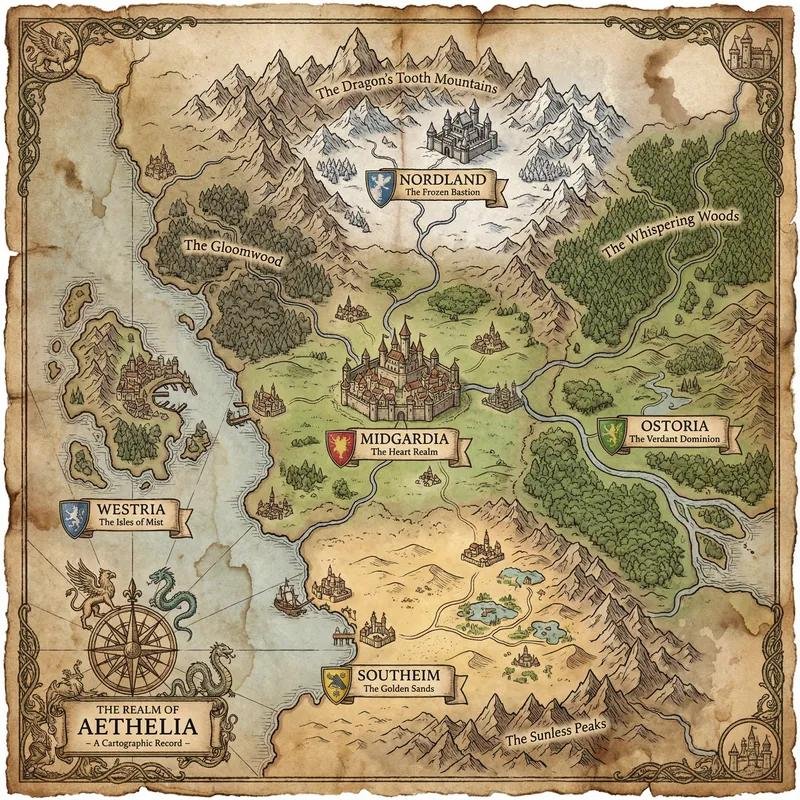
World Info stores details about a fictional setting, including locations, characters, factions, and historical events. Relevant entries can be added to prompts when their associated keywords or activation rules apply. This helps maintain a richer setting without manually repeating every detail in each message.
Group Chats
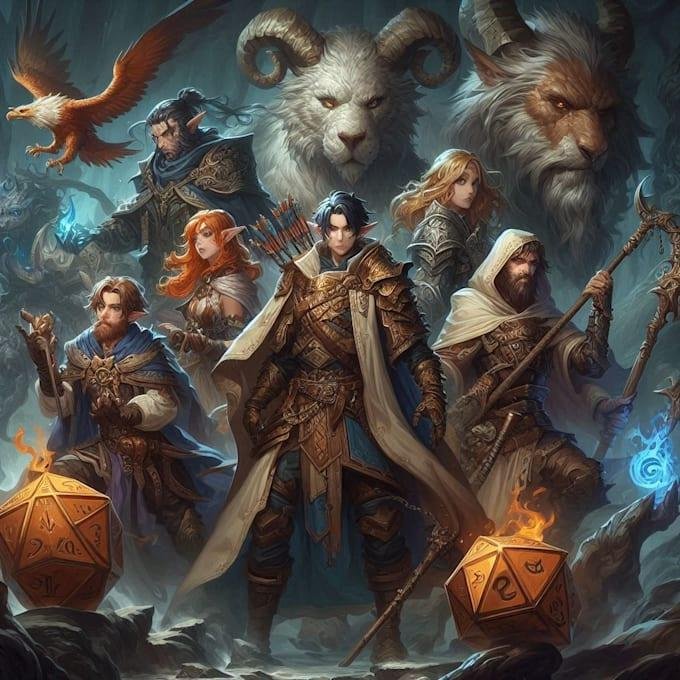
Multiple character cards can participate in a shared conversation. This is useful for interactive fiction, party-based adventures, and scenes involving several fictional personalities. Each character’s contribution still depends on the connected model and the instructions supplied.

Prompt and Generation Controls
Users can adjust supported generation settings, formatting templates, and prompts. These controls help influence response length, variation, structure, and writing style, although their effects depend on the model and its backend.
Other capabilities include:
- User personas: Define information about the role you want to play in a conversation.
- Chat history: Save conversations and return to earlier sessions.
- Document retrieval: Use supported Data Bank and retrieval-augmented generation (RAG) features to provide relevant information from stored documents.
- Extensions: Add compatible capabilities such as text-to-speech, translation, chat summarization, and image generation.
- Interface customization: Adjust themes, backgrounds, and other visual settings.
Individual extensions and integrations can have separate setup requirements and may not work with every backend.
How to Install and Set Up SillyTavern
SillyTavern is available for Windows, Linux, macOS, Android, and Docker-based installations, although the installation process differs by platform. The standard installation runs a local server and provides a browser-based interface.
For most beginners, Windows is a practical starting point if they have access to a computer.
Step 1: Install SillyTavern
Follow the official installation instructions for your operating system. Download the project, install its requirements, and start the server according to the recommended procedure.
Step 2: Choose an AI Backend
Decide whether you want to use a cloud API or a locally hosted model. Cloud services usually require an account and API key, while local models require compatible inference software and sufficient hardware.
Step 3: Configure the Connection
Open API Connections, select the appropriate backend type, enter the required connection details, and select an available model. The settings vary between services, so use the instructions for your chosen provider.
Step 4: Create or Import a Character
Give the character a name, write a description, define its personality, and add an opening message. Start with a simple character before experimenting with detailed lorebooks and advanced prompts.
Step 5: Test the Conversation
Send a message and check whether the response follows your character instructions. If the reply is inconsistent, review the character description, prompt formatting, selected model, and context settings before adding more complexity.
Which Installation Version Should You Choose?
The project maintains a release branch intended for most users and a staging branch that receives newer changes more frequently. The release branch is generally the safer choice for beginners because staging changes may introduce problems or compatibility issues.
Follow the project’s official installation instructions rather than copying commands from an unverified tutorial. This reduces the risk of installing an outdated version or exposing your setup through unsafe configuration.
Which AI Models Can You Use With SillyTavern?
One of SillyTavern’s biggest advantages is that you are not restricted to a single language model. You can choose a backend according to your budget, hardware, preferred writing style, and privacy requirements.
The application supports different locally hosted backends and cloud API connections, including Ollama, KoboldCpp, OpenAI-compatible services, and other compatible providers. Availability and compatibility depend on the selected integration.
| AI Option | Best Suited For | Main Consideration |
|---|---|---|
| Ollama | Beginners exploring local models | Requires model downloads and compatible hardware |
| KoboldCpp | Local storytelling and roleplay | Performance depends on model size and hardware |
| Cloud AI APIs | Users seeking hosted models without local inference | May involve usage fees and provider-specific restrictions |
| AI Horde | Experimenting with community-provided model access | Response times and available models can vary |
| Other compatible backends | Advanced users with specific model preferences | Setup and compatibility differ |
Local Models Versus Cloud Models
A local model runs on your own hardware. After downloading the model and configuring the software, you can generate responses without sending each prompt to an external model provider. Some initial downloads and software setup require an internet connection.
Cloud models run on infrastructure operated by a provider. They can offer access to models that would be difficult to run on a personal computer, but the provider processes the requests you send.
Neither approach is automatically better for everyone.
A capable cloud model may produce more consistent dialogue than a smaller local model. However, a carefully selected local model may be sufficient for simple storytelling and gives you more control over where inference occurs.
What Hardware Do You Need?
SillyTavern’s interface has relatively modest requirements compared with running a large AI model locally. The documented installation requires Node.js 20 or newer, while local inference has additional hardware needs. A computer with a compatible NVIDIA graphics card from the RTX 3000 series and at least 6 GB of video memory can be a starting point for some local model configurations, although actual requirements vary substantially.
When evaluating a computer for local AI, consider:
- VRAM: Video memory limits which models and context sizes can fit comfortably on a GPU.
- System RAM: Some configurations offload model processing to system memory.
- Model size and quantization: Smaller or quantized models generally need less memory, although quality and speed may change.
- Context length: Longer conversations require additional memory and processing.
- Generation speed: Hardware and model architecture affect how quickly replies appear.
You do not need an expensive graphics card simply to use SillyTavern with a cloud API. In that configuration, the provider handles the main model computation.
What Can You Use SillyTavern For?
SillyTavern is particularly useful when the conversation itself is the main activity. Its character-based design and prompt controls support several practical creative workflows.
Interactive Storytelling
A writer can create a fictional detective, describe a mystery, and allow the AI to play supporting characters. The writer then develops the plot through dialogue and decisions instead of writing every scene in advance.
For example, a mystery character might know that a valuable painting disappeared from a locked gallery. A lorebook could contain details about the gallery, suspects, and timeline. The model can use relevant details when generating subsequent scenes, provided those details fit within its available context.
Character Development and Dialogue Writing
Authors can experiment with different personalities, speech patterns, and motivations. A character card might describe a reserved scientist who avoids emotional language, while another describes an impulsive explorer who speaks enthusiastically.
The same scene can be tested with both characters to explore different dialogue possibilities. This can be useful during early drafting, but the resulting text still needs editing for continuity, originality, and quality.
Roleplaying and Game Preparation
Game masters can use SillyTavern to experiment with non-player characters, fictional locations, quest dialogue, and alternative story outcomes. Group chats may also help simulate conversations among several characters.
It should be treated as a creative aid rather than a guaranteed rules engine. An LLM can forget established facts, invent details, or misinterpret game mechanics.
AI Experimentation and Prompt Design
More technical users can investigate how different instructions affect a model’s output. They can compare character descriptions, generation settings, and formatting approaches while using the same underlying model.
This makes SillyTavern useful for learning about prompt engineering and model behavior without building an entire chat interface from scratch.
Document-Assisted Conversations
SillyTavern includes supported retrieval features that can help bring relevant material from stored documents into a conversation. This can be useful for fictional worldbuilding notes or reference material.
However, document retrieval is not the same as fine-tuning. Retrieval supplies relevant information to a prompt; fine-tuning changes a model’s learned parameters through a separate training process.
Is SillyTavern Free? Understanding the Costs
SillyTavern itself is free and open-source software. However, using it does not mean that every connected AI service or feature is free.
Your potential expenses depend on your setup.
- Software: There is no purchase price for the SillyTavern project itself.
- Cloud API usage: Some providers charge according to the model and the number of input and output tokens processed.
- Local models: Downloadable models may be available without a usage fee, but you still need compatible hardware and electricity.
- Optional services: Certain image-generation services, hosting arrangements, and other integrations may have their own pricing.
- Hardware upgrades: A user who needs faster responses or larger local models may choose to invest in better hardware.
A token is a small unit of text processed by a language model. A long conversation can consume more tokens because the model may receive relevant portions of the previous chat along with the latest message.
This is particularly important in SillyTavern because detailed character cards, extensive lorebooks, and long histories can increase prompt size.
How to Avoid Unexpected API Charges
If you use a paid cloud service, check the provider’s current pricing and usage controls before starting.
- Select the intended model rather than assuming the default is the cheapest.
- Keep generation lengths reasonable while testing.
- Avoid unnecessarily large context windows.
- Monitor API usage through the provider’s account dashboard.
- Set spending limits or alerts where the provider supports them.
Prices and free-tier conditions can change, so confirm them directly with the relevant provider before relying on a particular budget.
Privacy, Security, and Safety Considerations
SillyTavern’s local interface does not automatically make every conversation private. The distinction between where the interface runs and where the AI model processes information is essential.
Do Cloud Providers Receive Your Conversations?
When you use a cloud API, the prompts required to generate a response are sent to the selected provider. Depending on the integration, these can include your message, character instructions, relevant conversation history, and other contextual information.
The provider’s data-handling policies determine how those requests are processed, retained, or used. Review the provider’s current terms rather than assuming every API has the same privacy protections.
Does Local AI Offer Better Privacy?
Running a model locally can reduce the need to send conversation content to an external inference provider. However, privacy also depends on other components, including extensions, remote connections, backups, and any external tools you enable.
For a more private setup:
- Use a trusted local backend when appropriate.
- Keep API keys confidential.
- Avoid uploading sensitive personal or business information to services you have not evaluated.
- Install extensions only from sources you trust.
- Keep SillyTavern and its dependencies updated.
- Do not expose the local server to the public internet without understanding the security implications.
API keys are stored in a user-data secrets.json file by default. Protect the installation directory and any backups containing credentials.
Can AI Characters Make Mistakes?
Yes. Character instructions influence a model’s behavior, but they do not guarantee that it will follow every instruction or remember every detail correctly.
An AI character may invent a past event, contradict a previous statement, or confidently produce incorrect real-world information. For fiction, this can be a continuity problem. For factual research, it can be a more serious reliability issue.
SillyTavern should not be treated as a substitute for verified sources, professional advice, or careful fact-checking.
SillyTavern vs. Other AI Chat Platforms
SillyTavern serves a different purpose from general-purpose AI assistants. The main difference is the level of control you want over character definitions, prompts, model selection, and conversation structure.
| Platform or Approach | Main Strength | Main Limitation |
|---|---|---|
| SillyTavern | Character customization and detailed roleplay controls | Requires setup and a separate AI backend |
| ChatGPT | General assistance, writing, reasoning, and supported tools | Does not offer the same character-management workflow |
| Poe | Access to different bots and models through its hosted platform | Features and access depend on the service’s current offering |
| Local AI with Ollama | Running compatible models on your own computer | Requires suitable hardware and model configuration |
| KoboldCpp | Local text generation with support for compatible model formats | Requires a separate setup and appropriate model files |
These options are not direct substitutes in every situation. For instance, Ollama can be used as a local backend for SillyTavern, so you do not necessarily need to choose between them.
A useful way to decide is to identify your main goal. If you primarily want a general assistant for everyday questions, a conventional AI chatbot may be easier. If you want to construct elaborate characters, experiment with prompts, and manage long fictional conversations, SillyTavern is worth exploring.
Common SillyTavern Problems and How to Fix Them
Beginners sometimes assume that a poor response means the application is broken. In reality, problems can originate from the interface, model, connection settings, or character instructions.
Problem: The AI Does Not Respond
Check that the backend is running, the correct API type is selected, and the connection details are valid. For a cloud service, verify that your API key is active and that your account has access to the selected model.
Problem: The Character Ignores Its Personality
Review the character description and opening message. Remove conflicting instructions, make important personality traits explicit, and test a few short conversations before adding extensive lore.
Problem: The Character Forgets Earlier Events
Check the context window and how much conversation history is being included. A long chat may exceed the model’s available context, while summaries and relevant World Info entries can help preserve important details.
Problem: Replies Are Slow
With local inference, check available memory, model size, and GPU usage. With cloud inference, response time can depend on the provider, model, network, and request length.
Problem: An Imported Character Card Fails
Check that the file is a supported character-card format and that its embedded character data has not been stripped during downloading or conversion. Some image-based character cards may fail to import if their embedded data is missing or damaged.
Frequently Asked Questions About Silly Tavern
Is Silly Tavern Safe to Use?
SillyTavern is an open-source project, but safety also depends on your AI provider, extensions, installation, and network configuration. Use trusted downloads, protect API keys, and review privacy settings.
Is SillyTavern Completely Free?
The application is free and open source. Cloud API usage, optional services, and hardware for running local models can involve additional costs.
Can I Use SillyTavern Without an API Key?
Yes, depending on the backend. Some local configurations and community services offer alternatives to paid API keys, but their setup and availability differ.
Can I Run SillyTavern on My Phone?
Yes. You can access an installation running on another computer through a mobile browser. Android users can also try a direct installation through Termux, although that approach is not officially supported.
Does SillyTavern Use ChatGPT?
SillyTavern can connect to supported OpenAI APIs, but it is not the ChatGPT website. API access and ChatGPT subscriptions are separate, and API usage may incur separate charges.
Can SillyTavern Generate Images or Speech?
It supports compatible integrations for image generation and text-to-speech. Actual capabilities depend on the extensions, services, and models configured.
Is SillyTavern Suitable for Beginners?
Yes, if you are willing to learn basic installation and connection settings. Beginners can start with a simple character and a readily accessible backend before exploring advanced prompts, lorebooks, and extensions.
Conclusion
Silly Tavern offers a flexible way to explore AI-powered conversations, interactive storytelling, character creation, and prompt customization. Its greatest strength is the control it gives users over the conversational experience, particularly when working with detailed character cards, world information, and different AI models.
However, the application is only one part of the setup. Your choice of backend affects response quality, cost, speed, and privacy, while character instructions and context management influence how consistently the AI behaves. Beginners do not need to master every advanced setting immediately. Start with the official installation instructions, connect a suitable model, and create one simple character. Once you understand how prompts and conversation history influence the output, you can gradually explore more advanced features and decide whether SillyTavern fits your creative or technical needs.





















1 comment on “Silly Tavern: Features, Setup, and AI Models”