



Sakana AI is a Japanese artificial intelligence company based in Tokyo. It was founded in 2023 by David Ha, Ren Ito, and Llion Jones. The company focuses on new ways to build and use AI. Instead of only making larger models, Sakana AI studies ideas inspired by nature, evolution, and teamwork. Its name comes from the Japanese word “sakana,” meaning fish. The company uses the idea of a school of fish to explain how different AI systems can work together. Sakana AI now works on research, AI models, agents, and practical products. Its growing product range includes Sakana Chat, Sakana Translate, Sakana Fugu, and Sakana Marlin.
Sakana AI has gained attention because its work covers more than normal chatbot technology. The company studies how different AI models can cooperate on difficult tasks. It also explores ways for AI systems to improve research, software, and other complex work. One of its most famous projects is The AI Scientist. This system is designed to automate several parts of scientific research. Sakana AI has also created products for everyday users. These products bring some of its research into practical tools. This mix of research and products makes the company interesting for people who want to understand where artificial intelligence may go next.
What Is Sakana AI?
Sakana AI is mainly an AI research and development company. Its goal is to find new ways to make artificial intelligence more useful and flexible. The company studies several areas, including model merging, evolutionary algorithms, multi-agent systems, and automated research. These methods are different from the simple idea of making one model larger. Sakana AI looks at how several systems can share tasks and improve results. This approach may help AI handle different jobs more efficiently. Its research includes projects such as The AI Scientist, ShinkaEvolve, and other systems that explore new ways to improve artificial intelligence.
Another important part of Sakana AI is its focus on Japanese language and culture. The company has developed the Namazu family of AI models for Japanese users and tasks. These models support products such as Sakana Translate. The company also develops tools for research, business, and general AI use. Sakana Chat provides a simple way to interact with its AI technology. Sakana Fugu connects different models for more complex tasks. Sakana Marlin focuses on longer research projects. Together, these products show how Sakana AI is turning research ideas into tools that people can use.
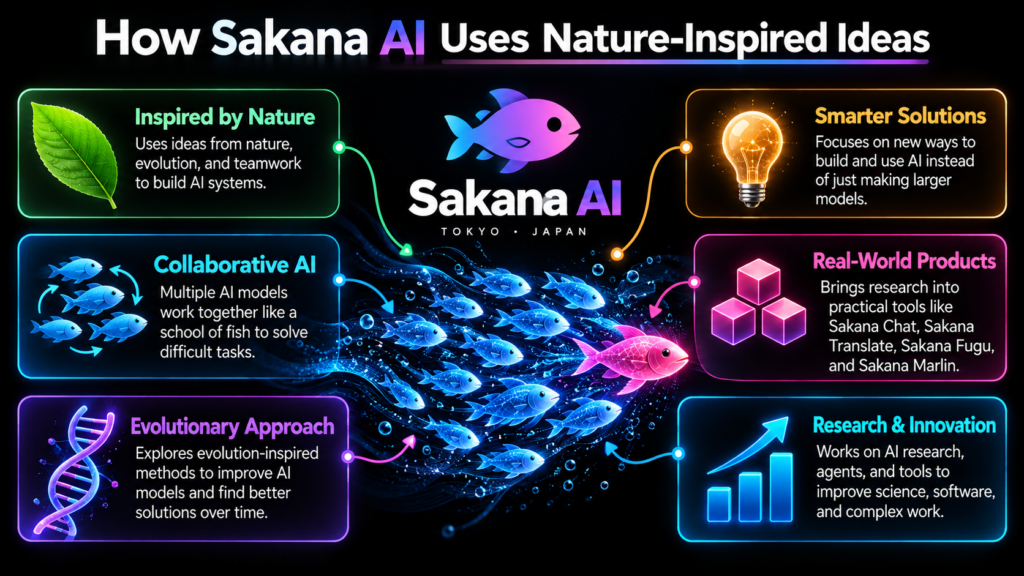
How Sakana AI Uses Nature-Inspired Ideas
The name and ideas behind Sakana AI are closely connected to nature. A school of fish can move together without one fish controlling every movement. Each fish reacts to the others and the environment. Sakana AI uses this idea as inspiration for AI systems. Instead of making one model responsible for everything, several models can work together. Each model can handle tasks that match its strengths. This can create a flexible system that changes according to the problem. The approach also connects with evolutionary ideas, where different solutions are tested and improved over time.
This method can be useful when one AI model cannot handle every part of a task equally well. For example, one model may be better at writing code, while another may be stronger at research or reasoning. A system can combine these abilities instead of choosing only one model. Sakana AI calls this type of approach model orchestration. The company is also studying ways to improve models through evolution and automated testing. These ideas are still developing, but they show a different path for AI development. Future AI systems may use many specialized models working together.
Sakana AI Research Philosophy
Research is a major part of Sakana AI’s identity. The company does not focus only on building products. It also studies new methods that could change how AI systems are created. One example is model merging. This approach looks at how useful abilities from different models can be combined. Another area is evolutionary AI, where systems can test different solutions and search for better results. The company also researches AI agents that can perform several connected tasks. These projects show a common goal: finding smarter ways to use existing AI technology instead of always starting from zero.
Sakana AI is also exploring systems that can help improve AI itself. This includes research into automated experiments, software improvement, and recursive AI development. These areas are still new, so many questions remain open. AI systems can make mistakes, and automated systems still need testing and human review. Sakana AI’s research does not mean that AI can already improve itself without limits. Instead, the company is studying how far these ideas can go. This research may become important as AI systems move from simple assistants toward agents that can plan, test, learn, and complete longer tasks.
Sakana AI Products and Services
Sakana AI has gradually moved its technology from research projects into products. Sakana Chat is designed for general AI conversations. Sakana Translate focuses on translation, proofreading, and related language tasks. Sakana Fugu uses several AI models through an orchestration system. Sakana Marlin focuses on longer research and strategy tasks. The products serve different purposes, but they share one idea. They use AI systems in ways that go beyond a simple chatbot. This product strategy allows Sakana AI to test its research ideas in real situations while giving users direct access to its technology.
| Product | Main Purpose | Main Focus |
|---|---|---|
| Sakana Chat | General AI conversations | AI assistance |
| Sakana Translate | Translation and proofreading | Japanese language |
| Sakana Fugu | Complex AI tasks | Multiple AI models |
| Sakana Marlin | Research and strategy | Long-term research |
| Namazu | AI model family | Japanese language and context |
Sakana AI expanded its product range in 2026. Sakana Chat lets users interact with its AI models through a simple interface. Sakana Translate helps users with multilingual tasks in Japanese, English, and Chinese. Sakana Fugu brings several AI models together for tasks that need different approaches. Sakana Marlin supports deeper research and handles projects that can take much longer than a typical chatbot request. Together, these products connect Sakana AI’s research with practical everyday uses. Users can choose the tool that best fits their needs and explore Sakana AI’s technology in different ways.
Sakana Chat and Namazu Models
Sakana Chat is one of the easiest ways for users to experience Sakana AI technology. It provides a conversational interface where people can ask questions and work with AI. The service has also gained additional features over time. These include access to Fugu capabilities, newer Namazu models, code execution, and previews for some generated content. This makes Sakana Chat more useful for different types of work. However, like other AI assistants, it can still make mistakes. Users should check important information before using it for business, research, education, or other decisions.
Namazu is an important part of Sakana AI’s product strategy. The model family is designed with Japanese language and context in mind. This focus can be useful because translation and communication are about more than changing words from one language to another. Japanese includes honorifics, cultural references, place names, and different levels of formality. A useful AI system needs to understand these details. Sakana Translate uses Namazu technology to support Japanese, English, and Chinese. The company is therefore combining language research with practical tools that can help users communicate across different languages.
Sakana Fugu and Multi-Agent AI
Sakana Fugu is designed around the idea of using multiple AI models together. A normal chatbot may depend mainly on one model for an answer. Fugu takes a different approach. It can choose or combine different models based on the task. This matters because AI models often have different strengths. One model may be strong at coding, another may be useful for reasoning, and another may perform well on a specialized task. Fugu can coordinate these capabilities. The goal is to create a flexible system that can handle different types of requests without depending on one model alone.
A simple Fugu workflow can be understood in six steps:
User request → Task analysis → Model selection → Multiple agents work → Results are checked → Final answer
This process can be useful for complex work. For example, a user may ask for research that requires information gathering, analysis, writing, and review. Different AI agents can handle different parts of that job. However, using more agents does not automatically mean better results. Each model can still make mistakes. The system can also make an incorrect routing decision. Human review remains important for serious work. Users should always check important facts, especially when AI output affects money, business decisions, legal matters, health, or other sensitive areas.
Sakana Marlin and AI Research
Sakana Marlin helps people who need detailed research rather than quick answers. It focuses on research and strategy tasks that often involve several steps. Users can enter a research question, and Marlin can help shape the research direction. It can then work on the task for a longer period and create a detailed report. This process differs from asking a regular chatbot a simple question. Marlin supports longer workflows that connect research, analysis, organization, and writing. It aims to reduce the manual effort that people often spend on large and complex research projects.
Long research tasks can be difficult for ordinary AI systems. A useful research process may involve finding information, comparing sources, identifying patterns, checking assumptions, and writing a clear conclusion. Marlin is designed around this longer process. However, users should not treat an AI research report as automatically correct. AI can misunderstand information or create unsupported statements. Important research should always be reviewed by a person. Marlin can help reduce research time, but human judgment remains necessary. The best use of tools like Marlin is often to support research rather than completely replace the person responsible for the final work.
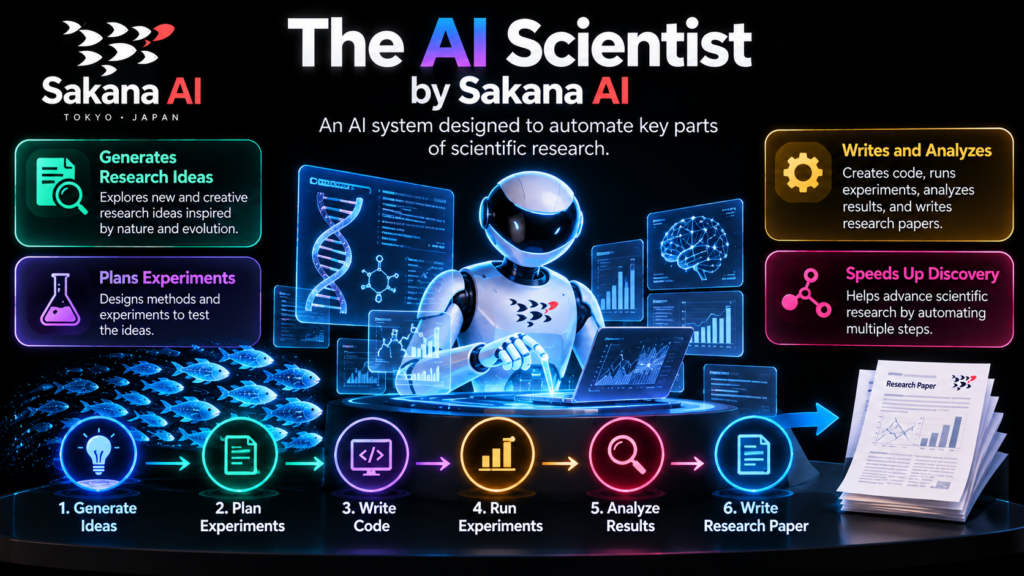
The AI Scientist by Sakana AI
The AI Scientist is one of Sakana AI’s most important research projects. It aims to automate several steps in scientific research. The system can generate research ideas, write code, conduct experiments, analyze results, create charts, and prepare research papers. It can also support the review process. This is significant because scientific research usually requires many connected steps. A researcher may spend large amounts of time testing ideas, writing programs, studying results, and preparing papers. The AI Scientist explores whether some of these tasks can be handled by an AI system working through a longer process.
The project has developed since its original release and has received significant attention in the research community. Research about The AI Scientist was published in Nature in March 2026. Sakana AI also reported an experiment in which an AI-generated research paper passed human peer review at an ICLR workshop. These results are interesting, but they should not be misunderstood. They do not prove that AI can replace scientists. AI research systems can still produce errors and weak ideas. Human researchers remain important for judging quality, designing meaningful studies, and understanding the wider scientific context.
Benefits and Limitations of Sakana AI
Sakana AI’s approach has several possible benefits. Its multi-model systems can combine different AI strengths. Its research tools can automate repetitive work. Its Japanese-focused models can help with language tasks that require cultural and linguistic understanding. Its research agents can also handle longer workflows than simple question-and-answer systems. These features may be useful for developers, researchers, businesses, and everyday users. The company’s approach also gives people another way to think about AI development. Progress does not always need to come from making one model larger.
There are also clear limitations. AI models can provide incorrect information, misunderstand questions, or make poor decisions. Multi-agent systems can introduce new errors when models communicate or when the system chooses the wrong model. Automated research can also produce weak experiments or unsupported conclusions. More computing time does not always mean better results. Users should therefore treat Sakana AI products as tools that support human work. They should review important outputs, check facts, and use trusted sources when accuracy matters.
Why Sakana AI Matters for the Future of AI
Sakana AI is interesting because it explores a different approach to artificial intelligence. Much of the AI industry has focused on larger models, more data, and greater computing power. Sakana AI also studies model cooperation, evolution, automated research, and long-term AI agents. These ideas could become useful as AI systems become more complex. Instead of asking one model to perform every task, future systems may use several specialized models. Each model could perform a specific role while an orchestration system manages the complete workflow. Sakana AI’s products provide early examples of this possible direction.
The company’s work also connects research with real-world products. Sakana Chat brings its AI models to general users. Sakana Translate focuses on language. Fugu explores multi-agent systems, while Marlin focuses on longer research tasks. The AI Scientist explores automated scientific work. Together, these projects show a company testing several ideas at the same time. Their long-term impact will depend on accuracy, cost, safety, reliability, and real-world use. The technology is still developing. For people following AI, Sakana AI provides a useful example of how the next generation of intelligent systems may be built.
Frequently Asked Questions About Sakana AI
What is Sakana AI?
Sakana AI is a Japanese AI research and development company founded in 2023. It studies nature-inspired AI, model merging, multi-agent systems, automated research, and AI agents. The company also develops products such as Sakana Chat, Sakana Translate, Sakana Fugu, and Sakana Marlin.
Who founded Sakana AI?
Sakana AI was founded by David Ha, Ren Ito, and Llion Jones. The founders have backgrounds in artificial intelligence, technology, research, and business. Their combined experience helped shape the company’s focus on new AI research methods and practical AI products.
What is Sakana Fugu?
Sakana Fugu is a multi-agent AI system. It can coordinate different AI models for a single task. The goal is to use the strengths of several models instead of depending on one model. This approach can be useful for complex research, reasoning, coding, and other tasks.
What is Sakana Marlin?
Sakana Marlin is an AI research assistant designed for longer research and strategy tasks. It can spend more time working on a research question and produce a detailed report. Users should still review its results because AI-generated research can contain errors or incomplete information.
What is The AI Scientist?
The AI Scientist is an AI research system developed by Sakana AI. It can generate ideas, write code, run experiments, analyze results, and prepare scientific papers. The project explores how AI can automate parts of the scientific research process while keeping human review important.
Conclusion
Sakana AI is building an interesting approach to modern artificial intelligence. The company studies more than large language models. It explores model cooperation, evolutionary methods, multi-agent systems, automated research, and longer AI workflows. Its products show how these ideas can become practical tools. Sakana Chat provides general AI assistance, while Sakana Translate focuses on language. Fugu connects several AI models, and Marlin supports deeper research. The AI Scientist explores automated scientific work. These projects are still developing, but they show how AI may become more flexible. Instead of one system doing everything, future AI may involve many systems working together.
For users, the main value of Sakana AI is its focus on new AI workflows. Its technology can help with research, translation, coding, analysis, and other tasks. However, AI should still be used carefully. Even advanced systems can make mistakes or misunderstand information. Human review remains important when accuracy matters. Sakana AI’s research will continue to show how far multi-agent and automated AI systems can develop. If you want to explore more AI topics, you can also read our related guides on AI tools, generative AI, and AI research. These resources can help you understand how modern AI is changing and where new technologies may lead.



1 comment on “Sakana AI: What It Is, Models, Products and Future”