


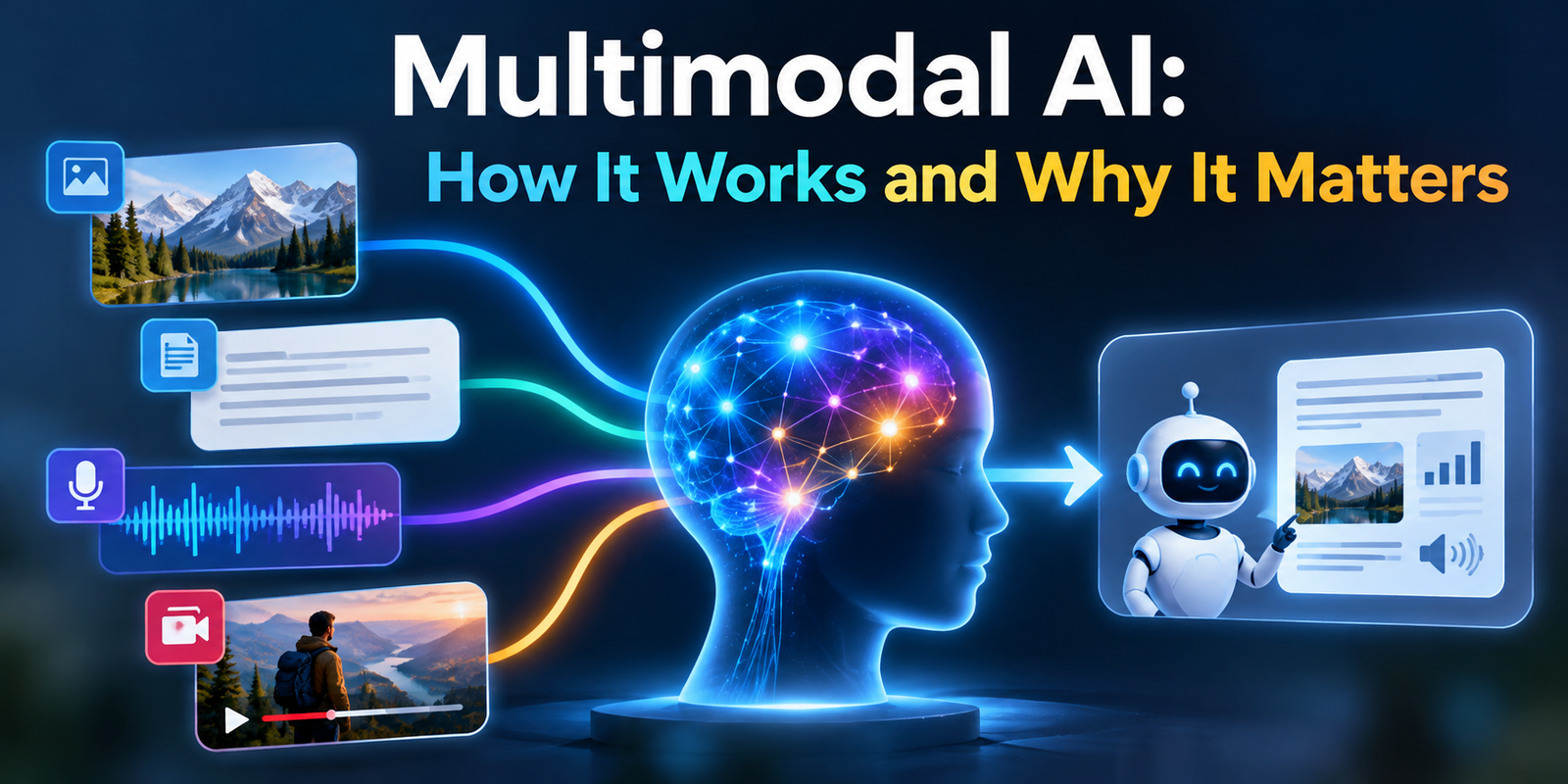
Multimodal technology is changing how artificial intelligence understands and interacts with the world. Instead of working with text alone, multimodal AI can process two or more types of information, such as images, audio, video, and written language. This allows an AI system to answer questions about a photograph, interpret spoken instructions, summarize a recorded meeting, or analyze a chart alongside its accompanying text.
The technology is becoming increasingly important as AI assistants move beyond traditional chatbots. Systems developed by companies such as OpenAI, Google, and Anthropic demonstrate different approaches to working with multiple forms of information, although their capabilities vary by model and product.
Understanding multimodal AI is useful for students, developers, businesses, researchers, and content creators. It helps explain how modern AI tools handle complex tasks and why they can sometimes provide more useful answers than text-only systems. This guide explores how multimodal AI works, its practical applications, its advantages and limitations, and what to consider before using it.
What Is Multimodal AI?
Multimodal AI is a type of artificial intelligence designed to process, interpret, or generate information across multiple data types, known as modalities. These modalities include text, images, audio, video, and, in some specialized systems, sensor readings or spatial data.
Traditional text-based AI primarily works with written language. A multimodal system can combine language with visual or auditory information to answer questions that require more than reading words.
For example, imagine uploading a photograph of a damaged bicycle to an AI assistant and asking which part appears broken. A system with suitable image-understanding capabilities may examine the photograph and explain what it can identify. If you also provide an audio recording describing the problem, a system that supports both inputs may use the additional information to produce a more relevant response.
The important distinction is that multimodal AI does not simply collect different file types. It uses computational methods to identify patterns and relationships between different forms of information.
What Are the Main Modalities in AI?
The modalities supported by a system depend on its architecture and intended purpose.
- Text: Written questions, documents, instructions, captions, and conversations.
- Images: Photographs, screenshots, diagrams, charts, and scanned documents.
- Audio: Speech, music, environmental sounds, and recorded conversations.
- Video: Sequences of frames, often combined with audio and timestamps.
- Spatial data: Coordinates, movement, depth, and other structured representations used in robotics and interactive environments.
Not every multimodal model supports all these inputs. Some systems work with text and images, while others process audio directly or combine video frames with spoken content.
How Does Multimodal AI Work?
Multimodal AI uses machine learning, deep learning, and neural networks to process information from different sources. The exact process varies between models, but most systems need a way to represent different modalities in a form that their computational architecture can use.
An image, for example, contains visual patterns rather than sentences. Audio contains signals that change over time. Text consists of linguistic units. A multimodal system must learn useful representations of these different inputs and, when necessary, connect them to one another.
1. Collecting and Processing Input
The process begins when a user provides information. This might be a written question, an uploaded image, a voice recording, or a video clip.
The system processes each input according to its type. Text may be divided into tokens, images may be represented through visual patches or features, and audio may be processed as a waveform or through intermediate representations. The precise method depends on the model.
Preprocessing can also involve resizing images, dividing audio into segments, extracting video frames, or identifying relevant portions of a document.
2. Learning Relationships Between Modalities
During training, multimodal models learn patterns within individual data types and relationships across them. For example, training data may connect an image of a dog with a written description of that image.
This helps a model associate visual features with language. More advanced training approaches can also help systems interpret spoken language, identify relevant sounds, or connect video events with accompanying narration.
Some models use separate encoders for different modalities, while others use architectures that process several input types within a shared model. These designs are not interchangeable, and their performance depends on training, architecture, and task.
3. Combining Information and Producing an Answer
After processing the inputs, the model uses the available information to perform the requested task. Depending on the system, it may generate text, produce speech, create an image, or return a structured result.
Consider a student who uploads a photograph of a mathematics problem and asks for an explanation. A suitable multimodal assistant can examine the visual information, identify the written problem, and generate a step-by-step response.
However, processing multiple modalities does not guarantee that the answer is correct. The model may misread a symbol, overlook part of an image, misunderstand speech, or produce an incorrect explanation. Important results should be checked against reliable sources or independent calculations.
Multimodal AI vs. Unimodal AI
Unimodal AI focuses on one type of information, while multimodal AI works with multiple types. The distinction matters because the best approach depends on the task.
| Feature | Unimodal AI | Multimodal AI |
|---|---|---|
| Input types | Primarily one modality | Two or more modalities |
| Typical example | Text classification | Answering questions about images |
| Information sources | One data type | Multiple data types |
| Processing requirements | Often simpler | Can require more complex processing |
| Practical use | Narrow, well-defined tasks | Tasks requiring combined context |
| Main challenge | Limited input perspective | Cross-modal errors and complexity |
A unimodal system may be the better choice for classifying short text messages or detecting a specific pattern in a single data type. A multimodal system becomes more useful when a task requires information from several sources.
For example, a customer support system that receives only written messages may classify complaints using text. A multimodal version might also analyze product photographs and voice recordings, provided those capabilities are supported and the relevant data is available.
Multimodal processing is not automatically superior. It can introduce additional cost, latency, and opportunities for mistakes. The goal is to select the simplest reliable approach that meets the actual requirements.
Types of Multimodal AI Models
Multimodal AI includes several architectural approaches. Understanding them helps explain why two AI tools that accept images may behave differently.
Early Fusion and Late Fusion
Early fusion combines information from different modalities relatively early in the processing pipeline. This can help a model learn relationships between inputs, but the architecture must handle differences in their representations.
Late fusion combines information after separate components have processed their respective inputs. For example, an image classifier and a text classifier might each produce a result that another component combines.
A third approach, often called intermediate or hybrid fusion, combines information at multiple stages. These are broad architectural categories rather than strict descriptions of every modern multimodal model.
Contrastive Models and Shared Representations
Some multimodal systems learn a shared representation for related information. Contrastive learning is one approach: it trains a model to associate matching items, such as an image and its description, while distinguishing them from unrelated pairs.
CLIP, a research model introduced by OpenAI in 2021, is a well-known example of image-text contrastive learning. It connects visual and textual representations and can support tasks such as matching images to descriptions.
However, a model designed for image-text matching is not necessarily a conversational assistant. Different architectures are built for different purposes, including classification, retrieval, generation, and interactive reasoning.
Native Multimodal Models
Some newer AI models are designed to handle multiple modalities within a more unified architecture rather than relying entirely on separate systems for each task.
Depending on the implementation, these models may process text and images, understand audio directly, or support real-time voice interactions. Some can also generate outputs in more than one modality.
The term native multimodal is not a universal technical guarantee. It is important to check a model’s documentation for supported inputs, outputs, context limits, and known restrictions rather than assuming that every multimodal model can perform every task.
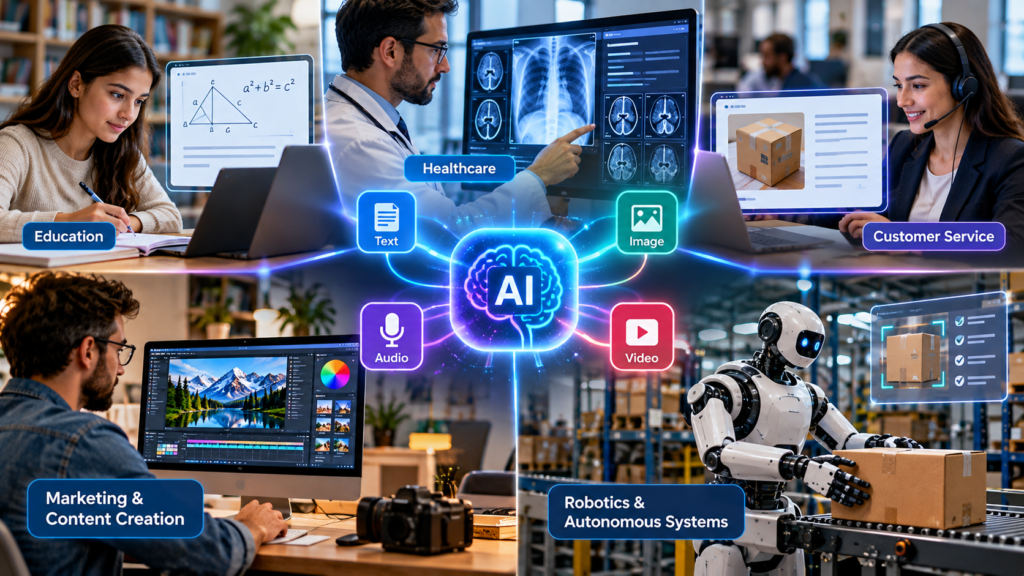
Real-World Applications of Multimodal AI
Multimodal AI is useful when information is spread across different formats. Rather than asking a person to describe every image, recording, or document manually, an AI system can analyze supported inputs together and help produce a result.
1. Education and Learning
Students can use multimodal AI to understand diagrams, solve problems, and review learning materials. A learner might upload a photograph of a physics diagram and ask how the forces interact. Another might provide a lecture recording and request a summary of the main concepts.
These applications can make complicated material easier to explore, especially when visual explanations are important. However, students should verify calculations and factual claims rather than treating every generated answer as correct.
2. Healthcare and Medical Research
Multimodal systems can support research involving medical images, clinical notes, laboratory results, and other forms of patient information. Researchers may use them to investigate relationships between different data sources or help organize large collections of records.
Clinical applications require particular care. Medical images can contain subtle findings that a model overlooks, and generated explanations may sound convincing despite being wrong. Any use affecting diagnosis or treatment requires appropriate clinical validation, privacy safeguards, and qualified medical oversight.
3. Customer Service and Business Operations
Businesses can combine written customer messages, product photographs, and voice recordings to improve support workflows.
For example, a retailer could use a suitable multimodal assistant to review a customer’s photograph of a damaged package alongside the written complaint. The system might summarize the issue, identify visible damage, and prepare a draft response for an employee to review.
Other potential applications include document processing, product inspection, meeting summaries, and information extraction. Actual results depend on input quality, integration with existing systems, and the reliability of the selected model.
4. Marketing and Content Creation
Content teams can use multimodal tools to examine images, transcribe video, summarize recordings, and develop content from several source materials.
A marketer working on a product launch might provide product photographs, a recorded interview, and a written product description. An appropriate model could help extract key messages and draft social media captions that reflect the supplied information.
These tools can reduce repetitive work, but they do not remove the need for editorial review. Claims about product performance, pricing, ingredients, or availability should be checked against reliable source material.
5. Robotics and Autonomous Systems
Robots often need to interpret several kinds of information to operate effectively. Cameras provide visual data, while other sensors can measure distance, movement, or environmental conditions.
Multimodal learning can help connect these signals with language-based instructions or learned representations of the environment. For instance, a research robot might combine camera input and depth information to identify an object and plan how to approach it.
However, multimodal understanding alone does not make a robot safe or autonomous. Reliable physical operation also requires control systems, planning, sensor calibration, testing, and mechanisms for handling unexpected situations.
Benefits of Multimodal AI
The main benefit of multimodal AI is its ability to work with information that would be difficult to understand through a single data type.
Its advantages include:
- Richer context: Images, audio, and text can provide complementary information about the same situation.
- More natural interaction: Users may be able to speak, upload photographs, or combine voice and text instead of typing every detail.
- Less manual processing: Suitable systems can help summarize recordings, extract information from documents, and review visual content.
- Flexible applications: The same general model may support several tasks, depending on its training and available capabilities.
- Improved accessibility: Image descriptions, speech interfaces, and audio-to-text features can help people access information in different ways.
These benefits are not automatic. A system must support the required modalities, perform well on the specific task, and fit the user’s workflow. A more complex model can be less practical than a specialized tool when the task is narrow and predictable.
Limitations and Risks of Multimodal AI
Despite its capabilities, multimodal AI has important technical and practical limitations. Understanding them is essential before using it for business, research, or personal tasks.
Hallucinations and Incorrect Interpretation
A multimodal model can misidentify objects, misread small text, misunderstand a speaker, or overlook important visual details. It may also generate a plausible explanation that is not supported by the supplied evidence.
For example, a model examining a photograph of a restaurant menu might confuse two similar prices or miss a small note about allergens. A human reviewer should check important details before acting on the answer.
Bias and Unequal Performance
AI models can perform differently across languages, accents, lighting conditions, image qualities, and demographic groups. Training data may also contain stereotypes or underrepresent certain populations.
These problems matter when multimodal systems are used for hiring, identity verification, healthcare, education, or other consequential decisions. Evaluation should include the real-world conditions in which the system will operate, not just general benchmark results.
Privacy and Data Security
Images, videos, and recordings may contain faces, addresses, financial documents, private conversations, or other sensitive information.
Before uploading such material, users should understand the service’s data-retention policies, access controls, and available privacy settings. Organizations should also consider whether their contracts and security arrangements permit the intended use.
Cost, Latency, and Technical Complexity
Processing several modalities may require more computation than handling text alone. High-resolution images, long recordings, and lengthy videos can increase processing time or usage costs, depending on the service.
Developers may also need separate preprocessing steps, additional storage, monitoring, and evaluation procedures. For applications that operate at scale, these factors can influence whether a multimodal model is commercially practical.
Limited Reasoning and Context
A model may receive a large amount of visual or audio information without successfully identifying the most important details. Video analysis can miss brief events, while long recordings may require careful segmentation or timestamps.
A large context window does not guarantee perfect recall or understanding. Important information can still be overlooked, and performance can deteriorate when inputs are noisy, ambiguous, or poorly structured.
Multimodal AI vs. Generative AI
Both are related, but they describe different characteristics of a system.
Multimodal AI describes the types of information a model can process or produce. Generative AI describes its ability to create new content. A model can be multimodal without being designed primarily for generation, and a generative model can operate on a single modality.
| Technology | Main purpose | Example |
|---|---|---|
| Multimodal AI | Processes multiple data types | Answering questions about an image |
| Generative AI | Creates new content | Drafting an article |
| Computer vision | Interprets visual information | Detecting objects in an image |
| Speech recognition | Converts speech into text | Transcribing an interview |
| Large language model | Processes and generates language | Summarizing a document |
A single AI product may combine several of these capabilities. For example, a multimodal generative assistant might interpret a photograph, answer a question about it, and generate a written explanation.
It is important not to assume that every generative AI system supports images or audio. Capabilities depend on the specific model and product configuration.
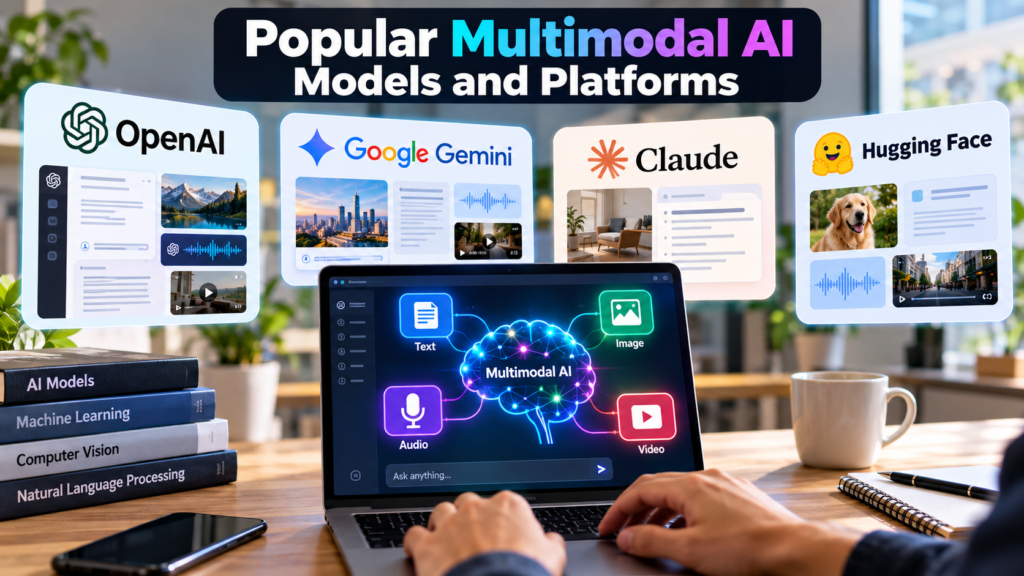
Popular Multimodal AI Models and Platforms
Several major AI developers offer models or products that work with multiple data types. Their supported capabilities can change as models and services are updated, so developers should consult current documentation before choosing a platform.
OpenAI
OpenAI provides AI models and products with multimodal capabilities, including image understanding and audio-related interactions in supported configurations. These features can be useful for conversational assistants, document analysis, and applications that combine language with other inputs.
The available capabilities depend on the model, interface, and API configuration. Developers should check current model documentation for supported input types, output formats, limits, and pricing.
Google Gemini
Google’s Gemini family includes models designed for multimodal tasks. Depending on the model and product, supported workflows may involve text, images, audio, video, or other structured information.
Potential applications include document analysis, research assistance, and extracting information from recorded material. However, support for a particular modality does not guarantee that every Gemini model or interface handles it in the same way.
Anthropic Claude
Anthropic’s Claude products support image understanding in applicable models and interfaces, alongside language-based tasks such as analyzing documents and writing summaries.
This can be useful when users need an assistant to interpret visual information alongside written instructions. Specific input formats, model limits, and other capabilities should be checked in the relevant documentation.
Open-Source Multimodal Models
Open-source and openly available model-weight ecosystems offer alternatives for developers who need more control over deployment, customization, or infrastructure.
Some models support image-and-text tasks, while others focus on speech or video. Availability of model weights does not necessarily mean that the training data, commercial permissions, or every part of the development process is open.
Organizations should review licensing, hardware requirements, security, and benchmark performance before selecting a model for production.
How to Use Multimodal AI Effectively
Getting useful results requires more than choosing a model that accepts multiple input types. The quality of the inputs, clarity of the task, and method used to verify the answer all influence the outcome.
Step 1: Choose a Model for the Specific Task
Identify exactly what you need the system to do. Reading a scanned invoice, transcribing a meeting, describing a photograph, and analyzing a video are different tasks.
Check that the chosen model supports the required modality and input format. If accuracy is especially important, test it on representative examples before relying on it.
Step 2: Provide Clear Instructions and Relevant Context
Explain what the model should look for, what output you expect, and which details matter most.
For example, instead of asking, “Analyze this chart,” provide a more specific instruction:
“Identify the chart’s title, compare the first and last quarters, report the values shown, and distinguish observations from assumptions. If any label is unreadable, say so.”
Clear instructions help narrow the task, although they cannot guarantee an accurate result.
Step 3: Keep Inputs Focused
Supply the relevant image, document, audio segment, or video portion rather than unnecessary material. Make sure important text is readable and audio is sufficiently clear.
For lengthy inputs, consider dividing the material into logical sections. This can make results easier to review and help identify where an error occurred.
Step 4: Verify Important Information
Compare extracted values with the original material. Check names, dates, numerical results, quotations, and claims that could affect a decision.
For business workflows, consider adding human approval for consequential actions. A model that can summarize a complaint should not automatically be trusted to issue a refund or change an account without appropriate controls.
Step 5: Evaluate Before Scaling
Test the system on typical cases, difficult cases, and unusual inputs. Track the types of mistakes it makes, the time required to process requests, and the cost per completed task.
A small pilot can reveal whether multimodal processing provides enough value to justify the added complexity. For repeatable workflows, establish clear criteria for when the model should answer, request clarification, or pass the task to a human.
The Future of Multimodal AI
Multimodal AI research is moving toward systems that can combine information more naturally and respond to users through different channels. Potential developments include more responsive voice interfaces, better video understanding, stronger connections between language and visual reasoning, and AI systems that interact with physical environments.
These developments could make AI assistants more useful in education, accessibility, scientific research, customer support, and robotics. For example, an assistant might eventually coordinate information from a live conversation, a visual scene, and relevant documents within a single workflow.
However, improvements should be measured rather than assumed. Better performance on one benchmark does not establish reliability across every real-world situation. Privacy, bias, computational cost, evaluation, and user control will remain important as these systems become more capable.
The most useful advances will not simply involve accepting more types of input. They will involve interpreting those inputs accurately, communicating uncertainty, and completing practical tasks safely.
Frequently Asked Questions About Multimodal AI
1. What does multimodal mean in AI?
Multimodal means that an AI system can process or generate information across two or more data types, such as text, images, audio, or video.
2. How does multimodal AI work?
It uses machine learning models to process different input types and learn patterns within and between them. The system then uses the relevant information to perform a task or generate a response.
3. What is an example of multimodal AI?
An AI assistant that examines a photograph and answers a written question about it is a simple example. A system that analyzes a meeting recording and produces a summary is another.
4. Is ChatGPT multimodal?
ChatGPT offers multimodal capabilities in supported configurations, including image understanding and certain audio or voice features. Available functions depend on the product, model, plan, and interface.
5. What is the difference between multimodal AI and generative AI?
Multimodal AI concerns the types of information a system processes or produces. Generative AI concerns creating new content. A system can be both multimodal and generative.
6. Is multimodal AI better than text-only AI?
Not always. It can be more useful when a task requires visual, audio, or other information, but a text-only model may be simpler, faster, or more economical for language-based tasks.
7. Can multimodal AI make mistakes?
Yes. It can misinterpret images, misunderstand speech, overlook video events, or generate unsupported claims. Important outputs should be checked against the original evidence.
Conclusion
Multimodal AI represents an important development in artificial intelligence because it allows systems to work with information in forms that better reflect how people communicate and understand their surroundings. By combining text, images, audio, video, and other data types, these models can support tasks ranging from document analysis and education to business automation and robotics.
However, the value of multimodal technology depends on how well it performs the task at hand. More input types do not automatically mean better reasoning, higher accuracy, or safer decisions. Users should choose models based on their actual requirements, verify important results, and protect sensitive information.
For businesses and developers, the practical next step is to test a suitable multimodal model on a clearly defined workflow. Start with a limited pilot, measure its accuracy and cost, and expand only when the results justify the investment.



1 comment on “Multimodal AI: How It Works, Benefits, and Real-World Uses”