


The decentralized AI movement is changing how researchers, developers, businesses, and communities think about building and controlling artificial intelligence. Instead of relying entirely on a small number of technology companies, this movement explores ways to distribute AI computing, model development, data ownership, and decision-making across multiple participants.
The idea goes beyond running an AI model on your own computer. It includes technologies such as federated learning, peer-to-peer computing, open-source AI models, blockchain-based coordination, and networks that reward people for contributing computing resources or useful AI services. Each approach addresses a different part of the problem.
However, decentralization does not automatically make AI more private, secure, affordable, or accurate. The results depend on how a system is designed and governed. Understanding these differences is essential for anyone interested in AI technology, Web3, digital ownership, or the future of open innovation.
This guide explains how the decentralized AI movement works, its practical applications, the projects and technologies associated with it, and the challenges that could determine its long-term success.
What Is the Decentralized AI Movement?
The decentralized AI movement is a broad effort to distribute control over artificial intelligence systems rather than concentrate it in a single company or centralized platform. Its supporters want more people and organizations to participate in developing, operating, accessing, and governing AI.
In a conventional AI service, one company may control the model, computing infrastructure, application programming interface (API), pricing, and access policies. Users receive a service, but they usually have limited influence over how the underlying system operates.
Decentralized approaches separate some of these responsibilities. For example, one organization might develop a model, independent providers might supply computing power, and a distributed network might coordinate access or payments.
The movement generally focuses on several goals:
- Open participation: Allowing more developers and organizations to contribute to AI development.
- Distributed computing: Using resources from multiple machines or providers.
- Data control: Reducing the need to transfer sensitive information to a central repository.
- Transparent coordination: Making certain rules, transactions, or governance decisions publicly verifiable.
- Reduced dependence on individual providers: Giving users alternatives when a service changes its prices, policies, or availability.
These goals are related, but they are not identical. An open-source model can still run on centralized cloud infrastructure. Similarly, a blockchain-based AI marketplace can depend on a small group of operators.
The important distinction is that decentralization is not a single product or technology. It is a collection of architectural and organizational choices.
How Does Decentralized AI Work?
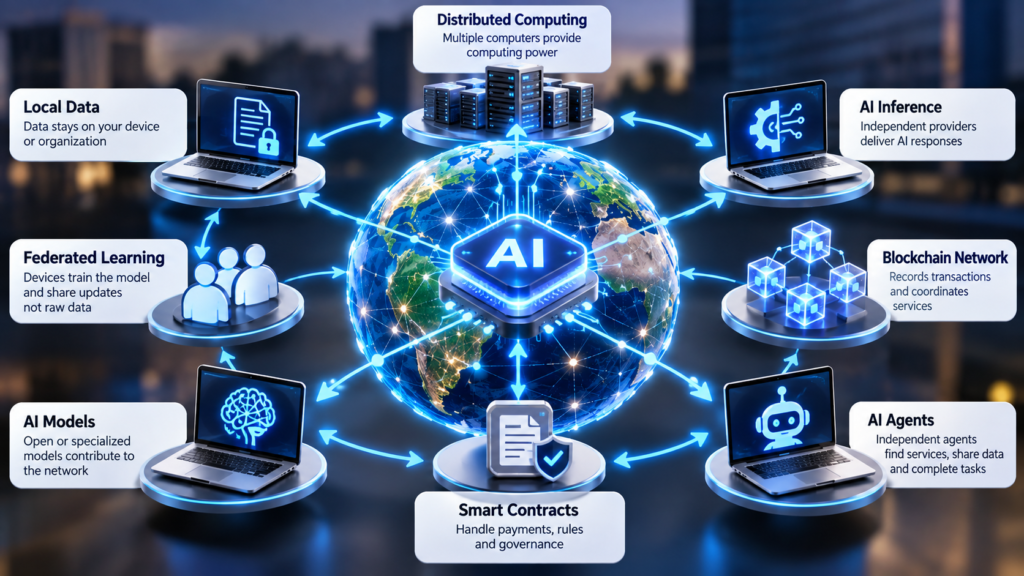
Decentralized AI works by distributing one or more parts of an AI system across independent computers, organizations, developers, or service providers. The exact process depends on the architecture.
A decentralized system might distribute model training, provide access to independently operated AI services, or coordinate payments and reputation through a blockchain. These approaches can work together, but they do not have to.
1. Distributed Computing
AI models require computing power to process information, train neural networks, and generate responses. Traditionally, much of this work happens in centralized data centers.
Distributed computing allows multiple machines to contribute resources to a shared task. A network might use different providers for model inference, training, or other AI workloads.
For example, an AI application could send separate requests to independent providers instead of relying on a single inference service. The application would need to manage response quality, availability, latency, and the security of each provider.
Distributed computing can increase flexibility, but coordinating many machines is not always faster or cheaper than using a well-managed data center.
2. Federated Learning
Federated learning allows multiple participants to help train a shared machine learning model without routinely sending their raw training data to one central location.
A simplified process looks like this:
- A coordinating system distributes an initial model to participating devices or organizations.
- Each participant trains the model using its local data.
- Participants send model updates rather than their original datasets.
- The updates are combined to improve the shared model.
- The process repeats until the training objective is reached or another stopping condition applies.
Consider several hospitals that want to improve a model for identifying patterns in medical images. With an appropriately designed federated learning system, each hospital can contribute to training without transferring all its patient images to a central training repository.
However, federated learning does not guarantee complete privacy. Model updates can sometimes reveal information, so additional protections, such as secure aggregation, differential privacy, and carefully designed access controls, may be necessary.
3. Blockchain and Smart Contracts
Blockchain can provide a shared record of transactions, service registrations, or agreed rules without requiring one organization to maintain the only authoritative ledger.
Smart contracts are programs deployed on supported blockchains. They can enforce defined rules, such as recording service registrations or releasing payments when specified conditions are met.
In decentralized AI, these mechanisms may support:
- Discovering AI services offered by independent providers.
- Recording payments and service-related transactions.
- Coordinating contributions and incentives.
- Maintaining verifiable records of selected actions.
- Supporting community-based governance.
Blockchain does not usually perform the expensive calculations required to train a large language model. Those calculations generally happen on conventional computing infrastructure. The blockchain coordinates selected activities around the AI service.
This separation is important because storing large datasets or processing every AI interaction directly on a blockchain would generally be impractical.
4. Distributed AI Agents
An AI agent is a software system that can pursue a defined goal by selecting actions, using tools, or interacting with other systems.
In a decentralized network, independent agents may discover one another and exchange information or request services. One agent could locate relevant data, another could analyze it, and a third could prepare a report.
For example, a business research workflow might use one agent to gather product information, another to compare specifications, and a third to summarize the findings. A decentralized coordination layer could help locate suitable services and manage interactions.
This is a possible architecture, not a guarantee that agents will cooperate reliably. They still need clear permissions, secure communication, error handling, and checks against fabricated or incorrect outputs.
The main takeaway is that decentralized AI combines several distinct technologies. Distributed computing supplies resources, federated learning supports collaborative training, blockchain can coordinate transactions, and agents can automate multi-step tasks.
Why Is the Decentralized AI Movement Gaining Attention?
The movement has attracted interest because the growth of generative AI has raised questions about who controls computing infrastructure, valuable training data, model access, and the economic benefits of AI.
Large AI systems can require substantial investment in hardware, electricity, engineering, and data infrastructure. This creates practical barriers for smaller developers and organizations.
Decentralized approaches offer alternative ways to organize these resources.
Reducing Dependence on a Single Provider
When an application depends on one AI API, a provider can change its pricing, usage limits, supported models, or access policies. An outage can also interrupt the entire application.
A system that supports multiple independent providers may offer greater flexibility. Developers can route requests to alternative services, provided those services are compatible and meet the application’s quality requirements.
This does not eliminate dependence entirely. A decentralized network might still rely on a small number of infrastructure operators, model developers, or token holders.
Giving More Developers a Route to Participate
Decentralized AI marketplaces can help developers publish specialized services without building an entire commercial platform from scratch.
A developer might offer a speech-recognition model, image-processing service, or document-classification tool. Other developers could integrate that service into their own applications.
This creates an alternative to relying exclusively on a single company’s model catalog. Its usefulness depends on whether the services are reliable, discoverable, secure, and reasonably priced.
Improving Control Over Sensitive Data
Organizations often cannot freely combine their datasets because of privacy requirements, contractual obligations, or internal security policies.
Federated learning and other privacy-preserving methods can help these organizations collaborate without routinely centralizing their raw data.
Still, keeping data local is only one part of privacy protection. Organizations must also consider model updates, access permissions, inference requests, logs, and the possibility of sensitive information appearing in model outputs.
Exploring New Economic Models
Some decentralized AI networks use tokens or other incentive mechanisms to reward computing, model development, evaluation, or service provision.
The intended benefit is to encourage independent participants to contribute resources. A well-designed incentive system could connect rewards to useful work rather than requiring every participant to operate under a single company.
The difficult part is measuring value accurately. If a network rewards activity that is easy to fake, participants may optimize for rewards rather than useful AI performance.
Decentralization therefore creates new possibilities, but it also introduces questions about incentives, accountability, and governance.
Major Projects Associated With the Decentralized AI Movement
Several projects illustrate how decentralized AI can work in practice. They focus on different problems, so it would be misleading to treat them as interchangeable competitors or assume that each decentralizes every part of AI development.
1. Bittensor
Bittensor organizes independent participants into task-specific networks called subnets. Miners provide digital services, including AI-related services, while validators evaluate their work according to subnet-specific rules. Network incentives are designed to reward contributions based on those evaluations.
Why it matters: It explores whether open competition and incentive mechanisms can coordinate AI services without requiring a single company to produce everything.
Main consideration: The quality of each subnet depends on its evaluation system, incentive design, and resistance to manipulation.
2. SingularityNET
SingularityNET provides infrastructure for publishing, discovering, and using AI services through a decentralized platform. Its architecture includes service registries, blockchain-based components, service metadata, and mechanisms for handling payments.
Services can cover areas such as text, speech, images, and machine learning.
Why it matters: Developers can make specialized AI capabilities available to other developers instead of building every component themselves.
Main consideration: A decentralized registry does not mean every service is independently hosted, equally reliable, or automatically trustworthy.
3. Fetch.ai
Fetch.ai’s agent ecosystem focuses on software agents that can discover other agents and coordinate activities. Its technology includes mechanisms for agent discovery and coordination.
Why it matters: Independent agents could help automate tasks that involve multiple services, businesses, or data sources.
Main consideration: Discovering an agent does not establish that it is competent, secure, or authorized to perform a particular action.
These examples represent different parts of the decentralized AI movement: incentive-based AI services, decentralized service marketplaces, and autonomous agent coordination. Their architectures and maturity differ, and the existence of a project does not establish that all its goals have been achieved.
Decentralized AI vs. Centralized AI
The difference between decentralized and centralized AI is primarily about control, infrastructure, and coordination—not necessarily intelligence or accuracy.
| Factor | Centralized AI | Decentralized AI |
|---|---|---|
| Control | Often managed by one provider | Distributed across multiple participants to varying degrees |
| Infrastructure | Commonly uses provider-managed servers | May use independent or distributed computing resources |
| Model access | May depend on a proprietary API | May combine open models and independent AI services |
| Data handling | Depends on the provider’s architecture and policies | May support local processing or collaborative learning |
| Governance | Provider sets most operational rules | May distribute selected decisions among participants |
| Payments | Often uses conventional billing | May use conventional payments, tokens, or smart contracts |
| Accountability | Provider may offer a clear central contact | Responsibility can be spread across multiple operators |
| Performance | Can benefit from tightly coordinated infrastructure | Depends on network quality, coordination, and task design |
Neither architecture is automatically superior. Centralized systems can deliver predictable performance and simpler support. Decentralized systems can offer flexibility, broader participation, and alternatives to single-provider dependence.
For many applications, a hybrid architecture is the most practical option. It might use an open model hosted on conventional cloud infrastructure, local processing for sensitive information, and a decentralized network to discover specialized services.
The right choice depends on the actual problem, rather than on whether a project describes itself as decentralized.
Real-World Applications of Decentralized AI
The strongest use cases are those where distributed ownership, access to independent computing resources, or collaboration between organizations solves a specific problem.
Healthcare and Medical Research
Hospitals and research institutions can use federated learning to train models across separate datasets. Each institution keeps its data within its own environment while contributing to a shared training process.
Potential applications include medical image analysis, disease risk prediction, and research involving data that cannot easily be pooled.
The benefits depend on the quality and diversity of the participating datasets. Differences in medical equipment, patient populations, data formats, and clinical practices can affect model performance. Privacy protections and clinical validation remain essential.
Financial Services and Fraud Detection
Banks and payment providers need to identify suspicious activity, but sharing transaction-level information can create privacy, security, and legal concerns.
A federated learning system could allow several institutions to contribute to fraud detection without routinely transferring their complete transaction databases to one location.
The system would still need safeguards against malicious model updates, data leakage, and attempts to manipulate its predictions. Financial institutions would also need to establish clear agreements about responsibility and permitted data use.
AI Development and Computing Marketplaces
Independent AI developers may have useful models but lack the infrastructure or customer base needed to distribute them widely.
A decentralized marketplace can help connect these developers with people who need specialized services. Depending on the platform, a developer could publish a model endpoint, define its interface, and charge for its use.
This approach is especially relevant for specialized workloads such as speech processing, document analysis, image recognition, and data classification.
The commercial value depends on measurable performance, reliable service, licensing rights, and the total cost of delivering each result.
Education and Research
Universities, independent researchers, and student developers can use open models and distributed computing tools to experiment with AI without depending exclusively on closed commercial APIs.
For example, a university research group might fine-tune an open-weight language model for a specialized research task and run it on infrastructure it controls.
Researchers could also collaborate on model evaluation or distributed training. However, open weights alone do not provide access to every part of a model’s development process. Training data, training code, and licensing terms vary between projects.
Autonomous Business Agents
Decentralized agent networks may help businesses automate tasks that cross organizational boundaries.
A hypothetical travel-planning application could use one agent to search transport options, another to compare accommodation, and another to assemble an itinerary. Independent services could handle individual steps while a coordinating agent manages the overall task.
This could make complex workflows more modular. Yet agents must still verify information, respect permissions, and handle failures. Financial transactions or other consequential actions should require appropriate safeguards rather than relying on an agent’s confidence alone.
Benefits of the Decentralized AI Movement
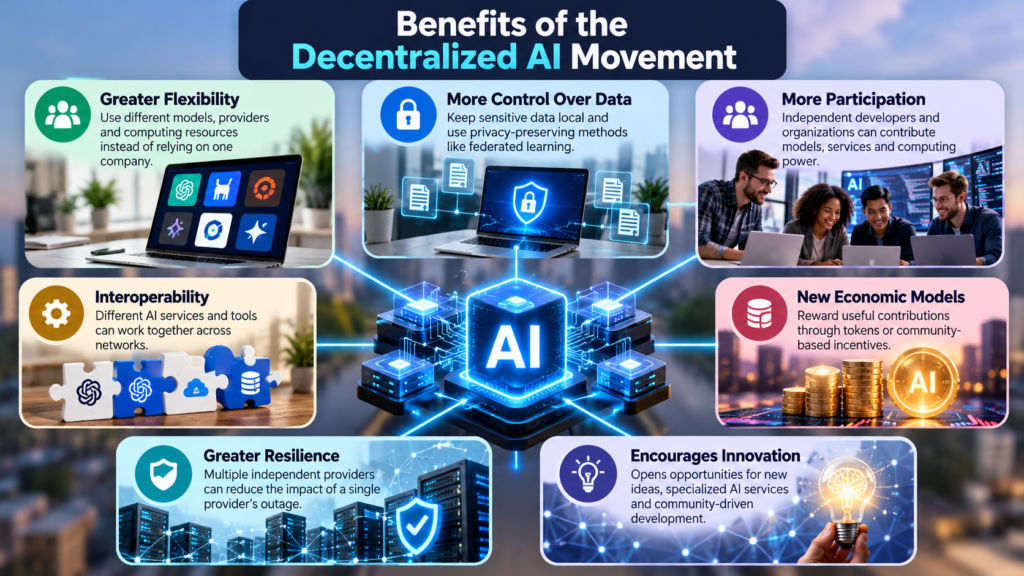
Decentralization offers several potential advantages when its architecture is matched to a genuine need.
- Greater flexibility: Applications can use different models, providers, or computing environments instead of relying on one service.
- More participation: Independent developers can contribute models, computing resources, and specialized services.
- Potential privacy improvements: Local processing and federated learning can reduce the need to centralize sensitive datasets.
- Interoperability: Well-designed interfaces can allow different AI services to work together.
- Alternative incentive structures: Networks can reward useful contributions through predefined mechanisms.
- Greater operational resilience: Multiple independent providers may reduce the impact of an individual provider’s outage.
These benefits are possibilities, not universal guarantees. A distributed network with poor coordination may be less reliable than a centralized service. Similarly, a decentralized marketplace may offer more choice without providing better models.
The practical question is whether the architecture improves a measurable outcome, such as data control, provider diversity, cost, uptime, or model quality.
Risks and Limitations of Decentralized AI
The decentralized AI movement faces technical and organizational challenges that are easy to underestimate, particularly when projects emphasize openness or token-based incentives.
Privacy Is Not Automatic
Keeping raw data on local machines can reduce exposure, but information may still leak through model updates, model outputs, or poorly secured endpoints.
Defenses such as secure aggregation and differential privacy can reduce certain risks, but they introduce design trade-offs and do not eliminate every threat.
Organizations should assess the complete data flow rather than assuming that decentralized architecture makes a system private.
Quality Control Is Difficult
A network of independent providers may contain services with different levels of accuracy, reliability, and security.
A participant could submit misleading results, manipulate an evaluation process, or provide a model that performs well on a benchmark but poorly on real tasks.
Useful safeguards include independent testing, reproducible evaluation, service monitoring, and penalties for demonstrably harmful behavior. Even these measures require careful design because evaluation metrics can be manipulated.
Computing Costs Can Remain High
Training and running advanced AI models requires hardware, electricity, networking, and technical expertise.
Distributed computing can make unused resources available, but it also creates communication overhead, scheduling problems, and variable hardware performance. Sending large models or intermediate results between machines can offset the benefits of distributing the workload.
A decentralized network is not necessarily cheaper than a conventional cloud provider, especially when a workload requires fast responses or high availability.
Token Incentives Can Distort Behavior
Some decentralized AI networks use cryptocurrency tokens to coordinate participants and distribute rewards. These mechanisms can support participation, but they can also encourage speculation or reward activity that does not improve AI quality.
For instance, a provider might optimize for a scoring mechanism instead of delivering genuinely useful results. Token prices can also fluctuate independently of a service’s technical value.
Anyone evaluating such a project should separate the usefulness of its AI services from the market price of its associated tokens.
Governance and Accountability Remain Unresolved
Decentralized networks may distribute decision-making across developers, validators, token holders, or community organizations. This can broaden participation, but it may also make responsibility harder to establish.
A network may be technically distributed while a small group controls key software updates, infrastructure, or voting power.
Questions about intellectual property, consumer protection, regulatory compliance, and responsibility for harmful outputs do not disappear when a blockchain is involved.
How to Get Started With Decentralized AI
You do not need to buy cryptocurrency or build a distributed network to explore decentralized AI. The best starting point depends on whether you are a beginner, developer, researcher, or business owner.
For Beginners
Learn the difference between open-source software, open-weight models, federated learning, distributed computing, and blockchain. These concepts overlap, but understanding their differences will help you assess projects more accurately.
For Developers
Experiment with an open-weight model and run inference locally. Then explore how to expose it through an API or connect it to another service. Check the model’s license, hardware requirements, and security needs before deployment.
For Researchers
Study federated learning, secure aggregation, and privacy-preserving machine learning. Begin with a small experiment using non-sensitive datasets before considering any deployment involving personal or confidential information.
For Businesses
Identify a concrete problem, such as reducing dependence on one model provider or enabling collaboration between data owners. Compare centralized and decentralized designs using the same quality, cost, security, and reliability requirements.
What Should You Check Before Choosing a Project?
Use this checklist when evaluating a decentralized AI platform or network.
- Identify which components are genuinely decentralized.
- Read the model, software, and service licenses.
- Check independent model evaluations and reliability evidence.
- Understand how data, prompts, logs, and model updates are handled.
- Calculate computing, networking, transaction, and maintenance costs.
- Review governance, security controls, and dispute procedures.
- Separate technical utility from token speculation.
The goal is to evaluate what a platform actually delivers, not simply how it describes itself.
The Future of the Decentralized AI Movement
The future of decentralized AI will depend on whether its technical advantages translate into useful, sustainable applications.
One promising direction is hybrid AI infrastructure. A company might use a managed model for complex reasoning, a locally hosted model for confidential documents, and independent services for specialized tasks. A routing layer could select the appropriate service based on privacy, latency, cost, and quality requirements.
Another direction is improved collaboration between organizations. Federated learning, secure aggregation, and other privacy-enhancing technologies may help organizations develop shared models without creating a single repository of sensitive information.
AI agents could also make service networks more useful by discovering capabilities and coordinating multi-step tasks. But this requires reliable identity, permissions, evaluation, and accountability.
The likely outcome is not necessarily a world in which every AI model runs on a blockchain or every company abandons centralized infrastructure. Instead, centralized and decentralized systems may coexist, each serving workloads for which it is best suited.
Frequently Asked Questions
What Is the Decentralized AI Movement?
It is an effort to distribute AI development, computing, services, or governance across multiple participants rather than relying entirely on centralized providers.
Is Decentralized AI the Same as Open-Source AI?
No. Open-source AI concerns access to and rights over software and other model components. Decentralized AI concerns how control, infrastructure, or coordination is distributed.
Does Decentralized AI Protect User Privacy?
Not automatically. Local processing and federated learning can reduce some privacy risks, but additional safeguards are often necessary to prevent data leakage and unauthorized access.
Which Projects Are Associated With Decentralized AI?
Bittensor, SingularityNET, and Fetch.ai are examples of projects exploring different aspects of decentralized AI, including service networks, marketplaces, and agent coordination.
Can Decentralized AI Run Without Blockchain?
Yes. Federated learning, distributed computing, and locally hosted open models can operate without a blockchain. Blockchain is an optional coordination mechanism in many architectures.
Is Decentralized AI Cheaper Than Centralized AI?
Not necessarily. Costs depend on hardware, network communication, provider pricing, transaction fees, and operational complexity. Compare the total cost for a specific workload.
Is Decentralized AI a Good Investment?
A technology’s usefulness does not guarantee that its associated token or project will increase in value. Evaluate technical progress, adoption, token economics, competition, and financial risks separately.
Conclusion
The decentralized AI movement offers a different way to organize artificial intelligence by distributing selected responsibilities across independent developers, computing providers, data owners, and communities. Its most valuable contributions may come from practical improvements in provider choice, collaborative learning, data control, and access to specialized AI services.
However, decentralization alone does not guarantee better performance, stronger privacy, lower costs, or fairer governance. Each system must be evaluated on its technical design, security protections, incentive mechanisms, and real-world results.
For beginners and developers, open models and small distributed AI experiments provide accessible starting points. For businesses and researchers, the more important question is whether decentralization solves a specific problem better than a conventional architecture.
Ultimately, the success of decentralized AI will depend less on its label and more on whether it delivers reliable, secure, and useful intelligence that people can access and trust.
1 comment on “Decentralized AI Movement: Benefits, Risks and Future”