


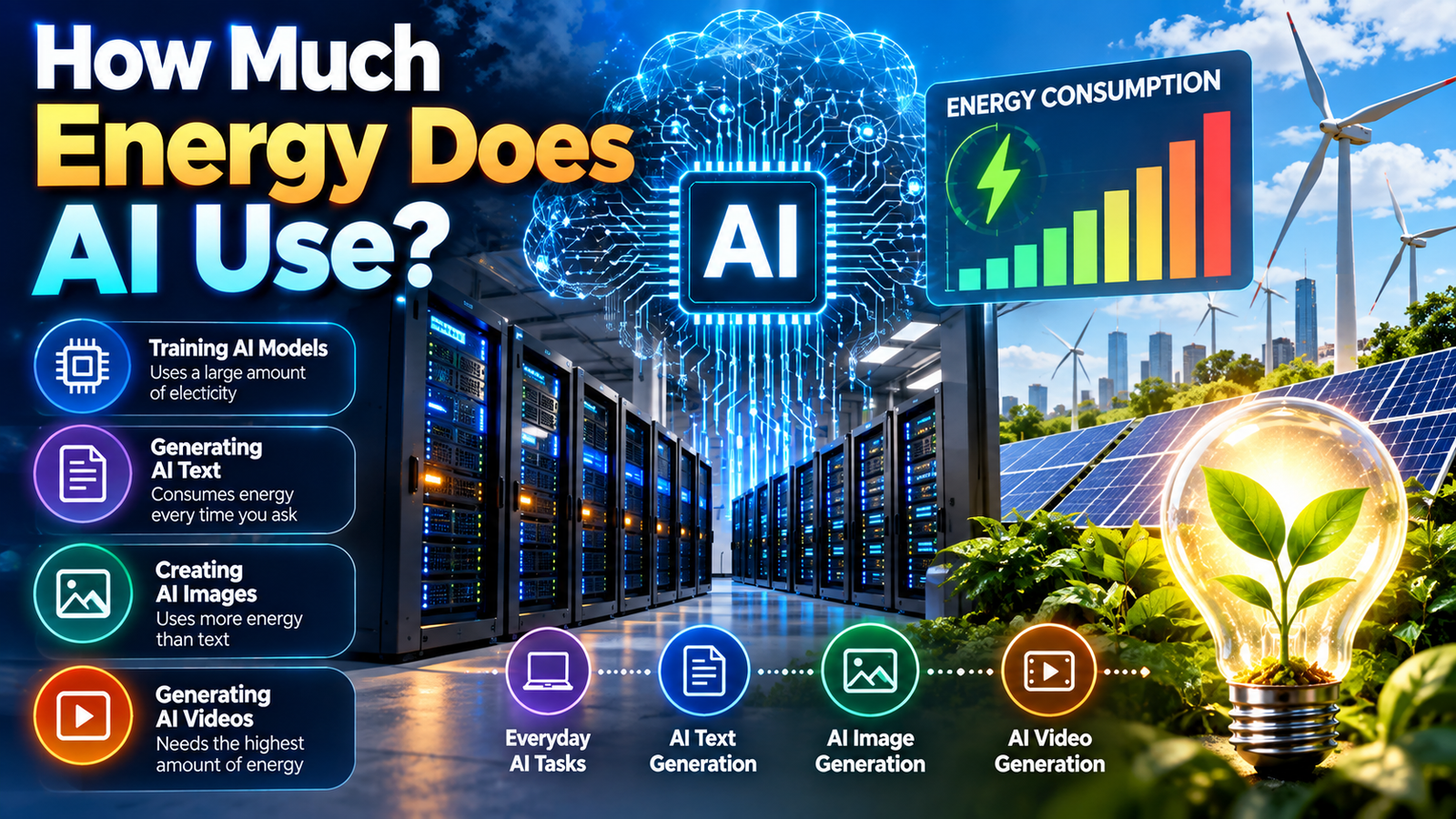
If you have ever wondered how much energy does AI use, the answer depends on what the AI is doing. A simple text request uses a small amount of electricity, while training a large model or generating video can require much more power. AI systems run mainly inside data centers filled with powerful processors, storage equipment, networking hardware, and cooling systems. The International Energy Agency says global data centers used about 415 terawatt-hours (TWh) of electricity in 2024. That represented around 1.5% of worldwide electricity consumption. AI is only part of this total, but its share is growing quickly.
How Much Energy Does One AI Query Use?
There is no single number for every AI query because different models perform different tasks. A short text question may require relatively little electricity, while image generation, video creation, deep reasoning, or an AI agent can require considerably more computing. Google reported in 2025 that the median Gemini Apps text prompt used about 0.24 watt-hours (Wh) of energy under its measurement method. This figure gives useful context, but it should not be treated as a universal number for every AI service. Hardware, model size, response length, data-center efficiency, and the task itself can all change energy use.
For perspective, 0.24 Wh is a very small amount of electricity for one text request. However, billions of requests can create significant demand when added together. The IEA also reports that energy efficiency per AI task has improved rapidly, with energy use per task falling by at least an order of magnitude annually in recent years. At the same time, people are using more AI and choosing more demanding applications. The IEA says video generation, reasoning, and agentic tasks can consume hundreds or thousands of times more energy per query than simple text generation. Therefore, asking about one query gives only part of the picture.
Where Does AI Use Electricity?
Most AI electricity use happens in data centers. These facilities contain servers with CPUs and specialized accelerators, such as GPUs, that process AI workloads. Electricity is also needed for networking, storage, backup systems, power conversion, and cooling. The IEA estimates that servers account for around 60% of electricity demand in modern data centers on average, although the exact share varies by facility. This means AI energy use is not simply the electricity consumed by a computer chip. The complete infrastructure supporting that chip also requires power. Understanding this broader system makes AI energy consumption much easier to understand.
Cooling is particularly important because powerful AI processors generate substantial heat. Data centers must continuously remove that heat to keep equipment operating safely and reliably. Large facilities can therefore require substantial electricity beyond the computing hardware itself. The IEA notes that conventional data centers may use around 10–25 megawatts (MW), while hyperscale AI-focused facilities can exceed 100 MW. One 100 MW AI-focused data center can consume electricity on a scale comparable to about 100,000 households, although actual household comparisons vary by location and consumption patterns.
AI Training vs. AI Inference Energy
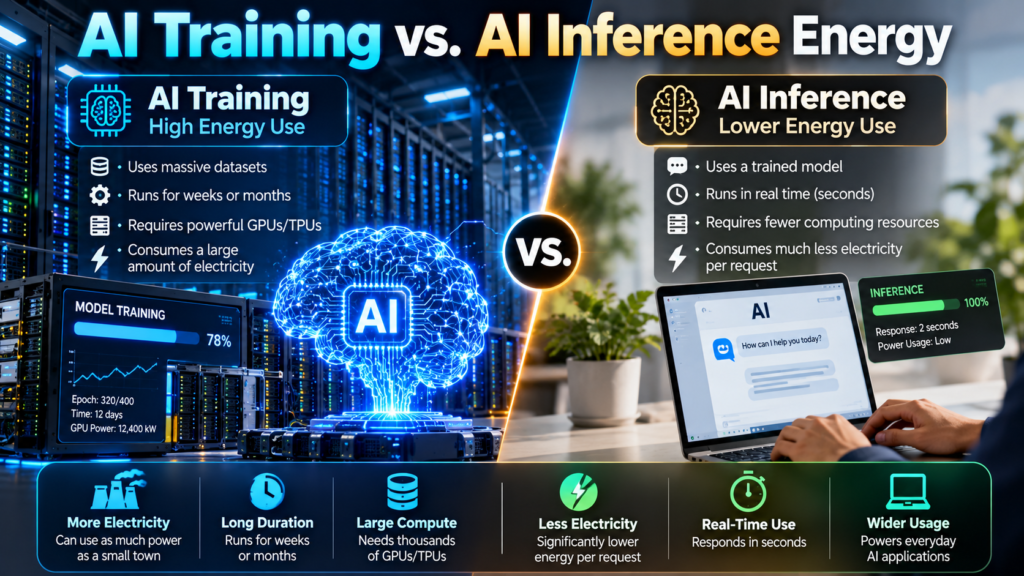
AI training means teaching a model by processing huge amounts of data and adjusting its internal parameters. This process can involve large numbers of specialized processors working together for extended periods. Training therefore creates a substantial electricity demand, especially for large models. However, training happens periodically rather than every time a person asks a question. Once a model is trained, it can be deployed so users can interact with it. The electricity required to produce answers, images, or other outputs is called inference energy. Both stages matter when calculating the overall energy footprint of AI systems.
Inference becomes especially important when an AI service has millions of users and handles requests continuously. A model may be trained once but then answer enormous numbers of requests over months or years. The energy required for each individual request can be small, yet the total can become significant because of scale. The balance also changes depending on the task. Simple text generation generally needs less computing than image or video generation. Advanced reasoning and autonomous AI agents can require additional processing. This is why AI energy discussions should consider both model development and everyday usage instead of focusing on training alone.
AI Energy Use in Simple Numbers
A useful way to understand AI electricity demand is to separate individual tasks from large-scale infrastructure. Consider this simple comparison based on publicly reported measurements and IEA estimates:
| AI energy example | Approximate electricity |
|---|---|
| Median Gemini text prompt | 0.24 Wh |
| Global data centers, 2024 | 415 TWh |
| Global data centers, 2025 | About 485 TWh |
| Projected global data centers, 2030 | About 950 TWh |
The first figure comes from Google’s reported Gemini measurement, while the broader data-center figures come from the IEA. These numbers are not directly comparable because data centers support many workloads besides AI. Still, they show why individual AI requests can appear small while the wider infrastructure can consume enormous amounts of electricity. The IEA’s latest analysis says global data-center electricity demand increased by 17% in 2025, while electricity consumption from AI-focused data centers increased by about 50%.
AI Energy Growth Chart
Global data-center electricity demand
2024   █████████████████        415 TWh
2025   ████████████████████     ~485 TWh
2030   █████████████████████████████████████  ~950 TWh
The chart illustrates the scale of expected growth rather than AI-only electricity use. The IEA’s latest outlook places global data-center electricity consumption at roughly 485 TWh in 2025 and around 950 TWh in 2030. It also expects electricity consumption from AI-focused data centers to triple between 2025 and 2030. These estimates remain uncertain because AI adoption, hardware efficiency, model design, electricity availability, and infrastructure constraints can all change quickly. In other words, the future energy demand of AI is not fixed. Efficiency improvements may reduce energy per task, while greater AI adoption may increase total electricity demand.
Why Is AI Energy Use Increasing?
AI energy demand is increasing for several connected reasons. First, more people and businesses are using AI services every day. Second, AI models are becoming more capable and are being used for increasingly complicated tasks. Third, companies are developing applications that require more computation, including video generation, advanced reasoning, and autonomous agents. The IEA says AI-focused data-center electricity consumption grew much faster than overall data-center consumption in 2025. This shows that efficiency improvements alone do not automatically reduce total electricity demand. When usage grows quickly, overall energy consumption can still rise even as each individual task becomes more efficient.
Another factor is the growing scale of AI infrastructure. Modern AI models often require specialized accelerators and large clusters of processors. Companies are also building larger data centers to support expanding AI services. According to the IEA, a typical AI-focused data center can consume electricity comparable to roughly 100,000 households, while the largest facilities under construction can be far larger. These facilities also require power infrastructure, cooling systems, networking equipment, and reliable electricity supplies. As AI adoption expands, the challenge is therefore not only about making individual models efficient. It is also about building efficient infrastructure that can support growing demand without placing unnecessary pressure on electricity systems.
How Much Energy Will AI Use in the Future?
The future depends heavily on how quickly AI adoption grows and how efficiently the technology develops. The IEA’s latest analysis expects global data-center electricity consumption to roughly double from about 485 TWh in 2025 to around 950 TWh by 2030. AI-focused data centers are expected to grow even faster, with their electricity consumption projected to triple during the same period. These figures cover data-center electricity rather than AI alone, so they should not be interpreted as a direct forecast for total AI electricity consumption. Still, they demonstrate why energy has become an important part of discussions about the future of artificial intelligence.
At the same time, AI hardware and software are becoming more efficient. The IEA reports that energy use per individual AI task has fallen rapidly in recent years. Better chips, improved algorithms, optimized software, and more efficient data centers can reduce electricity required for a particular task. However, lower energy per task does not guarantee lower total energy use. If AI becomes cheaper and easier to use, people may perform many more tasks. This creates a balance between efficiency and demand. Future AI energy consumption will therefore depend on both technological progress and how widely people use increasingly powerful AI applications.
Can AI Become More Energy Efficient?
Yes, efficiency is one of the most important ways to control AI’s energy footprint. Developers can use smaller models when large models are unnecessary, optimize algorithms, improve hardware utilization, and reduce unnecessary computation. Data centers can also improve cooling, power management, and overall infrastructure efficiency. These changes can lower the electricity required for individual AI tasks. The IEA’s findings show that AI energy efficiency has improved very rapidly, demonstrating that technological progress can significantly change the amount of electricity needed for similar workloads over time.
Users can also make practical choices that reduce unnecessary computing. A simple question does not always require the most advanced reasoning model. Likewise, generating several high-resolution videos may require much more energy than creating a short text response. Choosing the right tool for the task can reduce unnecessary processing. Businesses can take this approach further by measuring workloads and selecting efficient models based on actual requirements. If you are learning about responsible technology use, you can also explore our AI tools guide and AI technology trends articles for practical information about choosing and using modern AI systems.
Is AI Energy Use a Problem?
AI energy use is an important issue, but the scale needs context. Data centers accounted for around 1.5% of global electricity consumption in 2024, according to the IEA. That means data centers were not responsible for most global electricity demand. However, their growth is unusually fast, and their electricity needs can be highly concentrated in specific locations. This can create pressure on local grids even when the global percentage appears relatively small. The IEA projects data-center electricity consumption could reach around 3% of worldwide electricity demand by 2030. Therefore, both global totals and local effects matter when discussing AI energy use.
The electricity source also matters. AI does not consume a special type of electricity; data centers draw power from electricity systems supplied by different energy sources. The IEA’s 2025 analysis found that renewables supplied about 27% of electricity consumed by data centers globally, while natural gas supplied about 26% and nuclear about 15%. The exact mix varies by country and location. As AI demand grows, adding generation and improving grids will become increasingly important. At the same time, AI itself may help energy companies forecast demand, manage systems, and improve renewable integration.
How Can We Understand AI Energy Use Better?
The most useful approach is to avoid treating every AI request as equal. Text prompts, image creation, video generation, reasoning tasks, and autonomous agents can have very different computational requirements. Energy use can also change between models and data centers. This makes simple claims such as “one AI question always uses X amount of electricity” misleading. Public measurements are useful, but they should always be understood within their methodology and date. Google’s 2025 Gemini measurement, for example, applies to a specific service and measurement approach rather than every AI platform.
Better transparency will make future comparisons easier. The IEA has highlighted the need for more systematic energy-consumption disclosures as AI develops. Clear reporting could help users, researchers, governments, and companies understand how much electricity different workloads actually require. It would also make it easier to compare efficiency improvements over time. For now, the safest conclusion is simple: AI can use very little electricity for an individual text task, but the combined demand of billions of tasks and expanding data-center infrastructure can become substantial. That distinction is essential for understanding the real energy footprint of artificial intelligence.
Frequently Asked Questions
1. How much energy does AI use per question?
A specific amount depends on the model and task. Google reported a median energy use of about 0.24 Wh for a Gemini Apps text prompt in 2025. Other AI systems can use different amounts, especially for images, videos, long responses, reasoning, or agentic tasks.
2. Does AI use more electricity than Google Search?
It depends on the AI model and search system being compared. Simple AI text requests can use relatively little electricity, but more advanced AI tasks can require much more computing. The IEA says energy use varies greatly between simple text generation and intensive applications such as video generation and reasoning.
3. Why does AI need so much electricity?
AI needs electricity to operate processors that train and run models. Data centers also require networking, storage, cooling, power conversion, and other supporting equipment. Large AI facilities can therefore consume substantial amounts of electricity continuously while serving users and running workloads.
4. Will AI energy consumption decrease?
Energy use per AI task is already falling rapidly because of better hardware and software. However, total electricity demand can still increase if AI adoption grows faster than efficiency improves. The IEA expects global data-center electricity consumption to roughly double by 2030.
5. Can AI run on renewable energy?
Yes. Data centers can receive electricity from grids that include renewable sources such as solar, wind, and hydropower. The IEA estimates renewables currently supply about 27% of electricity consumed by data centers globally. The actual electricity mix depends on the location and local power system.
Conclusion: Understanding AI Energy Use
So, how much energy does AI use? There is no single answer because AI workloads vary greatly. A simple text prompt can require only a fraction of a watt-hour, while advanced reasoning, image generation, video generation, and large-scale model training can require far more computing. The bigger picture is also important. Global data centers used about 415 TWh in 2024, and the IEA expects their electricity demand to approach 950 TWh by 2030. At the same time, energy efficiency is improving rapidly. Understanding both sides gives a clearer view of AI’s energy footprint. As AI expands, efficiency, transparency, and responsible usage will become increasingly important.
1 comment on “How Much Energy Does AI Use? A Simple Guide”