


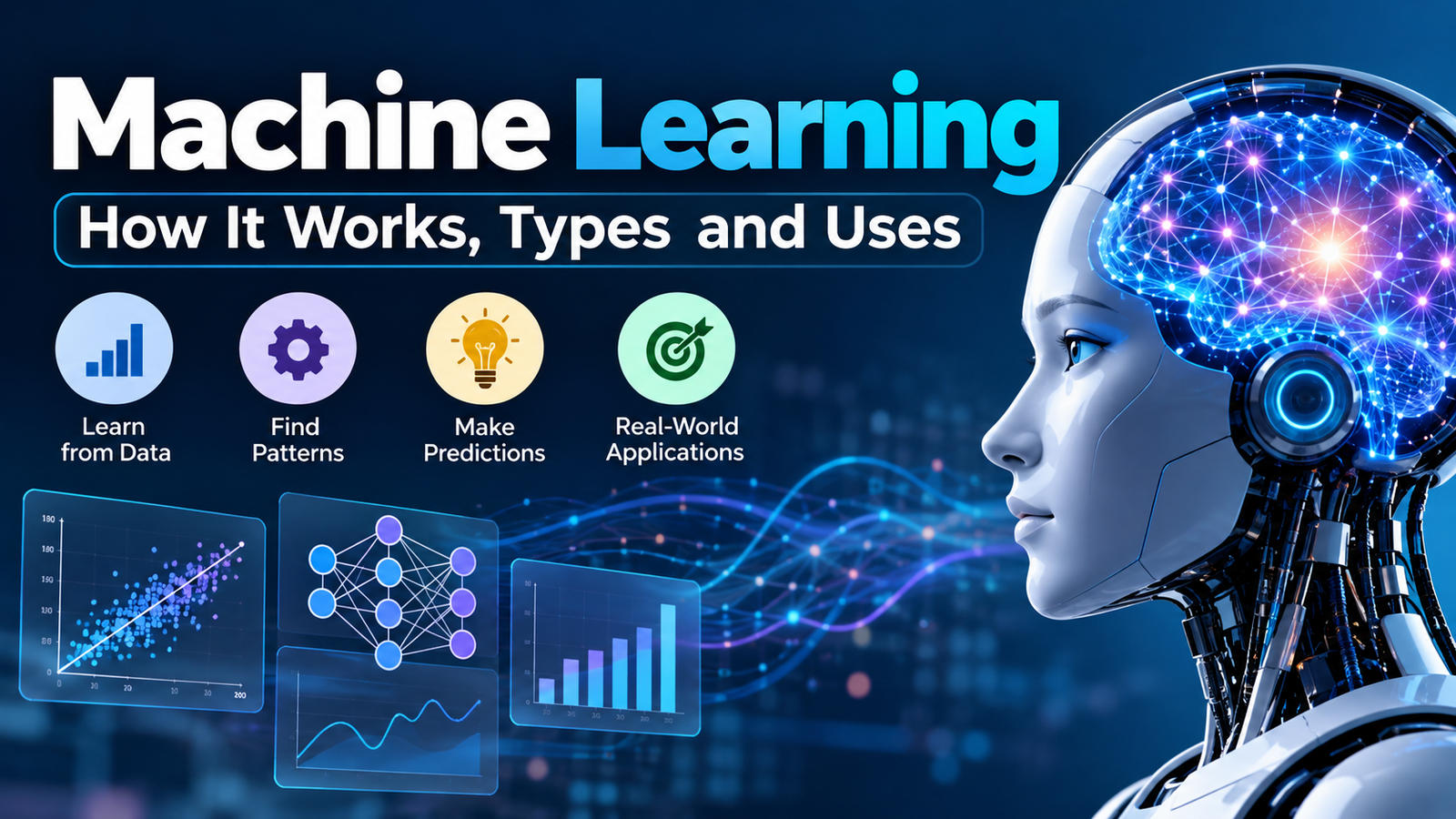
Machine learning is a branch of artificial intelligence (AI) that enables computers to learn patterns from data and use them to make predictions, identify information, or support decisions. Instead of programming every possible rule manually, developers train a machine learning model using examples. The model then applies what it has learned to new data.
This technology already supports many everyday services, including email spam filters, online recommendations, fraud detection, voice recognition, and image analysis. It also plays an important role in generative AI, which powers tools that create text, images, audio, and other content.
However, machine learning is not magic. Its performance depends on the quality of its training data, the suitability of its algorithm, and how carefully its results are evaluated. Understanding these factors helps explain both its potential and its limitations. This guide explores how machine learning works, its main types, practical applications, advantages, risks, and the skills beginners need to get started.
What Is Machine Learning?
Machine learning is a field of AI focused on developing systems that identify patterns in data and use those patterns to perform specific tasks. These systems learn statistical relationships during training rather than relying entirely on manually written rules.
For example, a traditional email filter might block messages containing certain words. A machine learning spam filter can learn from examples of spam and legitimate emails, recognizing combinations of signals such as suspicious links, unusual wording, sender behavior, and message structure.
Once trained, the model evaluates incoming emails and estimates whether they are likely to be spam. Its predictions can improve when the system receives useful new training data and is properly retrained.
Machine learning does not necessarily understand information the way a human does. It identifies relationships that help it complete a defined task. The quality of those relationships determines how useful its predictions will be.
Machine Learning vs. Artificial Intelligence
Artificial intelligence is the broader field of creating systems capable of performing tasks associated with human intelligence, such as recognizing speech, solving problems, and interpreting language.
Machine learning is one approach within AI. Other AI approaches include rule-based systems, search algorithms, and symbolic reasoning.
The distinction is straightforward:
- Artificial intelligence: The broad field of intelligent computer systems.
- Machine learning: A method that learns patterns from data.
- Deep learning: A type of machine learning that uses multilayered neural networks.
- Generative AI: AI designed to generate new content, often using deep learning.
These categories overlap, but they are not interchangeable. A system can use AI without machine learning, and not every machine learning model generates content.
How Does Machine Learning Work?
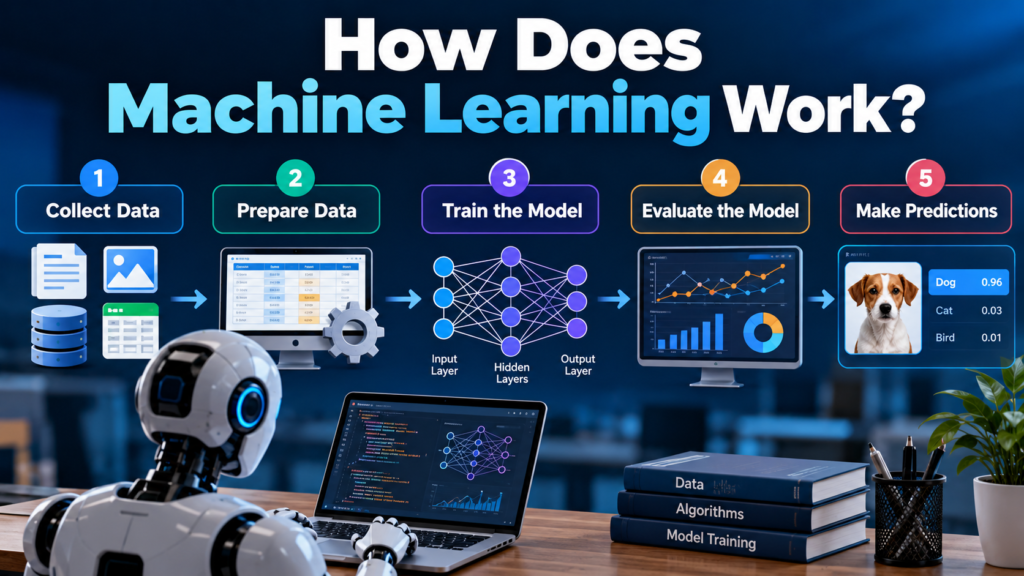
A machine learning project usually follows a series of steps. The exact process depends on the problem, the available data, and the algorithm being used.
1. Collect and Prepare Data
The process begins with relevant data. This might include sales records, photographs, customer messages, sensor readings, or historical transactions.
Raw data often contains missing values, duplicate records, errors, or inconsistent formats. Developers and data analysts clean the information, select useful features, and check whether the data represents the problem accurately.
For example, a retailer predicting future product demand might use historical sales, prices, promotions, holidays, and seasonal patterns. Poor-quality records can lead to unreliable forecasts, regardless of the algorithm selected.
2. Choose a Machine Learning Algorithm
An algorithm defines the method used to learn patterns from the training data. The choice depends on the task.
A linear regression model may estimate a numerical value, while a decision tree can make predictions through a series of decision rules. Neural networks can learn complex relationships in large datasets.
More complicated algorithms are not automatically better. A simple model may perform well when the data has clear patterns, requires limited computing resources, and needs straightforward explanations.
3. Train the Model
During training, the algorithm uses examples to adjust the model’s internal parameters. These adjustments aim to reduce the difference between its predictions and the expected results, according to a chosen objective or loss function.
Consider a model trained to estimate house prices. It might examine historical property prices alongside features such as location, floor area, property type, and number of bedrooms. Training helps the model learn relationships between these features and the prices in its examples.
The resulting model is then tested on data that was not used to fit it. This helps reveal whether it has learned useful patterns or merely memorized its training examples.
4. Evaluate and Deploy the Model
Before deployment, developers measure performance using metrics appropriate to the task. A classification model might be evaluated using precision, recall, and F1 score, while a forecasting model might use mean absolute error.
If the results are acceptable, the model can be integrated into an application, website, or business process. It then receives new inputs and produces predictions.
Deployment is not the end of the process. Teams may need to monitor performance, investigate errors, detect changes in incoming data, and retrain the model when necessary.
What Are the Main Types of Machine Learning?
Machine learning includes several approaches. The most suitable method depends on whether the training data has labels, whether the task involves learning through feedback, and what the system needs to achieve.
Supervised Learning
Supervised learning trains a model using examples that include both inputs and known target outputs. The model learns to predict the target for new inputs.
Common tasks include:
- Classification: Assigning a category, such as identifying a fraudulent transaction.
- Regression: Predicting a numerical value, such as future sales or delivery time.
For example, a bank could train a classification model using historical transactions labeled as fraudulent or legitimate. The model can then flag new transactions that resemble suspicious patterns.
Its predictions still require appropriate thresholds, testing, and safeguards. A flagged transaction is not automatically proof of fraud.
Unsupervised Learning
Unsupervised learning works with data that does not have predefined target labels. The goal is to identify meaningful structures or patterns within the information.
Common techniques include clustering, dimensionality reduction, and certain forms of anomaly detection.
A marketing team might use clustering to group customers according to purchasing behavior. These groups could help the team explore different customer needs or develop more relevant campaigns.
However, the resulting groups do not automatically represent meaningful customer types. Analysts must interpret the patterns and determine whether they are useful for the intended purpose.
Semi-Supervised Learning
Semi-supervised learning combines a smaller amount of labeled data with a larger amount of unlabeled data. It can be useful when collecting examples is relatively easy but labeling them requires time, money, or specialist knowledge.
For example, a medical research team might have thousands of images but only a limited number reviewed and labeled by qualified specialists. A semi-supervised approach can use both labeled and unlabeled images during training.
Its effectiveness depends on the data, the learning method, and the reliability of the available labels.
Reinforcement Learning
Reinforcement learning trains an agent to choose actions through interaction with an environment. The agent receives rewards or penalties and learns a strategy intended to maximize long-term reward.
This approach is used in areas such as robotics, game-playing systems, and certain optimization problems.
For instance, a simulated robot can learn how to move an object by trying different actions and receiving feedback. Simulation allows researchers to test behavior before considering deployment in a physical environment.
Reinforcement learning can require substantial experimentation and careful reward design. A poorly designed reward can encourage behavior that technically maximizes the score but fails to achieve the real objective.
Machine Learning vs. Deep Learning
Deep learning is a specialized area of machine learning that uses neural networks with multiple layers. These networks can learn complex representations from data, making them useful for tasks involving language, images, audio, and other high-dimensional information.
| Feature | Traditional Machine Learning | Deep Learning |
|---|---|---|
| Typical methods | Decision trees, regression, support vector machines | Multilayer neural networks |
| Data requirements | Can work well with smaller datasets | Often benefits from large datasets |
| Feature preparation | May require substantial manual feature engineering | Can learn useful features automatically |
| Computing needs | Often relatively modest | Can require substantial computing power |
| Common applications | Forecasting, tabular data, fraud detection | Image recognition, speech processing, language models |
These are general tendencies, not strict rules. Deep learning can work with limited data in some settings, while traditional machine learning can require extensive datasets for others.
The best choice depends on the problem, available resources, accuracy requirements, interpretability, and maintenance costs. For structured business data, a well-designed tree-based model may be more practical than a large neural network.
Real-World Applications of Machine Learning
Machine learning is useful wherever data contains patterns that can support predictions, classifications, recommendations, or automated analysis. Its value is especially clear in repetitive tasks involving large volumes of information.
Healthcare and Medical Research
Machine learning can help researchers analyze medical images, examine biological data, identify patterns in patient records, and support risk prediction.
For example, an image-analysis model can highlight areas of a scan that deserve closer attention from a qualified clinician. The model provides an additional analytical signal; it does not automatically establish a diagnosis.
Healthcare applications require careful validation, privacy protections, and evaluation across relevant patient populations. A model that performs well on one dataset may be less reliable in another hospital or demographic group.
Banking and Fraud Detection
Financial institutions use machine learning techniques to analyze transaction patterns and identify activity that may require investigation.
A model might consider transaction amounts, timing, location-related signals, and historical behavior to estimate the likelihood of fraud. Suspicious transactions can then be reviewed or handled according to the institution’s risk policies.
Fraud detection is an ongoing challenge because criminals change their methods. Models must be monitored and updated, while legitimate customers need protection from unnecessary payment blocks.
E-Commerce and Recommendation Systems
Online stores and streaming services can use machine learning to recommend products, films, music, or other content.
Recommendation systems may analyze previous interactions, item characteristics, and similarities between users or products. A shopping platform, for instance, could recommend accessories based on a customer’s browsing and purchasing patterns.
These recommendations are predictions about potential interest, not guarantees. They can also reinforce narrow preferences if the system repeatedly presents similar items without sufficient variety.
Manufacturing and Predictive Maintenance
Factories use sensor readings and equipment records to identify patterns associated with machine wear or potential failures.
A predictive maintenance model may analyze vibration, temperature, pressure, and operating history to estimate whether equipment is likely to require attention.
This can help maintenance teams plan inspections and reduce unexpected downtime. However, a useful system depends on reliable sensors, relevant historical records, and evidence that its predictions improve maintenance decisions.
Transportation and Logistics
Machine learning can support demand forecasting, traffic prediction, route planning, and delivery-time estimates.
A delivery company might combine historical travel times with current traffic conditions to estimate when a package will arrive. The estimate can help coordinate drivers and inform customers.
Actual travel times remain affected by road closures, weather, accidents, and other unpredictable events. Forecasts should therefore be treated as estimates rather than promises.
Cybersecurity and Spam Detection
Security systems can learn patterns associated with suspicious logins, malicious software, phishing messages, or unusual network activity.
These systems can help analysts prioritize alerts that might otherwise be difficult to review manually. However, attackers can deliberately change their behavior to evade detection, and unusual activity is not always malicious.
Machine learning works best here as part of a broader security process that includes access controls, software updates, human investigation, and incident response.
Machine Learning and Generative AI
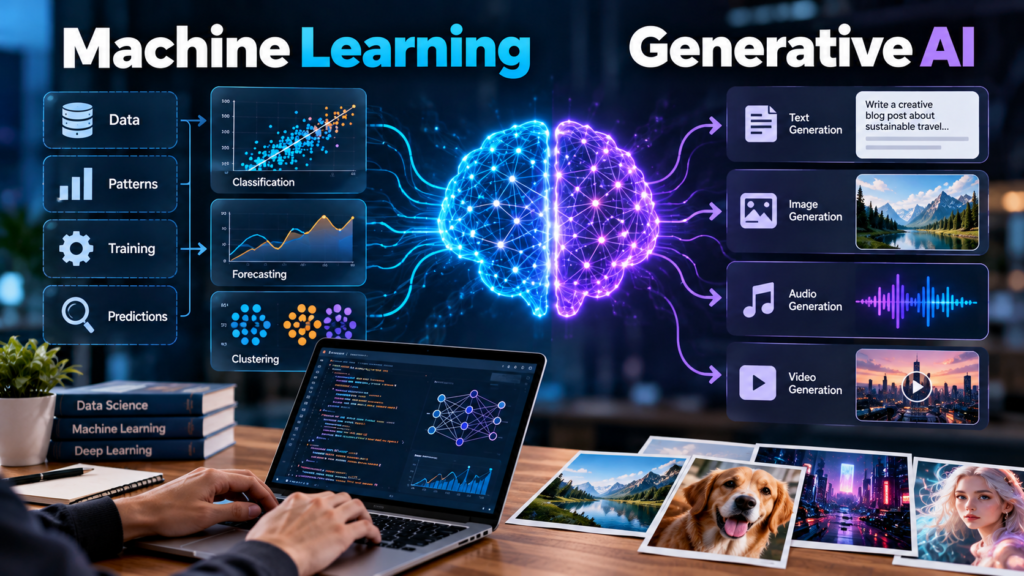
Generative AI has made machine learning more visible to the public. Tools that write articles, summarize documents, generate images, or assist with programming rely on models trained to learn patterns from large datasets.
Large language models (LLMs), for example, are typically trained using deep learning to model sequences of tokens. During generation, a language model commonly predicts a distribution over possible next tokens and produces an output based on its decoding strategy.
This process helps explain why an LLM can produce fluent text without guaranteeing that every statement is true.
How the Technologies Connect
The relationship can be summarized as follows:
- Machine learning provides methods for learning patterns from data.
- Deep learning uses multilayer neural networks to learn complex representations.
- Generative AI produces new content based on learned patterns.
- Large language models are a category of models designed primarily for language-related tasks.
- Retrieval-augmented generation (RAG) connects a generative model to retrieved information, such as relevant passages from a document collection.
For example, a business could build a document assistant that searches its internal policies and passes relevant passages to a language model before generating an answer. This can make responses more closely grounded in company documents, although it does not eliminate incorrect answers.
Fine-tuning is another option. It involves further training a pretrained model on selected examples to adapt its behavior to a particular task or style. It differs from prompting, which provides instructions or context without changing the model’s learned parameters.
Machine learning is therefore the foundation of many modern AI applications, but a complete application may also require databases, search systems, software integrations, access controls, and human review.
Benefits of Machine Learning
When appropriately designed and deployed, machine learning can improve how organizations analyze information and make decisions.
Its main benefits include:
- Processing large datasets: Models can examine more records than a person could reasonably review manually.
- Finding complex patterns: Algorithms can identify relationships that are difficult to capture with simple rules.
- Automating repetitive work: Classification and prediction can reduce manual effort in suitable workflows.
- Supporting faster decisions: A model can produce predictions quickly once it has been trained and deployed.
- Personalizing experiences: Recommendation systems can adapt suggestions to individual behavior.
- Improving with new evidence: Models can be retrained or updated when useful new data becomes available.
The benefits depend on the task. Automation is not automatically an improvement if the model produces too many errors or requires more maintenance than the process it replaces.
A successful project should measure its results against a meaningful baseline. A company might compare the cost, accuracy, processing time, and error rate of a machine learning system with its existing method before deciding whether to expand its use.
Limitations, Risks, and Ethical Concerns
Machine learning systems can be useful, but their outputs should not be treated as inherently objective or correct.
Data Quality and Bias
Models learn from the examples they receive. If those examples contain errors, gaps, or historical discrimination, the model may reproduce or amplify those problems.
For example, a hiring model trained on historical decisions may learn patterns that reflect past unfairness rather than genuine job-related ability. Removing an explicitly sensitive field does not necessarily eliminate bias because other features can act as indirect proxies.
Organizations should examine their datasets, test performance across relevant groups, and establish procedures for reviewing harmful outcomes.
Overfitting and Poor Generalization
Overfitting occurs when a model learns details or noise specific to its training data instead of capturing patterns that generalize to new examples.
A model might perform extremely well on training records but poorly on future transactions. This is why separate validation and test datasets are important.
Data leakage is another risk. It occurs when information that would not legitimately be available at prediction time influences training or evaluation. Leakage can make a model appear more accurate than it really is.
Privacy and Security
Training data may contain personal information, confidential documents, or commercially sensitive records. Organizations need to consider whether data collection and use are lawful, necessary, and appropriately protected.
Security risks also include attempts to manipulate inputs, extract sensitive information, or exploit weaknesses in a deployed model.
Practical safeguards include limiting data access, minimizing unnecessary collection, testing for security weaknesses, and reviewing how information is retained and shared.
Explainability and Accountability
Some models, particularly large neural networks, are difficult to interpret in detail. Understanding why a model produced a particular prediction may require specialized analysis, and some explanations remain approximate.
This matters when decisions affect employment, lending, healthcare, or other important interests. Organizations should establish clear accountability, meaningful human oversight, and a way to challenge consequential decisions.
Model Drift and Maintenance
A model can become less reliable when real-world conditions change. Customer behavior, economic conditions, fraud patterns, and sensor characteristics may shift after deployment.
Teams should monitor relevant performance indicators and investigate changes. Retraining may help, but it should follow evaluation rather than happen automatically without checking whether the new data is suitable.
How to Start Learning Machine Learning
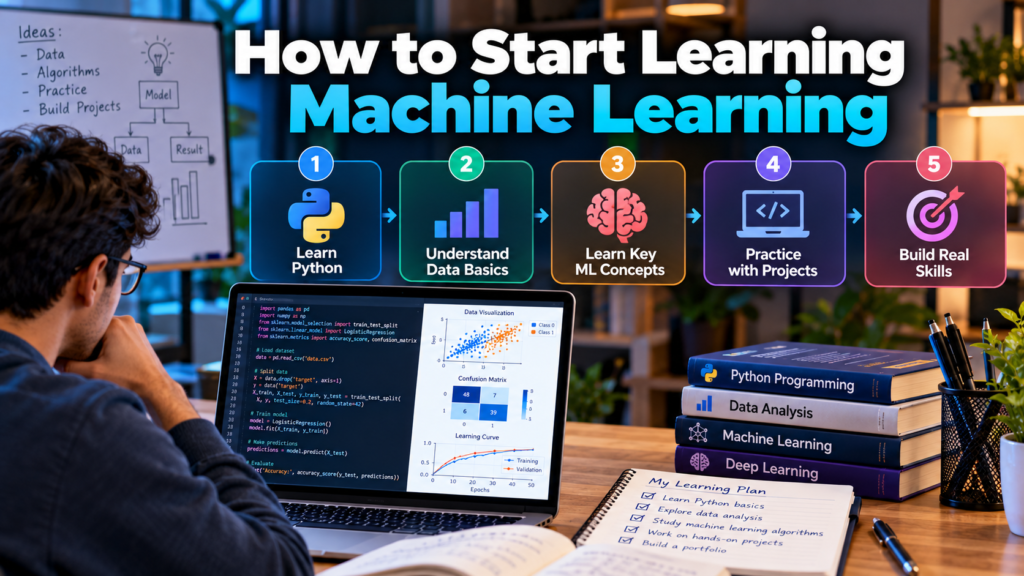
Beginners do not need to understand every algorithm before building their first model. A practical learning path starts with basic programming, introduces essential mathematical ideas, and moves toward small projects using real datasets.
Step 1: Learn Python and Basic Data Analysis
Python is widely used in machine learning because it has a large ecosystem of data and modeling libraries.
Start with variables, functions, loops, lists, dictionaries, and basic file handling. Then learn how to inspect and clean datasets using tools such as pandas and NumPy.
You should be comfortable reading a CSV file, identifying missing values, calculating simple summaries, and creating basic charts before moving to more complex projects.
Step 2: Understand the Essential Mathematics
You do not need advanced mathematics to begin experimenting, but several concepts become important as your skills develop.
Focus on:
- Statistics and probability: Understanding distributions, uncertainty, averages, and variation.
- Linear algebra: Working with vectors, matrices, and numerical representations.
- Calculus: Understanding derivatives and how optimization methods adjust model parameters.
For practical beginners’ projects, an intuitive understanding of these topics is enough to get started. Deeper mathematical knowledge becomes more useful when you study model training and optimization in detail.
Step 3: Build Your First Model
Scikit-learn is a useful Python library for learning traditional machine learning. It provides tools for preprocessing, model training, evaluation, and common algorithms.
A simple first project could classify flowers using measurements of their petals and sepals. Another option is to predict a numerical value from a small, well-documented dataset.
The important lesson is not simply achieving a high score. You should understand which data was used for training, how the model was tested, what its errors look like, and whether the result would remain useful with new examples.
Step 4: Learn Model Evaluation and Practical Deployment
Once you can train a basic model, study how to evaluate it properly.
Learn the difference between training, validation, and test data. Understand why accuracy can be misleading when one category is much more common than another. Practice using precision, recall, and confusion matrices for classification problems.
After evaluation, try saving a trained model and using it to make predictions on new inputs. A small application or API can demonstrate how a model becomes part of a working software system.
Step 5: Explore Deep Learning and Generative AI
After understanding the fundamentals, explore neural networks using a framework such as PyTorch or TensorFlow.
You can then study image classification, natural language processing, embeddings, language models, and retrieval-augmented generation. Choose a specialization based on the problems you want to solve rather than trying to learn every AI field at once.
For most beginners, a small project with carefully evaluated results is more valuable than a complicated application they cannot explain.
Common Machine Learning Misconceptions
Several misunderstandings can make machine learning appear more mysterious or more capable than it actually is.
- Machine learning is not the same as human learning. Models adjust parameters based on data and training objectives. Their processes differ from human understanding and experience.
- More data does not always mean better results. Irrelevant, inaccurate, biased, or duplicated data can reduce model quality.
- High accuracy does not guarantee usefulness. The costs of false positives and false negatives may matter more than a single performance score.
- Every machine learning model does not need deep learning. Simpler methods may be more efficient, easier to explain, and better suited to a particular dataset.
- A trained model does not automatically improve by itself. Many systems need explicit retraining, updated data, and additional evaluation.
- Generative AI can make mistakes. Fluent language and convincing images do not guarantee factual accuracy or reliable reasoning.
Understanding these distinctions helps businesses choose suitable technology and helps beginners evaluate claims about AI more critically.
Frequently Asked Questions
What is machine learning in simple words?
Machine learning is a type of AI that allows computers to learn patterns from data and use them to make predictions or perform tasks.
What are the four main types of machine learning?
The commonly taught categories are supervised learning, unsupervised learning, semi-supervised learning, and reinforcement learning.
Is machine learning the same as AI?
No. Artificial intelligence is the broader field, while machine learning is one approach used to build AI systems.
Is machine learning difficult to learn?
Beginners can start with basic Python and small datasets. More advanced work requires a stronger understanding of statistics, algorithms, and model evaluation.
Which programming language is best for machine learning?
Python is a popular starting point because of its libraries, documentation, and broad use in data science and AI development.
Does machine learning require a large amount of data?
Not always. Some traditional models work well with relatively small datasets, while complex deep learning systems may benefit from much larger amounts of data.
Will machine learning replace human jobs?
Its impact varies by occupation and task. It can automate some activities, change others, and create demand for new skills, but its effects depend on how organizations adopt the technology.
Conclusion
Machine learning has become an important part of modern computing because it allows systems to identify patterns in data and apply them to practical problems. Its applications range from fraud detection and demand forecasting to medical research, recommendation systems, and generative AI.
However, useful results require more than choosing an algorithm. Data quality, appropriate evaluation, privacy, fairness, and ongoing monitoring all influence whether a model performs reliably outside a training environment.
For beginners, the most effective starting point is to learn Python, understand basic statistics, and build small projects that solve clearly defined problems. For businesses, the priority should be identifying a genuine need and testing whether machine learning performs better than an existing approach.
The central lesson is simple: machine learning is a powerful tool for making data-driven predictions, but its value depends on how carefully it is developed, evaluated, and used.







1 comment on “Machine Learning: How It Works, Types and Uses”