


Claude Sonnet 4.6 is an advanced AI model from Anthropic, designed for coding, reasoning, computer use, writing, research, and professional work. It launched on February 17, 2026, as a major upgrade to Sonnet 4.5. The model introduced stronger instruction following, improved coding performance, better long-context reasoning, and enhanced agent planning. It also supports a 1-million-token context window in supported environments.
For everyday users, Claude Sonnet 4.6 can help with writing, analysis, document work, research, and creative tasks. Developers can use it for code generation, debugging, code review, and larger software projects. This guide explains what Claude Sonnet 4.6 offers, how it works, where it fits today, and what users should know before choosing it.
What Is Claude Sonnet 4.6?
Claude Sonnet 4.6 is a hybrid reasoning AI model developed by Anthropic. It belongs to the Sonnet family, which is positioned between Anthropic’s lighter and more powerful model options. The model was built to provide strong intelligence while remaining practical for high-volume work. It was designed with improvements across coding, computer use, long-context reasoning, agent planning, knowledge work, and design.
The main idea behind Claude Sonnet 4.6 is balance. Users can get advanced reasoning without always needing Anthropic’s most expensive model. It can handle simple requests while also working through complicated tasks when deeper reasoning is useful. This makes it suitable for developers, students, writers, researchers, businesses, and people who need an AI assistant for demanding everyday work.
Claude Sonnet 4.6 Key Features
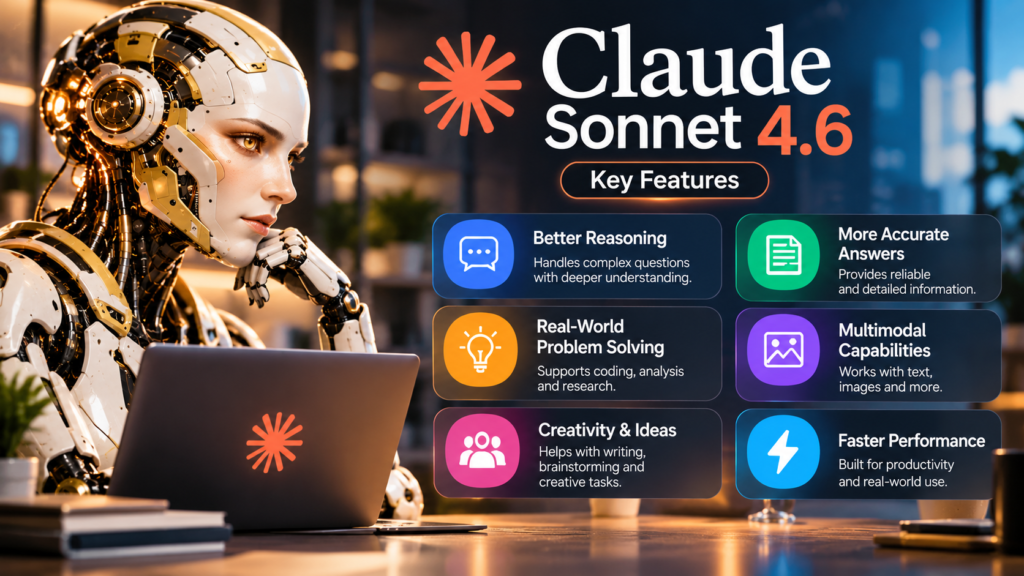
One of the biggest features of Claude Sonnet 4.6 is its large context capability. The model introduced a 1-million-token context window in supported environments, allowing it to process very large amounts of information. This can be useful when working with long documents, large codebases, research material, or several related files at once.
The model also focuses heavily on coding and agentic work. It offers improvements in consistency, instruction following, and long-running tasks compared with earlier Sonnet models. Its abilities also extend beyond coding into office work, document creation, research, analysis, design, and computer interaction. This makes the model useful across many different types of digital work.
Feature Chart
| Feature | Claude Sonnet 4.6 |
|---|---|
| Model type | Hybrid reasoning model |
| Release date | February 17, 2026 |
| Context window | Up to 1M tokens in supported environments |
| Main strengths | Coding, reasoning, agents, knowledge work |
| Inputs | Text and images |
| API access | Available |
| Computer use | Supported |
| Coding | Strong |
| Long documents | Strong |
| Agent planning | Improved |
This feature chart shows why Claude Sonnet 4.6 became important when it launched. Its design was not limited to ordinary chatbot conversations. Instead, it was created for tasks where an AI needs to understand information, follow instructions, use tools, and continue working through several steps.
For example, a developer could provide a large software project and ask the model to identify related problems. A researcher could provide multiple documents and request a structured summary. A business user could ask it to analyze information and prepare a report. The value comes from combining reasoning, context handling, and practical task execution rather than relying on one isolated feature.
Claude Sonnet 4.6 for Coding
Coding is one of the strongest areas for Claude Sonnet 4.6. The model was developed with improvements in code generation, debugging, instruction following, and working across larger codebases. These improvements can make it useful for both simple programming questions and more complicated development projects.
This makes Claude Sonnet 4.6 useful for both beginners and experienced developers. A beginner can ask for an explanation of unfamiliar code, while an experienced developer can use it for debugging or implementing changes. However, AI-generated code should still be reviewed carefully. Developers should test changes, inspect dependencies, check security issues, and verify that the final solution works as intended.
Claude Sonnet 4.6 for Large Projects
Large projects are where the model’s context capabilities can become especially useful. A bigger context window can allow an AI system to consider more project information at once instead of repeatedly receiving smaller pieces. This can help when working with entire codebases, lengthy documents, contracts, or research papers.
However, a large context window does not automatically make every answer perfect. The quality of the result still depends on the instructions, source material, task complexity, and tools being used. Users should provide clear goals and relevant information. For software work, it is also better to divide major changes into manageable steps and test every important modification before moving forward.
Claude Sonnet 4.6 for Writing and Research
It can also be useful for writing, editing, summarizing, brainstorming, and research. Its long-context abilities can help when a task involves large documents or multiple sources. Users can ask it to organize complicated information into simpler explanations, create outlines, compare ideas, or turn rough notes into polished content.
For research, users should remember that an AI model is not automatically a perfect source of current information. AI systems can have knowledge limitations, and information can change after a model’s training period. For important claims, users should verify facts with reliable and current sources. This is especially important for legal, financial, medical, political, or rapidly changing information.
Claude Sonnet 4.6 Context Window Explained
The context window describes how much information an AI model can consider within a request or working interaction. Claude Sonnet 4.6 introduced a 1-million-token context window in supported environments. This can allow users to work with substantially larger amounts of information than models with smaller context limits.
A larger context window can be valuable because users do not always need to split huge projects into many separate conversations. Imagine reviewing a long contract, studying a collection of research papers, or working through a substantial software repository. Having more relevant information available at once can improve continuity. Still, users should avoid adding unnecessary material because focused prompts often produce clearer and more useful results.
Claude Sonnet 4.6 vs Other Claude Models
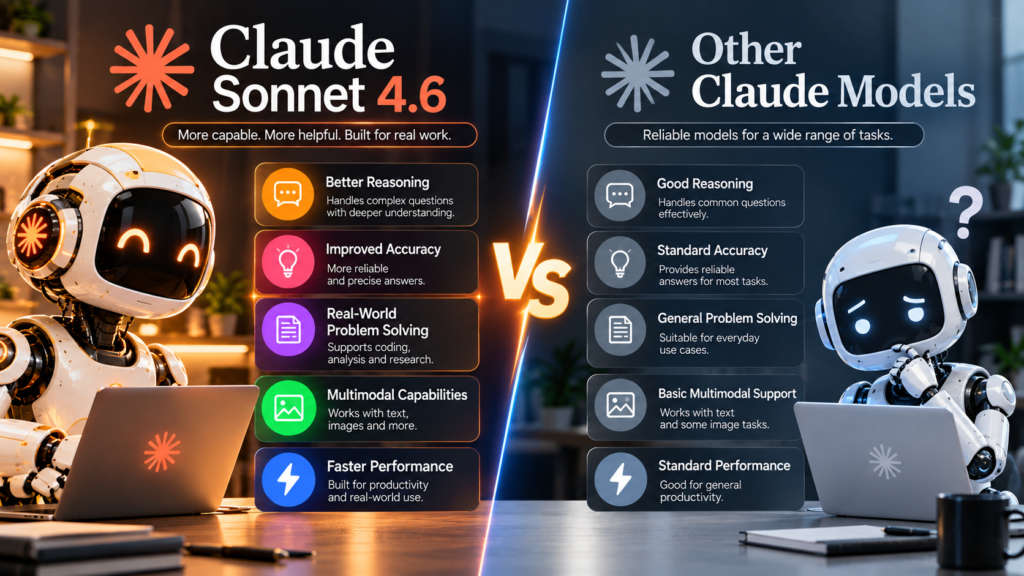
Claude Sonnet 4.6 was designed as a balance between capability, speed, and practical cost. It was positioned as a model capable of handling many demanding tasks without always requiring the highest-end Claude model. This made it attractive for users who wanted advanced AI performance while maintaining reasonable costs.
It is also important to understand the model’s position today. Anthropic has since introduced newer Claude models, so Claude Sonnet 4.6 should not automatically be considered the newest Sonnet model. Its importance remains relevant because it introduced meaningful improvements and provides useful context for understanding the development of Anthropic’s AI model family.
Simple Model Comparison Chart
| Model | Best suited for |
|---|---|
| Claude Sonnet 4.6 | Coding, agents, research, general work |
| Claude Opus 4.6 | Deep reasoning and complex tasks |
| Newer Sonnet models | Current general-purpose workloads |
| Claude Haiku models | Lighter and faster tasks |
The best model depends on the actual job rather than the model name alone. Someone writing emails may not need the most powerful option. A developer working with a complicated application may benefit from stronger reasoning and longer context. A business team handling many routine tasks may prioritize speed and cost. Comparing models by workload usually gives a better result than simply choosing the newest or most expensive model.
Claude Sonnet 4.6 Price and Availability
When Claude Sonnet 4.6 launched, its API pricing started at $3 per million input tokens and $15 per million output tokens. It was also introduced as a default model for certain Claude users at launch. Pricing and availability can change over time, however, especially as newer models become available.
Claude Sonnet 4.6 was made available through Anthropic’s API and major cloud platforms. Developers can access Claude models through different services depending on their technical requirements. Before building a new application, users should check the current pricing, model availability, usage limits, and platform requirements because these details can change.
Who Should Use Claude Sonnet 4.6?
It can be a strong choice for people who need more than basic chatbot answers. Developers can use it for coding and debugging. Writers can use it for drafting and editing. Researchers can use it for organizing large amounts of information. Businesses can use it for document analysis, knowledge work, and workflow automation.
It may be especially useful when a task requires several connected steps. For example, a user could provide project requirements, ask for an implementation plan, request code, review the result, and then ask for improvements. Its agent planning and instruction-following abilities make it useful for multi-step workflows. Users should still supervise important tasks and verify critical outputs.
How to Get Better Results From Claude Sonnet 4.6
The easiest way to improve results is to give clear instructions. Instead of asking, “Fix this,” explain what is wrong, what the desired result should be, and what limitations the solution must follow. For coding, include the relevant error, expected behavior, environment, and existing constraints. For writing, specify the audience, tone, structure, and purpose. Clear prompts reduce unnecessary back-and-forth.
It also helps to provide information in an organized way. Put the main goal first, then add background details and specific requirements. Ask the model to identify uncertainty instead of guessing. For important work, review the response before using it. You can also explore related topics such as AI coding tools, Claude AI features, and generative AI tools to understand where this model fits within a wider AI workflow.
Is Claude Sonnet 4.6 Still Worth Using?
Claude Sonnet 4.6 remains an interesting model for users who want strong reasoning, coding, long-context processing, and agent capabilities. Its release represented a meaningful improvement over previous Sonnet models, especially in areas such as coding, instruction following, computer use, and long-running tasks.
However, choosing it in 2026 requires some context because Anthropic has introduced newer models. The best choice depends on current availability, pricing, performance requirements, and the platform being used. If your application already works well with Sonnet 4.6, there may be little reason to change immediately. For a new project, compare current models first and choose based on actual testing.
Frequently Asked Questions
What is Claude Sonnet 4.6?
Claude Sonnet 4.6 is an Anthropic AI model released in February 2026. It was designed for coding, reasoning, computer use, research, writing, agent planning, and professional tasks. It also introduced a 1-million-token context window in supported environments, making it suitable for large documents and complex projects.
Is It good for coding?
Yes. Coding was one of the major focus areas of Claude Sonnet 4.6. Developers can use it for generating code, finding bugs, explaining existing projects, reviewing code, and planning technical changes. However, developers should always test AI-generated code and review it for security, accuracy, and compatibility.
Does Claude Sonnet 4.6 have a 1M context window?
Yes, Claude Sonnet 4.6 supports a 1-million-token context window in supported environments. This can help users work with large codebases, lengthy documents, and extensive research material. Availability and technical limits can vary depending on the platform or API environment being used.
Is Claude Sonnet 4.6 the newest Claude model?
No. Newer Claude models have been introduced since Sonnet 4.6. Therefore, Claude Sonnet 4.6 is not necessarily the newest Sonnet model available today. However, it remains an important model because of its improvements in coding, reasoning, context handling, and agent-style tasks.
Who should use Claude Sonnet 4.6?
Claude Sonnet 4.6 is suitable for developers, writers, researchers, students, businesses, and professionals. It is particularly useful when a task requires coding, long-context analysis, structured reasoning, document work, or multiple connected steps. Users should still review important answers and verify information before relying on it.
Conclusion
Claude Sonnet 4.6 was an important step in Anthropic’s AI model development. It combined strong coding, reasoning, computer-use, agent planning, and long-context capabilities in a practical Sonnet model. Its large context capability also made it attractive for large projects and documents.
Today, newer Claude models have changed the landscape, so users should compare current options before starting a new project. Still, understanding Claude Sonnet 4.6 helps explain how modern AI models have developed toward longer context, stronger agents, and better coding performance. If you are considering an AI model for work, coding, or research, focus on your specific needs and test the model with real tasks before making a final decision.