


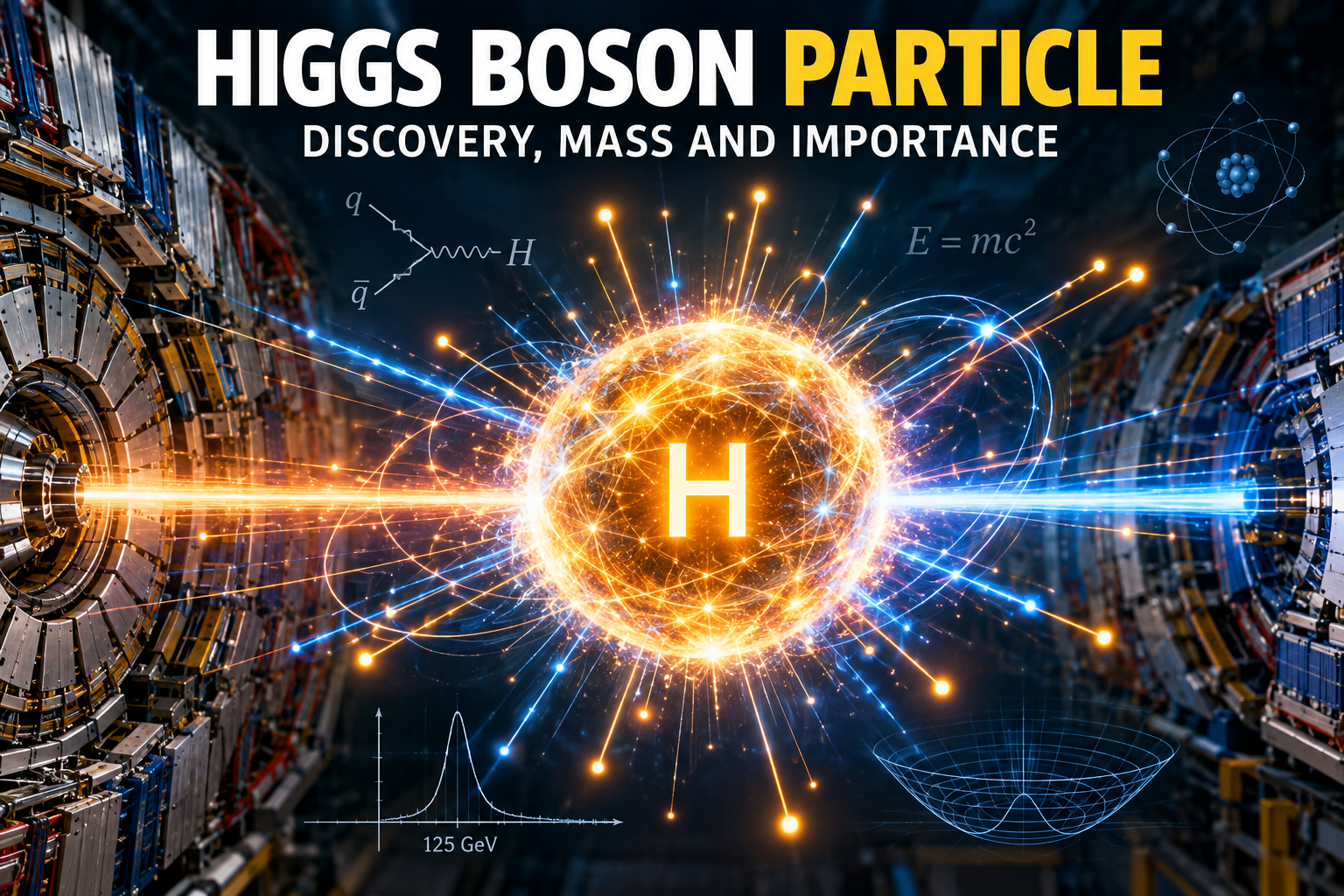
The Higgs boson particle is a fundamental particle that provides crucial evidence for how certain particles acquire mass. Scientists discovered it in 2012 at CERN using the Large Hadron Collider (LHC), following decades of theoretical research and experimental searches. The discovery confirmed a major part of the Standard Model, the theory physicists use to describe fundamental particles and their interactions.
Often called the “God particle” in popular media, the Higgs boson is not the source of all mass in the universe. It is associated with an invisible field that exists throughout space and interacts with elementary particles. Understanding this field helps explain why electrons, quarks, and W and Z bosons have mass while photons do not. This guide explores what the Higgs boson is, how it works, how scientists discovered it, and what researchers still hope to learn from it.
What Is the Higgs Boson Particle?
The Higgs boson is an elementary particle associated with the Higgs field, a quantum field that permeates space. In quantum field theory, particles are understood as excitations of underlying fields. For example, a photon is an excitation of the electromagnetic field, while the Higgs boson is an excitation of the Higgs field.
The Higgs field has a particularly important role: its interactions help explain why certain elementary particles have mass. Without the mechanism associated with this field, the Standard Model could not explain the observed masses of the W and Z bosons while maintaining a consistent description of electroweak interactions.
The Higgs boson is unusual because it has zero electric charge and zero intrinsic spin. Its mass is approximately 125 giga-electronvolts (GeV), making it much heavier than a proton, whose mass is about 0.938 GeV when expressed in equivalent energy units. The Higgs boson is extremely short-lived, decaying almost immediately after it is produced.
These properties make it difficult to observe directly. Physicists identify it by studying the particles created in its decay and checking whether their measured properties match the expected Higgs signal.
What Is the Higgs Field, and How Does It Work?
The Higgs field is more fundamental to the explanation than the Higgs boson itself. While the boson is a detectable particle produced in high-energy collisions, the field is present throughout space, including regions far from particle accelerators.
How Particles Acquire Mass
The Higgs field has a nonzero value even in its lowest-energy state, known as the vacuum state. Certain elementary particles interact with this field, and those interactions contribute to their masses.
The strength of the interaction differs between particles. In the Standard Model, this helps explain why the electron is relatively light, why the top quark is much heavier, and why the W and Z bosons have substantial masses.
The photon, by contrast, does not acquire mass through the Higgs mechanism. It remains massless, which is consistent with the long range of electromagnetic interactions.
A Simple Analogy
Imagine moving through a room filled with an invisible medium. Different objects respond to that medium in different ways. Some interact strongly, while others interact weakly or not at all.
This analogy helps illustrate the idea of different interaction strengths, but it should not be taken literally. The Higgs field is not an ordinary substance that slows particles down through friction. Particle mass arises from the field’s role in the underlying quantum theory.
The mechanism is called the Brout–Englert–Higgs mechanism, named after theorists associated with its development. It explains how the W and Z bosons can have mass without destroying the consistency of electroweak theory.
Why Is the Higgs Boson Particle Important?
The Higgs boson matters because its discovery confirmed a key prediction of particle physics. Before 2012, scientists had strong theoretical reasons to believe the Higgs field existed, but they had not detected its associated particle.
Its discovery provided an experimental way to investigate the field and test whether the mechanism worked as predicted.
Three aspects make the discovery particularly significant:
- It supports the Standard Model: The discovery filled a major gap in the model’s description of elementary particles.
- It helps explain particle masses: Measurements of Higgs interactions allow scientists to test how elementary particles acquire mass.
- It opens new research questions: Small deviations from predicted Higgs properties could point toward physics beyond the Standard Model.
However, discovering the Higgs boson did not solve every mystery in physics. The Standard Model does not fully explain dark matter, dark energy, or why neutrinos have the small masses that experiments have established. The Higgs discovery strengthened an important theory, but it did not make that theory complete.
How Was the Higgs Boson Discovered?
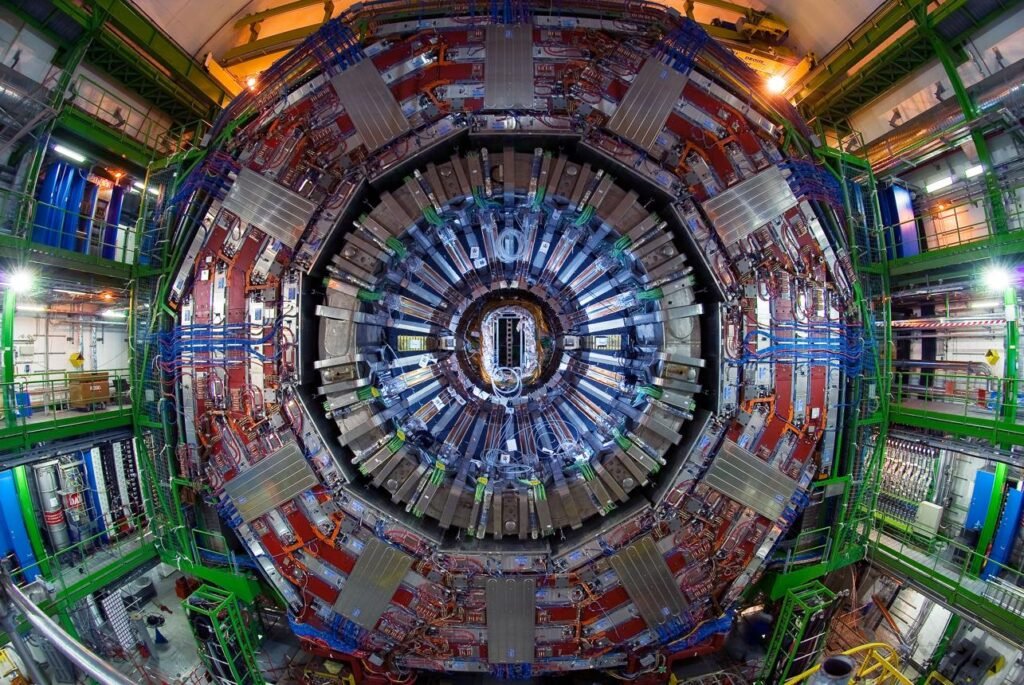
The Higgs boson was discovered at CERN, the European Organization for Nuclear Research, near Geneva, Switzerland. The announcement came on July 4, 2012, when the ATLAS and CMS experimental collaborations independently reported evidence for a new particle consistent with the Higgs boson.
The Role of the Large Hadron Collider
The Large Hadron Collider is a particle accelerator that sends protons around a circular underground tunnel and brings them into high-energy collisions. These collisions can convert energy into new particles, following Einstein’s mass-energy relationship.
The Higgs boson is produced only rarely in these collisions. Even when one is created, it survives for an extraordinarily short time before decaying into other particles. Researchers cannot simply photograph a Higgs boson or collect one in a container.
Instead, the ATLAS and CMS detectors measure the particles emerging from collisions. Scientists reconstruct possible decay events and compare the results with predictions for known processes and for a Higgs particle.
How Researchers Identified the Signal
The discovery depended on combining enormous amounts of collision data with statistical analysis.
The teams examined several possible Higgs decay channels, including:
- Two photons.
- Two Z bosons, which can subsequently produce four charged leptons.
- Two W bosons.
- A bottom quark and an antibottom quark.
- A tau lepton and an antitau lepton.
Some channels are easier to distinguish from background processes than others. The diphoton and four-lepton channels were especially useful for measuring the candidate particle’s mass.
By reconstructing the energies and momenta of the decay products, physicists calculated their combined invariant mass. Events associated with the Higgs boson produced an excess near 125 GeV in the relevant mass distributions.
What Did Five Sigma Mean?
Both collaborations reached the conventional five-sigma threshold for discovery. In statistical terms, this corresponds to a probability of roughly one in 3.5 million for a background-only fluctuation at least as extreme as the observed excess, under the assumptions of the statistical test.
This was powerful evidence that the signal was not simply a random fluctuation. Subsequent experiments have continued to measure the new particle’s properties and test whether they agree with the Standard Model Higgs boson.
What Is the Mass of the Higgs Boson?
The Higgs boson has a mass of approximately 125 GeV/c², commonly shortened to 125 GeV in particle physics. This corresponds to about 133 times the proton’s mass.
Mass is often discussed in energy units in high-energy physics because mass and energy are related by Einstein’s equation, E = mc².
The Higgs boson’s mass is important for several reasons. It determines the energy scale associated with producing the particle and influences its possible decay processes. Its measured value also plays a role in theoretical studies of the stability of the Higgs field’s vacuum state.
| Property | Higgs Boson |
|---|---|
| Particle type | Elementary boson |
| Approximate mass | 125 GeV/c² |
| Electric charge | 0 |
| Spin | 0 |
| Associated field | Higgs field |
| Discovery announced | July 4, 2012 |
| Discovery experiments | ATLAS and CMS |
| Research facility | Large Hadron Collider at CERN |
The mass value is not simply a label attached to the particle. It is a measurable property that researchers use to test theoretical predictions and look for differences between the observed particle and possible alternatives.
Does the Higgs Boson Give Everything in the Universe Its Mass?
No. This is one of the most common misunderstandings about the Higgs boson.
The Higgs mechanism explains how elementary particles such as electrons and quarks acquire mass, as well as the masses of the W and Z bosons. However, most of the mass of ordinary matter comes from a different source.
Where Does the Mass of Ordinary Matter Come From?
Protons and neutrons are made of quarks held together by the strong nuclear interaction, which is described by quantum chromodynamics (QCD).
The masses of their constituent quarks account for only a small fraction of a proton’s or neutron’s total mass. Much of the remaining mass arises from the energy of the strong interaction, including the motion of quarks and the energy associated with the gluon fields binding them together.
Since protons and neutrons make up atomic nuclei, this strong-interaction energy accounts for most of the mass of everyday objects.
The Higgs field still matters because it contributes to the masses of the quarks and electrons that make up matter. However, it is misleading to say that the Higgs boson directly creates the mass of everything around us.
The Important Distinction
- Higgs mechanism: Explains the origin of elementary particle masses within the Standard Model.
- Strong nuclear interaction: Accounts for most of the mass of protons and neutrons.
- Higgs boson: The particle associated with the Higgs field, allowing scientists to study the mechanism experimentally.
Understanding this distinction gives a more accurate picture of how matter acquires its mass.
What Are the Main Properties of the Higgs Boson?
Physicists have studied several characteristics of the Higgs boson since its discovery. These measurements help determine whether the particle behaves as predicted by the Standard Model.
Spin and Electric Charge
The Higgs boson has spin zero, making it a scalar particle. This distinguishes it from particles such as photons, which have spin one. It also has no electric charge.
These characteristics are important because they constrain how the particle can be produced, how it decays, and how it interacts with other particles.
Interactions With Other Particles
In the Standard Model, the strength of the Higgs boson’s interaction with a particle is related to that particle’s mass. More massive elementary particles generally have stronger Higgs interactions.
Researchers test this relationship by measuring how often Higgs bosons are produced and how frequently they decay through different channels. These measurements require large datasets because the particle is rare and many decay products can also arise from ordinary background processes.
Extremely Short Lifetime
The Higgs boson has a lifetime of approximately 10⁻²² seconds. It decays too quickly to travel through a detector as an identifiable particle.
Instead, experiments measure its decay products. This is a general feature of unstable particles in high-energy physics: their existence and properties are reconstructed from observable outcomes rather than direct visual observation.
How Do Scientists Use the Higgs Boson in Modern Research?
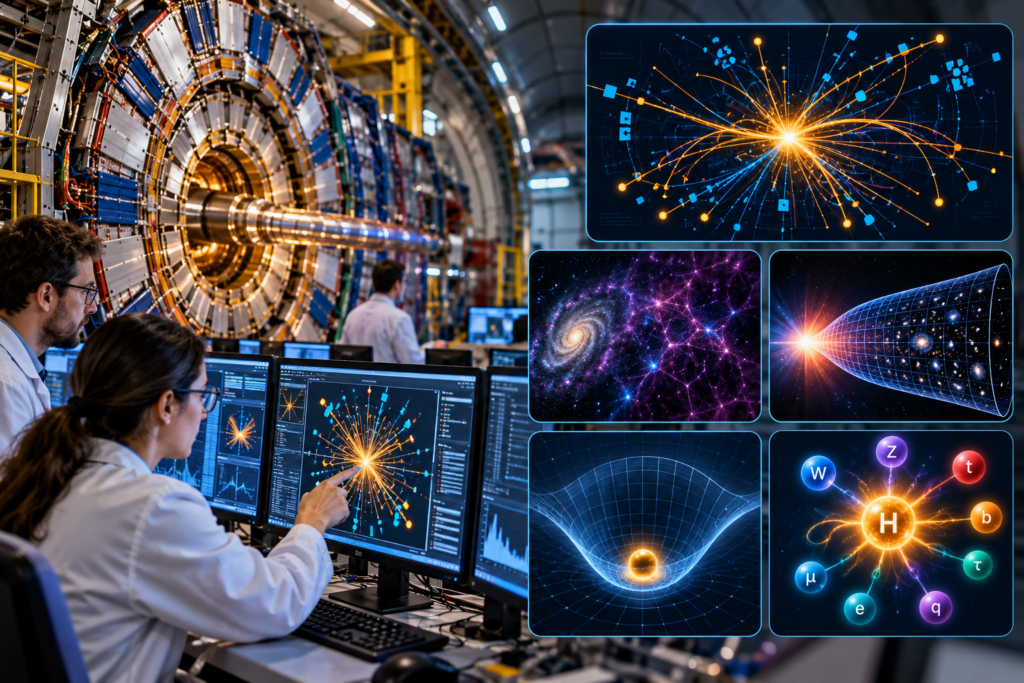
The Higgs boson is not a practical technology used in everyday products. Its value lies in fundamental research, where scientists use it to test the laws governing matter and energy.
Several important research areas depend on increasingly precise Higgs measurements.
Testing the Standard Model
Scientists compare measured Higgs production rates and decay probabilities with theoretical predictions. If reliable measurements reveal a significant discrepancy, it could indicate that the Standard Model is incomplete or that additional particles or interactions exist.
So far, measurements have broadly supported the Standard Model, although continued precision studies are needed to test its predictions more thoroughly.
Investigating Dark Matter
Dark matter makes up a substantial portion of the universe’s matter, but scientists do not yet know what it is made of. Some theoretical models propose that dark matter could interact with the Higgs field or that Higgs bosons could decay into invisible particles.
Experiments search for such possibilities by examining events in which the visible particles appear to carry away less momentum than expected. These searches are indirect tests of possible new physics; they do not establish that the Higgs boson is itself dark matter.
Studying the Early Universe
The Higgs field is relevant to theories describing the early universe, particularly the electroweak phase transition. Scientists investigate whether the field’s behavior in the early universe could help explain why matter exists in greater abundance than antimatter.
The observed Higgs boson, by itself, does not resolve the matter-antimatter imbalance. Researchers need additional evidence to determine whether new particles or interactions played a role.
Understanding the Higgs Field’s Stability
The measured Higgs mass and the mass of the top quark are important inputs in calculations of the Higgs field’s long-term stability. Under commonly used Standard Model assumptions, these measurements suggest that our vacuum may be metastable rather than absolutely stable.
This is a theoretical result, not a prediction that the universe will collapse soon. The relevant timescales, assumptions and uncertainties make vacuum stability a subject of fundamental research rather than an immediate physical danger.
What Are the Limitations of Higgs Boson Research?
Despite the discovery’s importance, studying the Higgs boson remains challenging.
The particle is rare. Only a small fraction of high-energy collisions produce Higgs bosons. Researchers need large amounts of collision data to measure its properties precisely.
Background events complicate measurements. Many ordinary particle interactions produce the same final-state particles as Higgs decays. Scientists must distinguish the Higgs signal from these competing processes using statistical methods.
Some interactions are difficult to measure. The Higgs boson’s interaction with lighter particles and its possible self-interaction can be particularly challenging to study. The self-interaction is important because it provides information about the shape of the Higgs field’s potential.
The discovery does not explain every mystery. Finding the Higgs boson confirmed a major prediction, but it did not identify dark matter, explain dark energy, or provide a complete theory of quantum gravity.
These limitations are not failures of the discovery. They define the questions researchers are now trying to answer with better detectors, more collision data and improved theoretical calculations.
What Is the Future of Higgs Boson Research?
Future research will focus less on proving that the Higgs boson exists and more on determining exactly how it behaves.
The Large Hadron Collider continues to provide data for increasingly precise measurements. Researchers are examining the particle’s interactions with different types of matter, its production mechanisms, and rare decay processes that could reveal departures from established predictions.
One major goal is to measure Higgs boson self-coupling. This interaction is related to the Higgs field’s potential and the way the field behaves around its lowest-energy state. Measuring it accurately would provide an important test of the Standard Model’s description of electroweak symmetry breaking.
Scientists are also exploring proposals for future particle colliders that could produce large numbers of Higgs bosons or measure their properties with greater precision. These proposals involve different technologies, costs and scientific objectives; they should not be confused with already completed or guaranteed projects.
The central question is whether precision measurements will continue to match the Standard Model or reveal small but meaningful differences. Even a modest discrepancy, if confirmed independently, could provide a valuable clue to physics beyond the current theory.
Frequently Asked Questions About the Higgs Boson Particle
1. What is the Higgs boson particle in simple words?
The Higgs boson is a fundamental particle associated with the Higgs field, which helps explain why certain elementary particles have mass.
2. Who discovered the Higgs boson?
The ATLAS and CMS collaborations at CERN announced its discovery on July 4, 2012. The theoretical mechanism was developed by several physicists, including Peter Higgs and François Englert.
3. Why is the Higgs boson called the God particle?
The phrase became popular through science communication and media coverage. It is not an official scientific name, and it does not mean that the particle has a religious or supernatural role.
4. What is the mass of the Higgs boson?
Its mass is approximately 125 GeV/c², or about 133 times the mass of a proton.
5. Does the Higgs boson create all mass?
No. It is associated with the mechanism that gives mass to certain elementary particles. Most of the mass of protons and neutrons comes from energy associated with the strong nuclear interaction.
6. Can scientists see a Higgs boson directly?
No. It decays almost immediately after production. Scientists identify it by measuring its decay products and reconstructing the properties of the original particle.
7. Why is the Higgs boson important?
It confirms a major part of the Standard Model and allows scientists to investigate the origin of elementary particle masses, test fundamental physics, and search for evidence of new particles or interactions.
Conclusion
The Higgs boson particle represents a major achievement in modern physics because its discovery confirmed the existence of the Higgs field and provided crucial evidence for the mechanism behind elementary particle masses. Announced at CERN in 2012, the discovery was the result of decades of theoretical development, sophisticated particle detectors and careful statistical analysis.
Its importance extends beyond identifying a previously unknown particle. By measuring how the Higgs boson interacts with other particles, researchers can test the Standard Model and investigate possible clues to physics that the model cannot yet explain. The distinction between elementary particle mass and the mass generated by the strong nuclear interaction is equally important for understanding ordinary matter.
The next stage of Higgs research is about precision: determining whether its properties match theoretical predictions in every detail. Those measurements may deepen our understanding of the universe and help reveal where current physics needs to go further.









1 comment on “Higgs Boson Particle: A Complete Guide to the God Particle”