


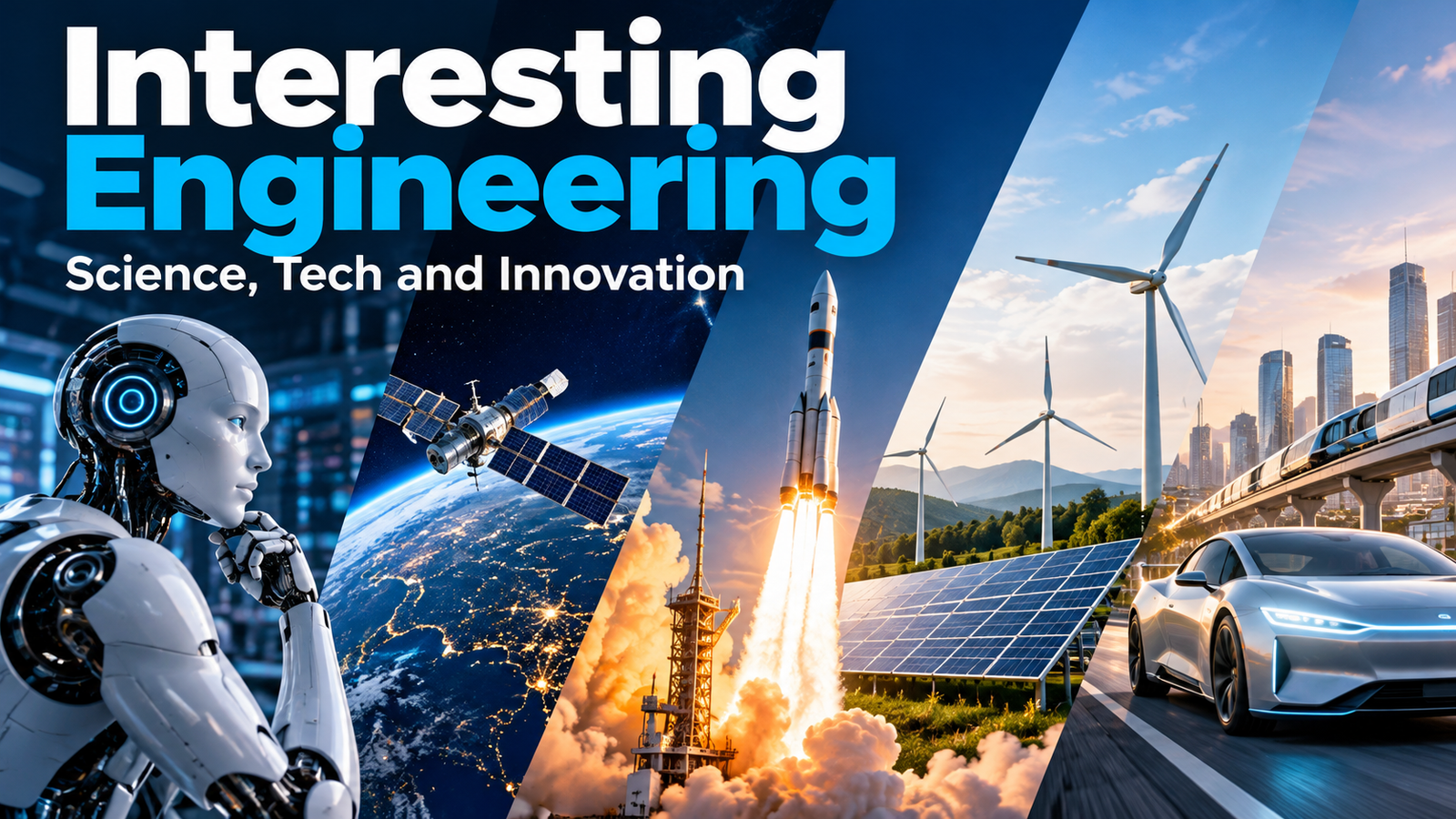
Interesting Engineering is a digital science and technology publication that explains scientific discoveries, engineering breakthroughs, and technological developments for a broad audience. Its coverage includes artificial intelligence (AI), robotics, space exploration, energy, transportation, military technology, and emerging innovations. Rather than simply reporting that something new has been developed, the publication aims to explain how technologies work and why they matter.
Founded in 2011, Interesting Engineering has grown from a blog into a broader digital media platform offering articles, videos, newsletters, podcasts, and other educational content. It serves engineers, students, technology professionals, researchers, and curious readers who want to understand the science behind modern inventions. Whether you are following developments in generative AI, learning about advanced spacecraft, or exploring renewable energy systems, Interesting Engineering provides an accessible starting point for discovering new ideas and understanding their practical significance.
What Is Interesting Engineering?
Interesting Engineering is an online publication focused on science, engineering, technology, and innovation. Its central purpose is to make complex technical developments easier to understand without reducing every subject to a simple headline.
The publication covers both established engineering disciplines and emerging technologies. Readers can explore subjects ranging from mechanical systems and industrial automation to artificial intelligence, quantum computing, and space missions.
Its content is particularly useful for people who want a general understanding of technical developments without necessarily reading academic research papers or specialist engineering journals.
Interesting Engineering also publishes multimedia content, including videos and podcasts. These formats allow readers to explore a subject through explanations, demonstrations, interviews, and visual storytelling.

The History and Background of Interesting Engineering
Interesting Engineering was founded in 2011 by Hüseyin Kılıç. It initially operated as a blog covering science and technology before developing into a larger digital publishing platform.
Its parent media organization, IE Media, has expanded beyond the original publication to include other brands covering subjects such as military technology, practical engineering, and food-related content. This broader structure reflects a strategy of serving different audiences through specialized media brands.
The publication’s development also reflects a wider change in how people consume technical information. Scientific and engineering developments are no longer discussed exclusively in academic journals, university classrooms, or specialist magazines. Digital publications make these subjects accessible to people who may have an interest in technology without having formal technical training.
However, accessibility should not be confused with academic authority. A general technology article can help readers understand a new development, but a detailed engineering decision may still require original research, technical documentation, or advice from a qualified professional.
What Topics Does Interesting Engineering Cover?
Interesting Engineering covers several major areas of science and technology. Each offers a different way to understand how research and engineering affect everyday life, industry, and future development.
Artificial Intelligence and Robotics
AI and robotics are important areas of modern engineering because they combine software, computing, electronics, sensors, and physical systems.
Coverage in this field may include autonomous robots, machine learning, industrial automation, humanoid machines, and advances in computer hardware. Readers can learn how machines process information, respond to their surroundings, and perform tasks that previously required direct human control.
For example, a robot that sorts objects must do more than move its mechanical arms. It may need cameras to identify objects, software to interpret visual information, sensors to estimate position, and control systems to coordinate movement.
Generative AI introduces another dimension. Large language models can produce text, summarize documents, and assist with programming, while multimodal models can process combinations of text, images, audio, or other supported inputs.
These technologies have different capabilities and limitations. An AI system that performs well in a controlled demonstration may still struggle with unfamiliar environments, unreliable inputs, or tasks requiring precise physical judgment.
Space Exploration and Astronomy
Space engineering involves some of the most demanding technical challenges in science. Spacecraft, satellites, launch vehicles, and robotic exploration systems must operate under conditions that are difficult or impossible to reproduce on Earth.
Interesting Engineering covers space-related developments that help readers understand these challenges.
Relevant subjects include:
- Rocket propulsion and spacecraft design.
- Satellite communication and Earth observation.
- Planetary exploration and robotic missions.
- Space telescopes and astronomical discoveries.
- Reusable launch systems and future space infrastructure.
Consider a spacecraft travelling to another planet. Engineers must account for propulsion, fuel consumption, navigation, communication delays, radiation exposure, temperature changes, and the reliability of equipment that cannot easily be repaired.
A news report about a successful mission becomes much more informative when readers understand these constraints. It explains not only what happened but also why the achievement required careful engineering.
Energy and Environmental Technology
Energy engineering is another important field because electricity generation, storage, distribution, and consumption influence nearly every modern industry.
Coverage in this area may include solar power, wind energy, battery technology, nuclear power, hydrogen production, and improvements to electrical infrastructure.
These technologies often involve trade-offs that headlines cannot fully explain. Solar panels, for instance, generate electricity when sufficient sunlight reaches them, but their output varies with weather and time of day. Energy storage, grid connections, and demand management can help address that variability.
Similarly, hydrogen is not automatically a clean fuel. Its environmental impact depends substantially on how it is produced and on the energy sources used in the process.
Readers should look for details such as efficiency, operating conditions, lifecycle emissions, material requirements, and commercial readiness when evaluating claims about new energy technologies.
Transportation and Automotive Engineering
Transportation engineering covers the design and operation of systems that move people and goods. Interesting Engineering’s broad technology coverage includes developments involving vehicles, aviation, industrial transport, and other mobility systems.
Electric vehicles illustrate how several engineering disciplines interact. Battery chemistry affects energy storage, power electronics control electricity flow, electric motors produce motion, and thermal management helps keep components within suitable operating temperatures.
Autonomous vehicles add sensors, computer vision, machine learning, mapping, and real-time decision-making.
Understanding these relationships helps readers evaluate claims about faster vehicles, longer battery range, safer automated systems, or more efficient transportation. A new component may improve one aspect of performance without solving every challenge facing the overall system.
Science, Materials, and Industrial Innovation
Engineering progress often depends on discoveries that receive less attention than major consumer technologies.
Materials science, manufacturing, electronics, and industrial design can produce improvements that influence numerous sectors. A stronger material may reduce structural weight, while a more efficient manufacturing process can lower energy consumption or reduce waste.
Industrial innovation also includes automation, precision manufacturing, digital twins, and advanced inspection systems.
A digital twin, for example, is a digital representation of a physical object, process, or system. Depending on its design and data inputs, it can help engineers examine operating conditions, test scenarios, and identify potential problems before making changes to real equipment.
These applications demonstrate why engineering news is relevant beyond laboratories. Technical improvements can affect production costs, product reliability, maintenance schedules, and resource consumption.
How Does Interesting Engineering Present Technical Information?
The publication uses digital journalism and multimedia formats to make science and engineering more accessible. Its editorial approach emphasizes explaining the mechanisms behind scientific breakthroughs and technological developments, rather than reporting announcements alone.
Several content formats serve different purposes.
News articles provide updates about discoveries, product developments, research, and engineering projects. They are useful for understanding what has happened and identifying the organizations involved.
Explanatory features offer additional context about technical concepts, systems, and the implications of new developments.
Videos can make physical processes easier to understand by showing machinery, experiments, prototypes, and demonstrations.
Podcasts provide longer discussions through interviews and conversations about engineering, science, and technology.
Newsletters help readers discover new content without having to visit the website repeatedly.
The format matters because different subjects benefit from different explanations. A video may be ideal for understanding a robot’s movements, while a detailed article may be better for examining the trade-offs in a battery design.
Nevertheless, presentation quality does not establish technical accuracy by itself. Readers should still consider the underlying evidence, the source of the claims, and whether the article distinguishes demonstrated results from future ambitions.
Is Interesting Engineering a Reliable Source?
Interesting Engineering can be a useful starting point for learning about science, technology, and engineering developments. However, its reliability should be assessed at the article level rather than assumed for every item published on the website.
A well-supported article should explain what happened, identify the researchers or organizations involved when relevant, and provide enough context to help readers understand the significance of the development.
When evaluating a technical story, consider the following factors.
- Original evidence: Does the article identify a scientific paper, official announcement, technical report, or other primary source?
- Clear attribution: Are claims attributed to the researchers, company, institution, or government agency responsible for them?
- Appropriate context: Does the report explain important limitations, experimental conditions, or uncertainties?
- Independent confirmation: Have other credible publications or researchers reported similar findings?
- Realistic conclusions: Does the evidence support the headline, or does the headline imply more than the research demonstrates?
This last point is particularly important for emerging technologies. A prototype that works under laboratory conditions is not necessarily a commercially viable product. A successful demonstration does not prove that a system will perform equally well in every environment.
For academic assignments, engineering projects, or professional decisions, readers should consult original research papers, official technical documentation, relevant standards, and specialist sources where appropriate.
Interesting Engineering is best treated as an accessible source of news and explanations, with further verification when the subject requires technical precision.
Who Should Read Interesting Engineering?
The publication can serve several audiences, although the amount of technical detail each reader needs will differ.
| Reader | How the publication can help |
|---|---|
| Students | Explore engineering disciplines, scientific discoveries, and possible study interests. |
| Engineers | Follow developments across fields beyond their own specialization. |
| Technology professionals | Discover emerging technologies and understand broader industry developments. |
| Researchers | Identify topics, organizations, and studies that may warrant further investigation. |
| Science enthusiasts | Learn how inventions and scientific systems work. |
| Business leaders | Monitor technological developments that may influence operations or markets. |
| Educators | Find accessible examples to introduce scientific and engineering concepts. |
For students, the publication can help identify subjects for further study, but it should not replace textbooks or course materials.
For working engineers, it offers a way to keep up with developments outside a narrow specialty. An electrical engineer, for instance, might use technology news to explore advances in battery systems or AI hardware.
Business leaders can also benefit from broad technology coverage, provided they distinguish early-stage research from technologies that are mature enough for practical deployment.
Interesting Engineering Compared With Academic Journals and Other Technology News Sources
Interesting Engineering serves a different purpose from a peer-reviewed journal or a specialist technical publication. Understanding that distinction helps readers choose the right source for each task.
| Source type | Main purpose | Best use | Important limitation |
|---|---|---|---|
| Interesting Engineering | Accessible science and technology reporting | Discovering developments and understanding their context | Not every article provides the depth of an original research paper |
| Peer-reviewed journals | Publishing and evaluating scholarly research | Examining methods, results, and scientific evidence | Articles may require specialist knowledge |
| University and research institute websites | Sharing research findings and institutional information | Checking original announcements and research context | Institutional announcements may emphasize positive results |
| Government technical agencies | Providing official data, standards, and technical information | Verifying regulations, public research, and technical guidance | Material can be specialized or narrowly focused |
| Specialist engineering publications | Covering particular disciplines or industries | Detailed professional and technical analysis | Coverage may be less accessible to general readers |
These sources are complementary rather than interchangeable.
Suppose you read about a new battery material. An article from Interesting Engineering might explain why the material matters. The original research paper could reveal the testing conditions, energy density, cycle life, and experimental limitations. An independent technical assessment could help establish whether the results are likely to translate into commercial battery production.
Using these sources together produces a more reliable understanding than relying on a headline alone.
How to Use Interesting Engineering for Research and Learning
Readers can get more value from the publication by treating each article as the beginning of an investigation rather than the final word on a subject.
1. Start With a Specific Question
Choose a subject you want to understand. Instead of browsing technology news without a clear objective, ask a focused question such as how a heat pump transfers energy, how an AI accelerator differs from a conventional processor, or why reusable rockets require specialized landing systems.
A clear question makes it easier to identify which information is relevant.
2. Identify the Main Technical Claim
Determine what the article actually reports. Is it describing a new scientific finding, a working prototype, a commercial product, a planned project, or a prediction?
These categories are not equivalent. A proposed technology may be promising without having been built or tested.
3. Follow the Original Sources
Look for references to research papers, laboratory announcements, technical specifications, and official documentation. Read the original material whenever the details affect your understanding.
Pay particular attention to sample sizes, testing environments, performance measurements, and stated limitations.
4. Compare Independent Sources
When a story involves a major scientific claim, search for independent coverage or relevant technical analysis.
Multiple articles repeating the same company announcement do not necessarily provide independent confirmation. Stronger verification comes from sources that examine the underlying evidence separately.
5. Apply What You Learn
Turn the information into something useful. Students can create study notes, engineers can investigate a new design approach, and business teams can assess whether a development merits further research.
For example, someone studying renewable energy could use an introductory article to understand battery storage, then investigate round-trip efficiency, degradation, installation costs, and grid requirements using technical sources.
This approach helps separate interesting information from evidence that can support a real decision.
Benefits and Limitations of Interesting Engineering
Interesting Engineering has several practical advantages for readers interested in science and technology.
Main Benefits
- Accessible explanations: Technical developments are presented for a broad audience.
- Wide subject coverage: Readers can explore AI, robotics, space, energy, transportation, and other fields.
- Multiple content formats: Articles, videos, podcasts, and newsletters support different learning preferences.
- Discovery of emerging topics: Readers can identify developments worth investigating in greater depth.
- Cross-disciplinary learning: Coverage can reveal connections between engineering, computing, materials, and industry.
Important Limitations
- Variable technical depth: An introductory article may omit details required for engineering calculations or professional decisions.
- Dependence on source quality: The strength of a story depends partly on the research, documentation, and evidence available.
- Potential headline simplification: Technical findings can be compressed into language that obscures important conditions or uncertainty.
- Changing technology claims: New products and research can develop quickly, making older reports incomplete or outdated.
- Limited suitability for formal verification: Readers may need original papers, standards, or technical manuals to confirm specific claims.
These limitations are common considerations when using general technology journalism. They do not automatically make a publication unreliable; they explain why the source should be matched to the reader’s purpose.
The Future of Engineering Journalism
Engineering journalism is likely to remain important as technologies become more interconnected and difficult for the general public to evaluate.
Artificial intelligence, advanced materials, robotics, energy storage, and space infrastructure all involve specialized knowledge. Explaining these developments requires more than announcing new performance figures. Readers need to understand what was tested, what improved, what remains uncertain, and how the technology might be used.
AI tools may also influence how readers discover and summarize technical information. They can help organize documents, explain unfamiliar terms, and compare descriptions from different sources. However, AI-generated summaries can omit qualifications or reproduce errors, so important claims still require verification.
For publications such as Interesting Engineering, the challenge is to make technical reporting accessible while preserving the distinctions between evidence, interpretation, and speculation.
The most useful engineering journalism will help readers ask better questions, recognize uncertainty, and understand the practical consequences of innovation rather than treating every new invention as a guaranteed breakthrough.
Frequently Asked Questions
1. What is Interesting Engineering?
Interesting Engineering is a digital publication covering science, engineering, technology, and innovation through articles, videos, newsletters, and podcasts.
2. Who founded Interesting Engineering?
Interesting Engineering was founded by Hüseyin Kılıç in 2011.
3. What topics does Interesting Engineering cover?
Its coverage includes artificial intelligence, robotics, space exploration, energy, transportation, materials science, and technological innovation.
4. Is Interesting Engineering a reliable website?
It can be a useful source for technology news and explanations. Verify important claims against original research, official documentation, and independent sources.
5. Is Interesting Engineering suitable for students?
Yes. Students can use it to explore engineering concepts, discover research topics, and learn about developments beyond their textbooks.
6. Does Interesting Engineering publish videos and podcasts?
Yes. The publication offers multimedia content, including videos and podcasts, alongside its written articles.
7. Is Interesting Engineering an academic journal?
No. It is a digital media publication, not a peer-reviewed academic journal. Its articles serve a different purpose from original scholarly research.
Conclusion
Interesting Engineering provides an accessible way to explore the science, technology, and engineering developments shaping modern life. Its broad coverage helps readers discover new ideas, understand unfamiliar technologies, and follow progress in fields such as AI, robotics, energy, and space exploration.
Its greatest value lies in making complex subjects easier to approach. Students can use it to identify topics for further study, professionals can follow developments outside their specialties, and curious readers can gain a better understanding of how technology works.
The important distinction is between discovering information and verifying it. Interesting Engineering can be an effective starting point, but technical decisions and academic work often require original research, official documentation, or independent evidence. Used alongside those sources, it can help readers build a more informed and balanced understanding of engineering innovation.







1 comment on “Interesting Engineering: A Guide to Science, Technology, and Innovation”