

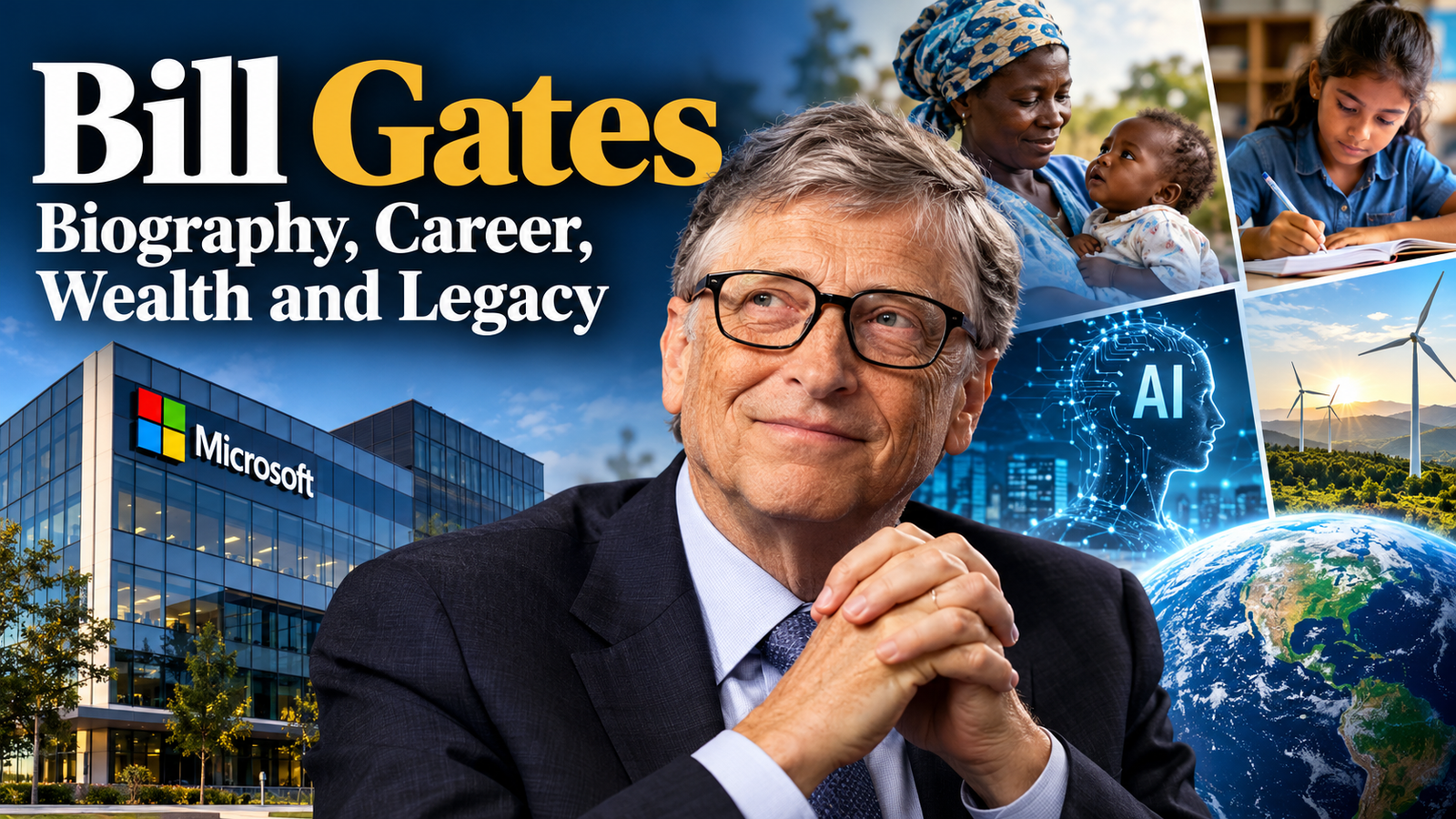
Bill Gates is an American entrepreneur, software pioneer, author, and philanthropist best known for co-founding Microsoft, one of the most influential technology companies in the world. Born on October 28, 1955, in Seattle, Washington, he helped make personal computers accessible to millions of people through software such as Microsoft Windows. His success in the technology industry made him one of the world’s wealthiest individuals, but his work extends far beyond business.
Today, Gates focuses much of his attention on global health, education, climate change, clean energy, and scientific research. Through the Gates Foundation and other initiatives, he supports efforts to improve living conditions and expand access to essential services. He has also become an important public voice on artificial intelligence and its potential impact on society. Understanding Bill Gates means looking at both his role in building the personal computing industry and his continuing efforts to address global challenges.
Who Is Bill Gates?
Bill Gates, whose full name is William Henry Gates III, is a technology entrepreneur who helped establish the modern personal computer software industry. He co-founded Microsoft with his childhood friend Paul Allen in 1975. Their company initially focused on software for early personal computers before becoming a major force in operating systems, productivity applications, and business technology.
Gates is no longer responsible for Microsoft’s daily operations. He stepped away from his full-time role at the company in 2008 and resigned from its board in 2020. He remains associated with technology through his private office, Gates Ventures, while also serving as chair and board member of the Gates Foundation.
His career is notable for combining commercial innovation with large-scale philanthropy. However, his business legacy is not without controversy, particularly regarding Microsoft’s competitive practices during the 1990s. Both his achievements and the criticism surrounding his business methods help explain his lasting influence.
Bill Gates Biography Table
| Detail | Information |
|---|---|
| Full name | William Henry Gates III |
| Popular name | Bill Gates |
| Date of birth | October 28, 1955 |
| Age | 70 years old as of October 15, 2026 |
| Birthplace | Seattle, Washington, United States |
| Nationality | American |
| Profession | Entrepreneur, software pioneer, author, philanthropist |
| Known for | Co-founding Microsoft |
| Co-founder | Paul Allen |
| Education | Attended Harvard University; left before graduating |
| Former spouse | Melinda French Gates |
| Children | Three |
| Main philanthropic organization | Gates Foundation |
| Private office | Gates Ventures |
| Major interests | Technology, artificial intelligence, global health, education, climate change, clean energy |
Early Life and Education
Childhood and Interest in Computers
Bill Gates grew up in Seattle in a family that encouraged education, independent thinking, and competition. His father, William H. Gates II, was a lawyer, while his mother, Mary Maxwell Gates, was involved in education and community organizations.
Gates developed a strong interest in mathematics, reading, and problem-solving at an early age. His access to computers at school during the late 1960s was particularly important. At a time when computers were expensive and far less accessible than they are today, he began experimenting with programming and learning how software could control machines.
These early experiences helped shape his technical interests. In his memoir, Source Code: My Beginnings, published in 2025, Gates reflects on his childhood, education, and the people who encouraged his curiosity.
Harvard University and the Decision to Leave
After graduating from high school, Gates enrolled at Harvard University in 1973. He studied a range of subjects and continued developing his programming skills, but the rapid growth of the personal computer industry soon changed his priorities.
In 1975, Gates and Paul Allen saw an opportunity to develop software for the Altair 8800, an early personal computer. They created a version of the BASIC programming language for the machine and established Microsoft.
Gates subsequently left Harvard to concentrate on building the company. He did not complete his degree, but his decision reflected a specific business opportunity rather than a general rejection of education. Microsoft was entering an emerging industry in which timing, technical knowledge, and the ability to develop useful software could make a substantial difference.
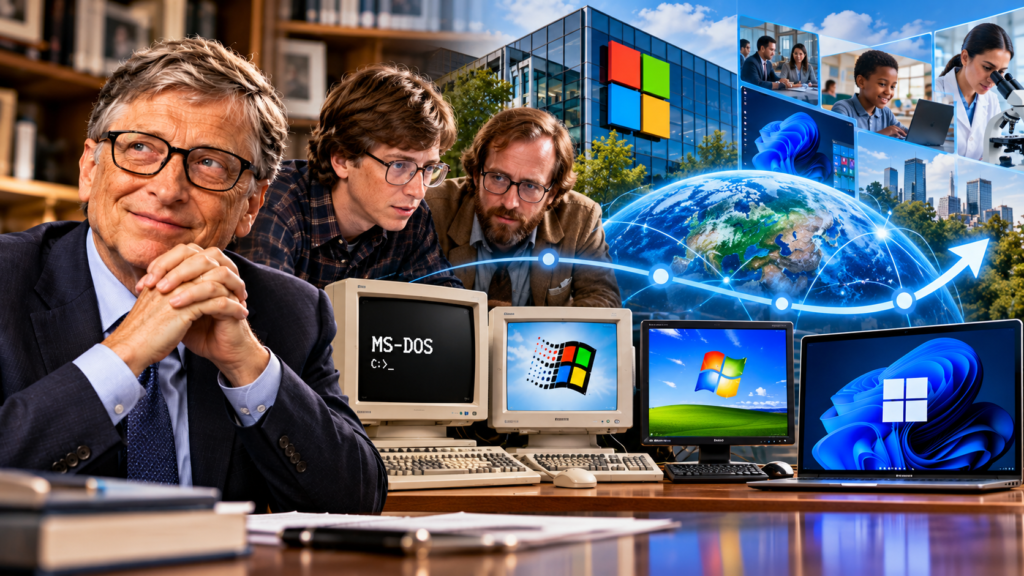
How Bill Gates Built Microsoft
The Founding of Microsoft
Microsoft was founded in April 1975 by Bill Gates and Paul Allen. Their initial goal was to develop software for the growing personal computer market. The company’s early work focused on programming languages that allowed people to write and run instructions on computers.
As personal computing expanded, Microsoft developed relationships with computer manufacturers and software developers. One of its most important opportunities came through the development of an operating system for IBM’s personal computer.
Microsoft supplied MS-DOS, an operating system that became widely used on IBM-compatible computers. This helped establish the company’s position in the software market and created opportunities for further growth.
The company’s business model was significant because software could be licensed to multiple computer manufacturers. Rather than depending entirely on selling computers, Microsoft could earn revenue from software used across a broad range of machines.
The Rise of Windows and Office
Microsoft Windows introduced a graphical environment that made computers easier for many people to use. Instead of relying primarily on typed commands, users could interact with windows, menus, icons, and a mouse.
Windows became increasingly influential as personal computers entered homes, schools, and workplaces. Microsoft Office strengthened that position by bringing applications such as Word, Excel, and PowerPoint into a widely used productivity suite.
These products helped Microsoft become central to everyday computing. Businesses used them for documents, calculations, presentations, and administrative work, while individuals relied on them for education and personal tasks.
Gates played a major role in Microsoft’s strategy, product direction, and corporate leadership. Nevertheless, the company’s success was the result of work by many engineers, designers, executives, partners, and developers—not one individual alone.
Leadership, Competition, and Controversy
Gates served as Microsoft’s chief executive officer until 2000, when Steve Ballmer took over the position. He later concentrated more heavily on philanthropy while maintaining involvement with Microsoft for several years.
Microsoft’s growth also attracted significant antitrust scrutiny. In the United States, the company’s practices in the browser market led to a major antitrust case during the late 1990s. The litigation examined how Microsoft used its position in operating systems and its relationship with computer manufacturers to compete with rivals.
The case became an important chapter in the history of technology regulation. It highlighted a continuing challenge for the industry: a company can develop valuable products while also gaining enough market power to raise concerns about competition.
Gates’ legacy therefore includes both the widespread adoption of personal computing and difficult questions about how powerful technology companies should compete.
Bill Gates’ Net Worth and Sources of Wealth
Bill Gates built most of his original fortune through his ownership and leadership of Microsoft. As the company’s software products became widely adopted, its commercial value increased substantially, rewarding early shareholders.
His wealth has since been influenced by investments, asset sales, charitable giving, and changes in financial markets. Gates has diversified his holdings over time, so his personal fortune is not simply a measure of the Microsoft shares he owns.
His exact net worth changes with market conditions and depends on how assets and liabilities are valued. For that reason, any published figure should be treated as an estimate tied to a particular date, not a fixed amount.
How Did Bill Gates Become So Wealthy?
Several factors contributed to his financial success:
- Early entry into software: Microsoft entered the personal computer market while the industry was still developing.
- Software licensing: Products such as MS-DOS and Windows could be licensed across many computers.
- Business productivity tools: Microsoft Office became widely used by businesses, schools, and individuals.
- Long-term ownership: Gates held a significant stake in Microsoft during the company’s expansion.
- Investment diversification: His later financial activities extended beyond Microsoft’s software business.
Gates has also committed substantial resources to charitable causes. In May 2025, he announced plans to give virtually all of his remaining wealth to the Gates Foundation, which is scheduled to close permanently on December 31, 2045. This long-term commitment is intended to accelerate the foundation’s work during the coming decades.
Bill Gates and the Gates Foundation
Why the Foundation Was Established
The Gates Foundation was established in 2000 by Bill Gates and Melinda French Gates. Its mission centers on improving health, expanding opportunity, and helping people build healthier and more productive lives.
The organization supports programs in global health, poverty reduction, education, agricultural development, nutrition, and other areas. Rather than delivering every service itself, the foundation commonly works through governments, universities, research institutions, nonprofit organizations, and other partners.
This approach allows it to fund research, support public health programs, and help develop solutions that can be adopted on a larger scale. However, funding alone cannot solve every problem. Successful programs also depend on effective local institutions, reliable delivery systems, community trust, and long-term public investment.
Major Areas of Philanthropic Work
The foundation’s work includes several important priorities:
- Global health: Supporting research, vaccines, disease prevention, and stronger health systems.
- Maternal and child health: Helping improve care during pregnancy, childbirth, and early childhood.
- Education: Supporting efforts to improve learning outcomes and educational opportunities.
- Agriculture and nutrition: Investing in approaches that can strengthen food security and agricultural productivity.
- Sanitation and development: Supporting initiatives that improve access to essential services and economic opportunity.
The impact of philanthropic funding can be difficult to measure because results often depend on many organizations and public policies. It is therefore important to distinguish between money committed, programs delivered, and improvements in people’s lives.
The Foundation’s Future
In May 2025, Gates announced that the foundation would distribute its resources more rapidly and close in 2045. He also pledged to give virtually all of his remaining wealth to the organization.
The decision represents a shift toward concentrating philanthropic resources within a defined period rather than preserving the foundation indefinitely. Its stated priorities include ending infectious diseases, saving the lives of mothers and babies, and helping people escape poverty.
This plan does not mean every global health or development challenge will be solved by 2045. Instead, it establishes a time frame for directing funding toward measurable progress and long-term public benefit.
Bill Gates and Artificial Intelligence
Artificial intelligence has become an important part of Gates’ public discussions about technology. His perspective draws on decades of experience with software and a continuing interest in how innovation can improve health, education, and economic productivity.
In recent years, he has discussed the potential of AI to help with tasks such as tutoring, medical research, scientific discovery, and access to information. He has also emphasized the need to consider the risks of increasingly capable systems.
His interest does not mean that Gates personally created the modern generative AI systems used by the public. Microsoft has developed and integrated AI technologies through its own teams and partnerships, while the wider AI industry includes many independent research organizations and companies.
How AI Could Change Education
AI assistants can explain difficult topics, generate practice questions, and adapt explanations to a student’s level. A learner struggling with algebra, for example, could ask an AI system to show each step of a calculation and provide additional practice problems.
These capabilities may help students who lack access to individual tutoring. However, AI-generated explanations can be incorrect, and a system may not understand a student’s learning needs as well as a skilled teacher.
Effective educational use therefore requires human oversight, reliable materials, and opportunities for students to develop their own reasoning skills. Artificial intelligence is most useful when it supports learning rather than simply supplying answers.
AI in Healthcare and Scientific Research
AI can help researchers analyze large datasets, identify patterns, summarize scientific literature, and explore possible research directions. In healthcare, such tools may assist with administrative work, medical research, and certain forms of clinical decision support.
For example, an AI system could help a research team organize information from thousands of scientific papers. Researchers would still need to check the sources, evaluate the quality of the evidence, and determine whether the conclusions are scientifically sound.
AI does not automatically make a medical discovery reliable or turn a promising research result into an approved treatment. Clinical testing, safety evaluation, regulatory review, and appropriate medical judgment remain essential.
AI’s Risks and Limitations
The benefits of AI depend partly on how responsibly it is developed and deployed. Important concerns include:
- Incorrect answers: Generative AI can produce convincing statements that are factually wrong, a problem commonly called hallucination.
- Privacy: Sensitive personal, business, or medical information may be exposed if systems are used without suitable safeguards.
- Bias: AI outputs can reflect problems in training data or system design.
- Employment changes: Automation may alter job responsibilities, reduce demand for some tasks, and create new skills requirements.
- Unequal access: Communities without reliable internet, suitable devices, or digital skills may not benefit equally.
- Security risks: AI can be misused to support fraud, cyberattacks, and the creation of misleading content.
These issues require practical responses, including testing, privacy controls, human review, worker training, and appropriate regulation. The central question is not simply whether AI can perform a task, but whether it can do so reliably, safely, and fairly in a real-world setting.
Bill Gates’ Work on Climate Change and Clean Energy
Climate change is another major focus of Gates’ work. Through Breakthrough Energy and related initiatives, he has supported the development of technologies intended to reduce greenhouse gas emissions.
Some climate solutions are already available, including solar and wind power, while other industries face harder technical and economic challenges. Heavy industry, long-distance transport, and certain industrial processes may require technologies that are difficult to scale using existing approaches alone.
Gates has supported innovation in areas such as advanced energy systems, industrial decarbonization, and other technologies that could reduce emissions. The aim is to make lower-emission options practical and affordable across different parts of the economy.
However, supporting a technology is not the same as proving it will succeed. New energy solutions must demonstrate technical performance, acceptable costs, reliable supply chains, and the ability to operate at scale. Climate progress also depends on deploying existing solutions rather than waiting for future inventions.
Bill Gates’ Books and Ideas
Gates has used books, essays, interviews, and public writing to share his views on technology, science, business, and global development.
Source Code: My Beginnings
Published in February 2025, Source Code: My Beginnings explores Gates’ early life, family, education, and introduction to computing. It offers a personal account of the experiences that helped shape his interests before Microsoft became a global company.
The book is useful for readers interested in the early history of Gates and the circumstances surrounding his decision to enter the software industry.
The Road Ahead
First published in 1995, The Road Ahead explored the emerging possibilities of personal computing and the internet. It reflected the technological changes taking place during a period when digital communication was beginning to reshape everyday life.
Some predictions from that era have aged differently as technology developed, but the book remains part of the history of how business leaders understood the early internet.
How to Avoid a Climate Disaster
Published in 2021, How to Avoid a Climate Disaster explains Gates’ approach to reducing greenhouse gas emissions. It discusses the sources of emissions, the challenges of changing energy systems, and the need for technological innovation and policy support.
The book is especially relevant to readers who want to understand why reducing emissions requires changes across electricity, manufacturing, transport, buildings, and agriculture.
Personal Life and Family
Bill Gates married Melinda French Gates in 1994. They have three children: Jennifer, Rory, and Phoebe. The couple announced their divorce in 2021 after 27 years of marriage.
Although they ended their marriage, their shared philanthropic history remains an important part of the story of the Gates Foundation. Melinda French Gates later pursued her own philanthropic work, with a strong focus on women and girls.
Gates generally keeps much of his family’s private life separate from his public work, although he has discussed his childhood and personal experiences in his memoir and public writing.
His interests outside business include reading, scientific research, and learning about emerging technologies. These interests are also reflected in his book recommendations and essays.
Why Bill Gates Remains Influential
Gates continues to influence conversations about technology and public policy because his career connects several major areas of modern life. His work at Microsoft helped shape the software people use at home, in schools, and in businesses. His philanthropic efforts direct funding toward global health, education, and development, while his climate initiatives support research into lower-emission technologies.
Gates views are influential, but they should not be treated as the final word on every issue. Technology decisions involve engineers, researchers, governments, workers, and the communities affected by them. Philanthropic initiatives also deserve scrutiny regarding priorities, accountability, and measurable outcomes.
The most useful way to understand Gates is to consider both the scale of his contributions and the limits of any one person’s influence. His career demonstrates how software can reshape an industry, while his later work highlights the difficulty of applying innovation to complex global problems.
Frequently Asked Questions About Bill Gates
1. Who is Bill Gates?
Bill Gates is an American entrepreneur and philanthropist who co-founded Microsoft with Paul Allen in 1975. He is known for his influence on personal computing and his work in global health and development.
2. How old is Bill Gates?
Bill Gates was born on October 28, 1955. He is 70 years old as of October 15, 2026.
3. What is Bill Gates famous for?
He is best known for co-founding Microsoft and helping popularize personal computer software through products such as Windows and Microsoft Office.
4. Is Bill Gates still involved with Microsoft?
Gates left his full-time role in 2008 and resigned from Microsoft’s board in 2020. His main focus is now philanthropy and other projects through his private office.
5. What does Bill Gates do today?
He works on philanthropy, global health, education, climate change, clean energy, and scientific research. He also writes about technology and artificial intelligence.
6. Does Bill Gates work on artificial intelligence?
Gates discusses AI’s potential applications and risks, especially in education, healthcare, science, and productivity. He is not the sole creator or developer of today’s AI systems.
7. What is the Gates Foundation?
The Gates Foundation is a philanthropic organization that funds programs in global health, education, poverty reduction, agriculture, and other areas. Gates serves as its chair and a board member.
Conclusion
Bill Gates’ career illustrates how a major technological shift can create enormous economic opportunities and change the way people work, communicate, and learn. Through Microsoft, he helped bring personal computing into the mainstream. Through philanthropy, he has directed substantial resources toward health, education, and development challenges that affect people around the world.
His current interests in artificial intelligence and clean energy reflect a continuing belief in innovation, but technology alone cannot solve every problem. AI systems need oversight, climate technologies must become practical at scale, and public health initiatives require strong local partnerships. Gates’ lasting significance lies in the combination of his role in software history and his efforts to apply wealth and technology to wider social challenges. Understanding both sides of his career provides a clearer picture of his influence and the responsibilities that accompany it.