


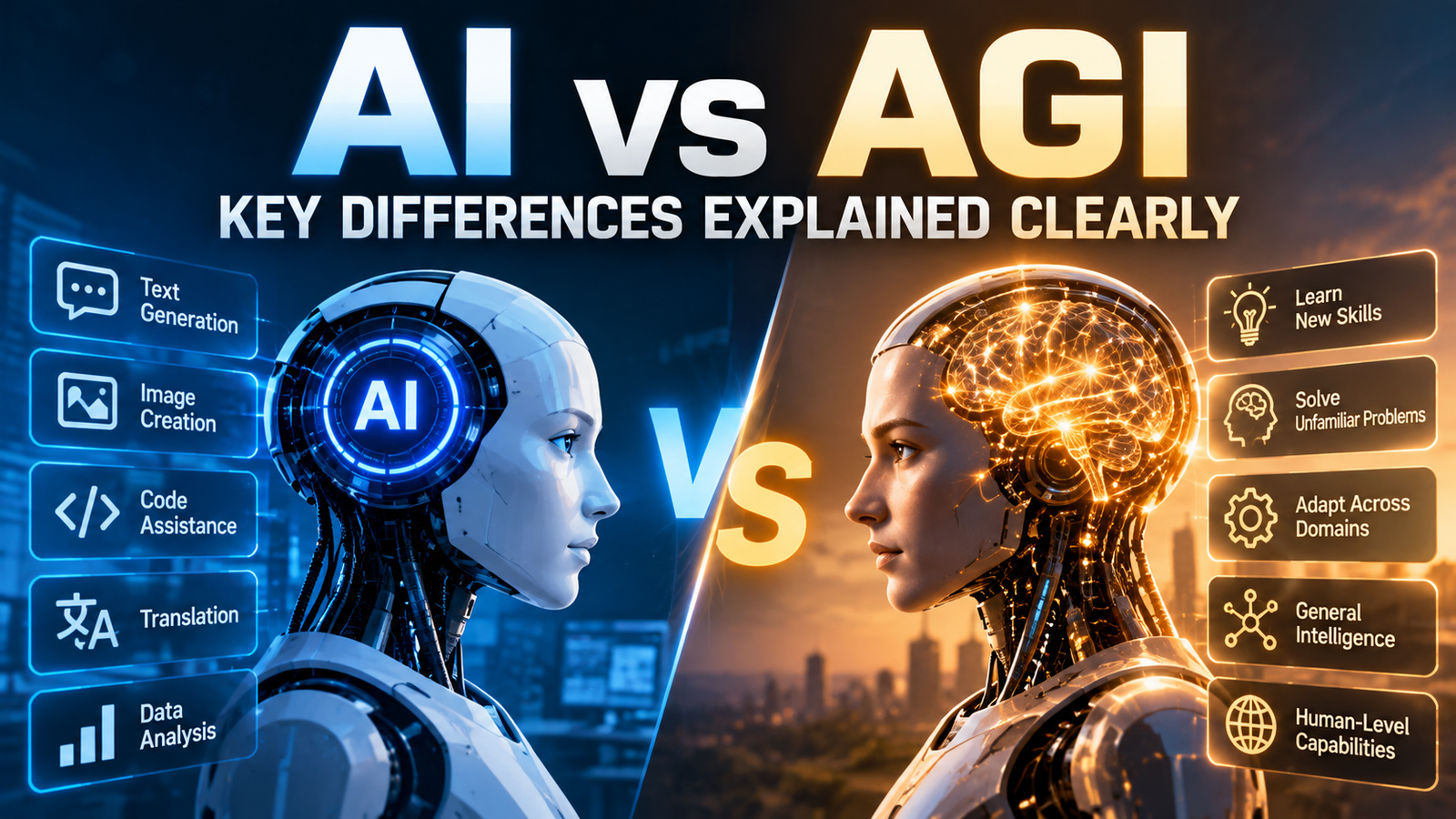
Artificial intelligence already handles tasks that once seemed to require human intelligence, from writing and translating text to analyzing images, generating software code, and answering complex questions. But AI vs AGI is an important distinction because these terms describe different levels of capability. AI generally refers to systems designed to perform particular tasks or groups of tasks, while Artificial General Intelligence, or AGI, describes a theoretical form of intelligence capable of learning and applying knowledge across a much broader range of problems.
The difference is not simply that AGI is a “smarter AI.” The more important question is whether a system can reliably transfer what it learns between very different situations, adapt to unfamiliar problems, reason with limited instruction, and operate across domains at a broadly human level. This article explains the difference between AI and AGI, where current AI systems fit, what AGI would actually require, and why the distinction matters.
What Is AI?
Artificial intelligence, or AI, is the broad field of building computer systems that can perform tasks associated with capabilities such as perception, prediction, language processing, reasoning, planning, and decision-making.
Modern AI is largely based on machine learning. Instead of programmers manually writing every rule a system needs, machine-learning models learn patterns from data. Deep learning, which uses large neural networks with many layers, has become particularly important for modern language, vision, speech, and multimodal systems.
AI does not necessarily have to be general-purpose. A system can be highly capable while remaining limited to a particular problem.
For example, an AI system might:
- Detect objects in medical images.
- Recommend products based on user behavior.
- Translate between languages.
- Generate text, images, audio, or video.
- Predict demand for products.
- Identify fraudulent transactions.
- Assist developers with programming.
- Answer questions using information retrieved from documents.
These systems can be extremely useful without possessing general intelligence.
What Is AGI?
Artificial General Intelligence, commonly abbreviated as AGI, generally refers to a hypothetical or not-yet-settled level of machine intelligence that can perform a broad range of intellectual tasks rather than being narrowly optimized for specific applications.
There is no universally accepted technical test that definitively determines whether a system has achieved AGI. Researchers and companies can also use the term differently, which makes claims about AGI difficult to compare.
A useful way to think about AGI is generality.
Imagine giving a capable human a completely unfamiliar task. They may not know the subject beforehand, but they can learn the relevant concepts, connect them with existing knowledge, experiment, recognize mistakes, and gradually become competent.
A system approaching AGI would need a similarly broad ability to adapt across substantially different tasks and environments.
That does not necessarily mean it would think exactly like a human. AGI could potentially have very different strengths, weaknesses, learning mechanisms, or forms of reasoning.
AI vs AGI: The Core Difference
The simplest distinction is that AI is the broad category, while AGI refers to a much more general form of intelligence within the broader AI field.
| Area | AI | AGI |
|---|---|---|
| Scope | Often specialized or bounded | Broad and general-purpose |
| Learning | Usually trained for defined capabilities | Expected to learn across many domains |
| Adaptability | Can be limited outside familiar tasks | Expected to adapt to unfamiliar problems |
| Knowledge transfer | May struggle between unrelated tasks | Would require strong cross-domain transfer |
| Human-level breadth | Not required | Generally considered an important goal |
| Current status | Widely deployed | No universally agreed achievement |
| Examples | Recommendation systems, LLMs, vision models | Primarily a research goal/concept |
The boundary is not perfectly sharp. Modern foundation models can perform many different tasks, which makes the old distinction between “narrow AI” and “general AI” less straightforward than it once was.
A model can be broad without necessarily meeting every interpretation of AGI.
Why Modern AI Can Look Like AGI
One reason the AI vs AGI debate has become complicated is the rise of large foundation models and multimodal systems.
A modern large language model can potentially summarize a report, explain a programming concept, translate text, draft an email, analyze code, brainstorm ideas, and answer questions in the same conversation. Add image, audio, video, tool use, retrieval systems, and external applications, and the resulting system can appear remarkably general.
However, breadth of use does not automatically prove general intelligence.
A model may perform well across many benchmarks and practical tasks while still having important weaknesses. It can produce an impressive answer one moment and make a surprisingly basic mistake the next. It may also depend heavily on its training data, prompting, available tools, context, and the way a task is presented.
This is why the question is not simply, “How many things can AI do?”
A more useful question is, “How reliably can the system learn, reason, adapt, and transfer knowledge when the situation changes?”
How Current AI Systems Work
Many modern AI systems use neural networks trained on large datasets. During training, the model adjusts internal parameters so that it becomes better at identifying patterns in the training material.
Large language models provide a useful example.
An LLM processes text as tokens and learns statistical relationships between them. During generation, it predicts likely continuations based on the context it has received. Modern systems can perform much more than simple autocomplete because their scale, architecture, training methods, instruction tuning, reinforcement techniques, and supporting tools can produce sophisticated behavior.
But the underlying mechanism does not mean the model has unlimited understanding.
Its performance depends on factors such as:
- Training data and its quality.
- Model architecture.
- Training methods.
- Context available at inference time.
- Tools connected to the model.
- Retrieval systems and external information.
- The complexity of the task.
- How accurately the model can evaluate its own output.
This explains why a model can be highly capable in one situation and unreliable in another.
Where Generative AI Fits Into the AI vs AGI Debate
Generative AI is a branch of AI focused on creating new content, including text, images, audio, video, software code, and other forms of data.
Large language models are among the best-known examples.
Generative AI has made the discussion around AGI more prominent because one model can now support many types of work. A single system may help with programming, writing, research, mathematics, document analysis, and other tasks.
But generative AI and AGI are not interchangeable terms.
Generative AI describes what a system does: it generates content. AGI describes a proposed level or type of general intelligence.
A generative AI system could therefore be extremely capable without necessarily being considered AGI.
The distinction matters because a system that can generate convincing text is not automatically a system that independently understands every domain, learns continuously from experience, and reliably handles unfamiliar situations.
What Would AGI Need to Do?
There is no single official checklist for AGI, but several capabilities are commonly associated with the concept.
General Learning
An AGI system would need to learn new skills without requiring a completely new model or specialized development process for every task.
For example, suppose it encounters an unfamiliar piece of software. A genuinely general system should be able to understand the instructions, experiment with the interface, learn the workflow, and eventually perform useful work.
Transfer of Knowledge
Knowledge transfer is one of the most important differences between narrow capability and general intelligence.
A person who learns principles of logic can apply them in mathematics, programming, science, or everyday decision-making. AGI would need strong mechanisms for transferring useful knowledge between domains.
Reasoning and Planning
General intelligence involves more than producing plausible answers.
A broadly capable system would need to break complex objectives into steps, evaluate alternatives, identify mistakes, revise plans, and work toward goals that may take considerable time to complete.
Adaptation
Real environments change.
Instructions can be incomplete. Information can be missing. Tools can fail. A customer can change their requirements halfway through a project.
An AGI system would need to handle these changes rather than simply repeating patterns learned from familiar examples.
Robustness
A system that performs well only under carefully controlled conditions would have limited generality.
AGI would ideally need to remain useful when the wording changes, the environment is unfamiliar, or the task contains unexpected complications.
A Practical Example of AI vs AGI
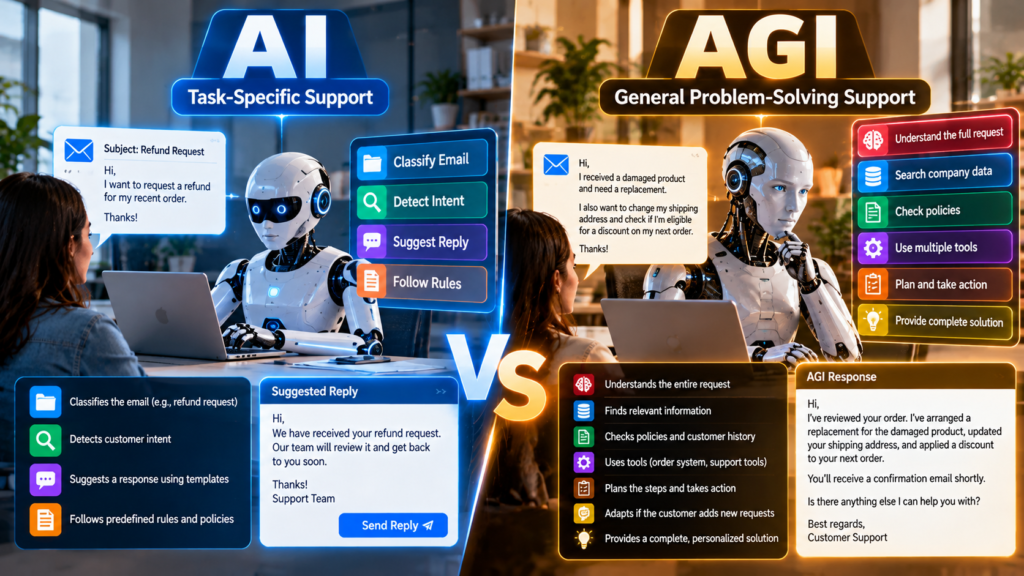
Consider a company that receives thousands of customer emails.
A conventional AI system could classify messages into categories such as refunds, technical problems, billing questions, and account issues. Another model could draft suggested responses.
This is valuable automation.
Now imagine a system receiving a completely unfamiliar customer problem. Instead of merely matching it to an existing category, the system would need to understand the customer’s goal, inspect relevant documentation, determine what information is missing, use appropriate software tools, reason about company policies, propose a solution, recognize when it is uncertain, and adapt if the customer provides new information.
A sufficiently advanced AI agent could perform some of these steps today, especially when connected to appropriate tools and carefully designed workflows.
That still does not establish that the system is AGI.
The difference lies partly in reliability, autonomy, adaptability, and breadth across unfamiliar tasks.
AI Agents Are Not Automatically AGI
AI agents have added another layer to this discussion.
An AI agent can use a model to pursue a goal through multiple steps. Depending on its design, it may search for information, call APIs, interact with software, execute code, maintain task state, or use external tools.
This can make an AI system appear far more autonomous than a traditional chatbot.
For example, a developer could build an agent that receives a software issue, searches documentation, examines a codebase, proposes a change, runs tests, and prepares a report.
That is a significant capability.
But an agent’s abilities depend heavily on the model, tools, permissions, environment, and workflow surrounding it. A sophisticated agent is therefore not automatically AGI.
Agentic systems may be an important component of future general-purpose AI, but autonomy and general intelligence are separate concepts.
Why Current AI Still Has Important Limitations
The impressive capabilities of modern AI should not obscure its weaknesses.
Hallucinations
AI models can generate statements that sound convincing but are incorrect. This is often called hallucination.
The problem can be reduced through better models, retrieval systems, tool use, verification, and carefully designed workflows, but it has not simply disappeared.
For high-stakes work, important outputs should therefore be checked against reliable sources or authoritative records.
Limited Reliability
A model may solve a difficult problem correctly and then fail on a simpler variation.
This inconsistency is particularly important when AI is expected to operate autonomously.
Context and Memory Constraints
AI systems work with information available within their context and any memory or external storage mechanisms provided to them. A long conversation or large document does not automatically mean the system has unlimited, human-like memory.
Dependence on Tools
An AI model connected to search, databases, calculators, code execution, or business software can accomplish much more than the model alone.
This creates an important distinction between the intelligence of the underlying model and the capability of the complete AI system.
Evaluation Problems
Passing a benchmark does not necessarily prove general intelligence.
Benchmarks measure specific capabilities under defined conditions. A system can become very good at benchmark-style tasks without demonstrating the flexible learning and adaptation associated with stronger interpretations of AGI.
AI vs AGI: Which One Exists Today?
AI unquestionably exists and is already integrated into consumer products, business software, research, manufacturing, cybersecurity, healthcare, education, and many other areas.
AGI is different.
There is no universally accepted declaration that the world has reached AGI because there is no universally accepted definition or objective threshold for AGI in the first place.
Some AI researchers and companies believe increasingly capable foundation models could eventually lead to AGI. Others argue that current systems remain fundamentally different from the flexible intelligence implied by the term.
The safest way to discuss AGI is therefore to distinguish demonstrated capabilities from predictions about future systems.
A model can be extraordinarily capable without requiring us to label it AGI.
Could AGI Be Built From Today’s AI?
Possibly, but this remains an open research question.
One possibility is that scaling existing approaches, combined with better reasoning, memory, multimodal learning, tool use, planning, and training techniques, could eventually produce systems with much broader general capabilities.
Another possibility is that important components of intelligence are still missing and will require substantially different approaches.
There is no reliable basis for claiming that simply making a current model larger will automatically produce AGI.
The development path could involve improvements in several areas at once, including:
- More capable reasoning systems.
- Better long-term memory.
- Improved planning.
- Stronger learning from experience.
- More reliable tool use.
- Better multimodal understanding.
- Improved self-correction and verification.
- Safer autonomous operation.
- More efficient inference and training.
Whether these advances will be sufficient remains uncertain.
What AGI Could Mean for Businesses
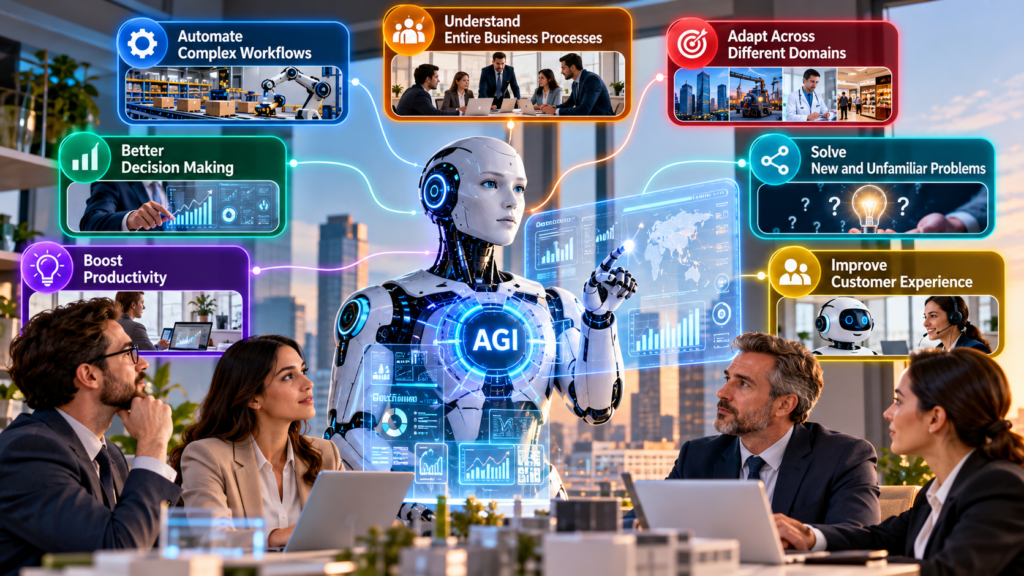
If highly capable AGI eventually becomes practical, its impact could be broader than today’s task-specific automation.
A current AI system might automate one part of a workflow. A more general system could potentially understand an entire workflow and coordinate multiple steps.
For example, a business could use today’s AI to summarize meetings, draft reports, classify documents, or answer common support questions.
A much more general system could potentially analyze a business objective, research relevant information, create a plan, interact with software systems, monitor results, and adjust its approach.
That would shift AI from being primarily a tool for individual tasks toward becoming a more general-purpose problem-solving system.
However, such capabilities would also raise significant questions about security, privacy, accountability, employment, decision-making, and human oversight.
AI vs AGI: What Should Businesses Use Today?
For most organizations, the practical question is not whether a system qualifies as AGI.
The better question is whether a particular AI system can reliably solve a specific business problem.
Before adopting an AI system, evaluate:
- What task does it actually perform?
- How accurate does it need to be?
- What happens when it makes a mistake?
- Does it require human review?
- What data does it receive?
- Where is that data stored or processed?
- Can the system connect to existing software?
- Can its outputs be verified?
- What happens when the system encounters an unfamiliar situation?
For many businesses, a focused AI workflow can deliver more predictable results than trying to give a general-purpose model unrestricted control.
The strongest implementation is often not the most impressive demonstration. It is the one that solves a real problem reliably, securely, and at a reasonable cost.
Common Misconceptions About AI and AGI
“AGI is simply a more powerful chatbot.”
Not necessarily. AGI refers to general intelligence, not merely conversational ability. A system could be excellent at conversation while still having important limitations in learning, planning, reliability, or real-world autonomy.
“Any AI that can perform many tasks is AGI.”
Broad capability is relevant, but it is not enough by itself. Generality, adaptability, reliability, and performance on unfamiliar tasks also matter.
“AGI will definitely think like a human.”
There is no reason to assume that. Artificial intelligence may eventually achieve broad capabilities through mechanisms that differ substantially from biological intelligence.
“AGI is already officially defined.”
It is not. Different researchers and organizations use different definitions and thresholds.
“AI cannot reason at all.”
That is also too simplistic. Modern AI systems can demonstrate sophisticated problem-solving and reasoning behavior on many tasks. The more important issue is how reliable, general, transferable, and robust that reasoning is.
AI vs AGI: The Bottom Line
The key difference in AI vs AGI is not simply intelligence level. It is the breadth and flexibility of that intelligence.
AI is already a practical technology used for language, vision, prediction, generation, automation, recommendation, coding, research, and many other tasks. Modern foundation models have expanded what AI systems can do, and AI agents can combine models with tools to complete increasingly complex workflows.
AGI represents a much broader concept: a machine capable of general intellectual competence across diverse tasks, including learning unfamiliar skills, transferring knowledge, reasoning through new problems, adapting to changing conditions, and working with considerably less task-specific engineering.
Whether and when such systems will exist remains uncertain. For now, the most useful approach is to judge AI by demonstrated capabilities rather than labels. Understanding what a system can reliably do—and where it fails—is more valuable than assuming that impressive performance automatically means AGI.
FAQs About AI vs AGI
Is AGI the same as artificial intelligence?
No. AI is the broader field and includes systems designed for specific or broad tasks. AGI generally refers to a much more general form of machine intelligence.
Is ChatGPT AGI?
A chatbot’s ability to perform many tasks does not by itself establish that it is AGI. Whether any current system qualifies depends partly on the definition and evaluation criteria being used.
What is the main goal of AGI?
The broad goal is to create an AI system capable of handling a wide range of intellectual tasks with strong adaptability and generalization rather than being limited to a narrow application.
Can current AI learn new tasks?
Yes, modern AI can adapt to new tasks through prompting, context, tool use, retrieval, fine-tuning, and other techniques. However, this does not necessarily mean it learns continuously or generally like a human.
Will AGI replace all jobs?
There is no reliable basis for predicting that. The effects would depend on the capabilities of future systems, how quickly they are adopted, economic conditions, regulation, and how organizations redesign work.
Is AGI available today?
There is no universally accepted evidence or definition that allows a definitive statement that AGI has been achieved.
Why is the AI vs AGI distinction important?
It helps people separate the capabilities of today’s AI systems from the broader goal of creating machines with general-purpose intelligence. That distinction is important when evaluating products, research claims, and future predictions.





1 comment on “AI vs AGI: What’s the Difference?”