


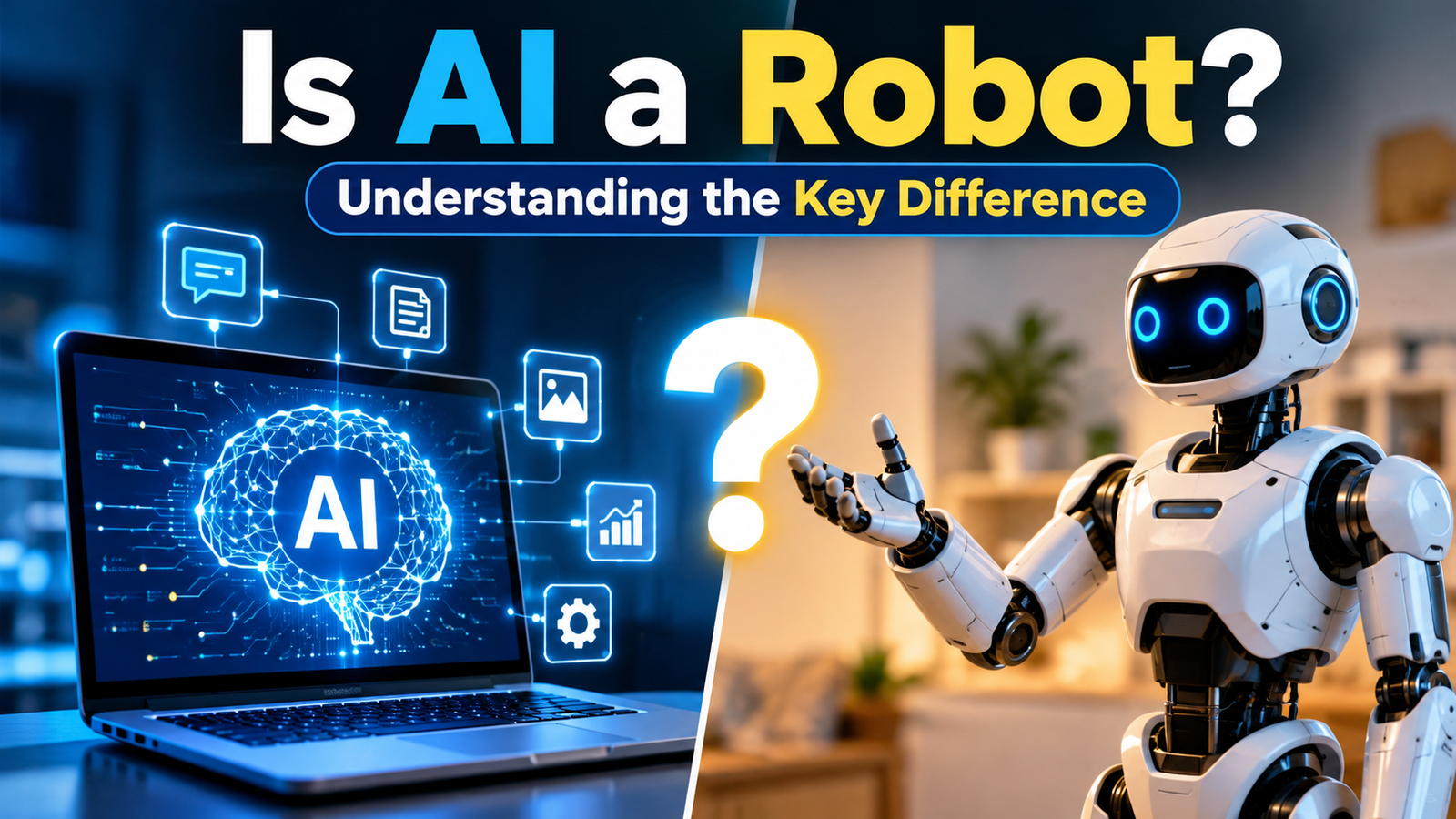
Is AI a robot? No. Artificial intelligence and robots are related technologies, but they are not the same thing. AI is primarily about software and systems that can perform tasks involving abilities such as learning, prediction, language understanding, perception, reasoning, or decision-making. A robot, by contrast, is a physical machine designed to perform actions in the real world.
The confusion happens because some robots use AI, while many AI systems have no physical body at all. Chatbots, recommendation systems, image generators, translation tools, and large language models can all use AI without being robots. Understanding this distinction makes it much easier to understand modern AI, robotics, autonomous machines, and AI agents.
Is AI a Robot?
AI is not inherently a robot. Artificial intelligence is a technology or collection of computational techniques that enables machines and software to perform tasks that can involve learning, perception, prediction, reasoning, language processing, or decision-making.
A robot is a physical system designed to perform actions in the real world. It may have motors, sensors, mechanical components, software, and varying degrees of autonomy.
The simplest way to remember the difference is:
AI is the intelligence-related technology; a robot is the physical machine that can act in the real world.
However, this is a simplification. Not every AI system makes autonomous decisions, and not every robot requires sophisticated AI. Some robots simply execute carefully programmed movements.
What Is Artificial Intelligence?
Artificial intelligence refers to computer-based systems designed to perform tasks associated with forms of human intelligence. These can include recognizing patterns, understanding language, generating content, making predictions, solving problems, and selecting actions.
Modern AI includes several approaches. Machine learning, for example, allows systems to learn patterns from data rather than relying entirely on manually written rules. Deep learning uses neural networks with many layers and powers many modern computer vision, speech, language, and generative AI applications.
Generative AI is one particularly visible part of the field. Tools based on large language models can generate text, answer questions, summarize documents, write code, or transform information without possessing a physical body.
That means a computer running an AI model can be an AI system without being a robot.
What Is a Robot?
A robot is a physical machine capable of carrying out actions in the physical environment.
Depending on its design, a robot may have:
- Motors and mechanical joints
- Cameras and other sensors
- Wheels, legs, arms, or other mechanisms
- Onboard computers
- Control software
- Communication systems
- Some degree of autonomous operation
Robots can be very simple. An industrial machine that repeatedly moves an object between two positions can qualify as a robot even if it does not use advanced machine learning.
More sophisticated robots may combine sensors, control systems, computer vision, machine learning, planning algorithms, and other AI technologies.
This is why robotics and AI overlap without being identical.

How Do AI and Robots Work Together?
AI becomes particularly useful when a robot needs to deal with situations that cannot be handled effectively through a fixed sequence of instructions.
Imagine a warehouse robot transporting packages. A traditional automated machine might follow predetermined routes. An AI-enabled robot could potentially use cameras and other sensors to recognize obstacles, interpret its surroundings, estimate where objects are located, and select an appropriate action.
The basic process can look like this:
Sensors → Perception → AI/model → Decision or planning → Robot controller → Physical action
For example, a robot equipped with computer vision might detect an object, classify it, determine where it is located, plan how to approach it, and then control its mechanical arm.
The AI does not magically become the robot. Instead, AI can provide part of the software intelligence that helps the physical machine operate.
AI Can Exist Without a Robot
This is one of the most important points when answering is AI a robot.
Consider a large language model. It receives digital input, processes it through a trained model, and produces an output. There does not need to be a mechanical body involved.
The same applies to many everyday AI systems.
Chatbots
A chatbot can answer questions, summarize text, translate languages, or help draft documents entirely through software.
Recommendation Systems
Streaming platforms and online stores can use machine-learning models to predict which content or products may be relevant to a user.
Image-Generation Systems
Generative AI can create or modify images without controlling a physical machine.
Fraud Detection
Financial systems can use machine-learning models to identify unusual transaction patterns.
AI Coding Tools
AI models can analyze source code, suggest changes, explain errors, or generate code without operating a physical robot.
In all of these cases, AI is present but robotics is not.
Robots Can Exist Without Advanced AI
The relationship works in the opposite direction too.
A robot does not automatically require advanced artificial intelligence. Many robotic systems can operate using predefined instructions, sensors, feedback loops, and conventional control algorithms.
For example, an industrial robot might repeatedly perform the same welding or assembly movement. Its behavior can be highly automated without requiring a large language model or sophisticated generative AI.
This distinction matters because the terms automation, AI, and robotics are often used interchangeably in casual discussions.
They are not interchangeable.
Automation means a task happens with limited human intervention. AI involves computational systems capable of functions such as prediction, learning, perception, or decision-making. Robotics concerns physical machines capable of movement or manipulation.
A single system can involve all three.
What Is an AI Robot?
An AI robot is generally a physical robot that uses artificial intelligence as part of its perception, decision-making, learning, planning, or control system.
For instance, consider a hypothetical service robot in a hospital.
It could use cameras to recognize its environment, machine learning to identify objects, software to plan routes, and motors to move through corridors. Its AI components would help interpret information and choose actions, while its robotic hardware would physically carry them out.
Some modern systems also combine multimodal AI, allowing models to work with multiple forms of information such as text and images.
The important point is that AI robot describes a combination of technologies rather than a definition of AI itself.
What About AI Agents?
The distinction becomes more interesting with AI agents.
An AI agent is software designed to pursue a task by using models, tools, information, and actions. An agent does not necessarily need a physical body.
For example, an AI agent can interact with websites or software applications. It may interpret information on a screen, decide what action is appropriate, and perform tasks such as clicking, scrolling, typing, or retrieving information.
This creates an important distinction:
An AI agent can act autonomously without being a robot.
Its environment may simply be digital rather than physical.
A robot, on the other hand, operates in the physical world. An advanced system could potentially combine both concepts: an AI agent could make decisions while a robotic platform carries those decisions into the physical environment.
AI vs. Robot: Key Differences
| Aspect | AI | Robot |
|---|---|---|
| Basic nature | Software, models, or computational systems | Physical machine |
| Physical body | Not required | Required |
| Main purpose | Processing, prediction, reasoning, generation, decision-making | Physical movement, manipulation, or interaction |
| Can work digitally? | Yes | Usually operates in the physical world |
| Can use sensors? | Yes, when connected to them | Commonly uses physical sensors |
| Can use machine learning? | Often | Sometimes |
| Can operate autonomously? | Some systems can | Some robots can |
| Always uses AI? | AI is the core technology | No |
| Example | Language model | Industrial robotic arm |
The biggest takeaway is that AI describes a type of computational capability, while robotics describes a physical machine and its mechanisms.
Where AI-Powered Robots Are Used
Combining AI with robotics can be useful when machines must respond to changing physical environments rather than simply repeat predetermined movements.
Manufacturing
Factories use robots for tasks such as assembly, welding, handling, and inspection. AI can assist with visual inspection, anomaly detection, planning, and adaptive processes.
Warehousing
Robotic systems can move goods around warehouses. AI and computer vision can help machines understand objects, routes, and changing surroundings.
Healthcare
Robotics can support certain medical, rehabilitation, laboratory, and logistics applications. The exact level of autonomy varies significantly by system and task.
Agriculture
Robotic platforms can potentially use cameras and machine-learning systems to identify crops, weeds, or other objects and support precision agricultural operations.
Transportation
Autonomous vehicles combine sensors, software, perception systems, planning, and control technologies. AI can be one component of that larger technical system.
Home and Service Robots
Consumer robots can perform tasks such as cleaning or navigation. More advanced systems can use computer vision and machine learning to adapt to their surroundings.
What Makes AI Robots Different From Traditional Robots?
Traditional robots are often built around predictable environments and clearly defined instructions. When the environment changes, they may need new programming or adjustments.
AI can make a robotic system more adaptable.
For example, a conventional robotic arm may be programmed to pick up an object from a precise location. An AI-assisted system could use computer vision to identify objects even when their positions or appearances vary.
That does not mean the robot can understand everything like a person. It means the system can use learned patterns and computational models to handle certain variations more effectively.
This distinction is important because AI does not automatically give a robot human-level intelligence.
Does AI Have a Brain Like a Robot?
No. The word “brain” is often used as an analogy, but AI models are not biological brains.
A neural network is a mathematical and computational model inspired loosely by aspects of biological neural networks. Modern AI models process numerical representations of information and use learned parameters to generate predictions or outputs.
For example, a language model does not have a human brain hidden inside a computer. It processes tokens and uses learned statistical relationships to generate responses.
Likewise, when AI is installed in a robot, the model does not become a biological-style brain. It becomes one software component within a larger robotic system.
Does AI Think or Understand Like Humans?
This question requires more care than simply saying yes or no.
AI systems can perform tasks that look like reasoning, language understanding, perception, or planning. However, successful task performance should not automatically be interpreted as evidence that the system has human-like consciousness, emotions, intentions, or subjective experience.
Modern AI systems can also make mistakes. A language model may generate an incorrect statement that sounds convincing, while an AI agent can make an incorrect action.
Therefore, it is better to describe AI according to what it can demonstrably do rather than assuming that human-like behavior means human-like thinking.
Common Misconceptions About AI and Robots
“Every AI is a robot”
False. Most AI systems people use every day are software systems with no physical body.
“Every robot has AI”
Also false. Robots can operate through programmed instructions and traditional control systems without advanced AI.
“AI becomes a robot when it becomes autonomous”
Not necessarily. An autonomous software agent can operate without a human continuously directing it while remaining entirely digital.
“A humanoid robot is just AI”
Not quite. A humanoid robot includes mechanical hardware, sensors, actuators, control systems, software, and potentially AI models.
“AI robots are automatically intelligent like humans”
No. Their capabilities depend on their models, sensors, software, hardware, training, environment, and safety controls.
What Is the Future of AI and Robotics?
The most interesting developments are likely to come from combining AI with physical systems rather than treating AI and robotics as competing technologies.
Multimodal models can process different kinds of information, while robotics provides a way to perceive and act in the physical world. AI agents can also perform tasks across digital environments without needing a physical body.
The challenge is that physical environments are much less forgiving than text on a screen. A mistake in a chatbot response may be inconvenient; a mistake made by a machine moving through a crowded environment can have physical consequences.
For that reason, useful AI robotics requires more than a powerful model. It also needs reliable sensors, mechanical design, real-time control, testing, safety systems, human oversight, and careful evaluation.
The future is therefore unlikely to be simply “AI becomes robots.” It is more accurately described as AI increasingly becoming one component of systems that can perceive, decide, and act in both digital and physical environments.
Is AI a Robot? The Simple Answer
If someone asks, “Is AI a robot?”, the clearest answer is no.
AI is a technology used to perform computational tasks associated with capabilities such as learning, prediction, perception, language processing, reasoning, and decision-making. A robot is a physical machine capable of movement or manipulation.
They can work independently, or they can be combined.
A chatbot is AI but not a robot. An industrial robotic arm can be a robot without advanced AI. An autonomous machine that uses computer vision and machine learning can be both a robot and an AI-powered system.
Understanding this difference helps separate three concepts that are often confused: AI, robotics, and automation. AI provides computational capabilities, robotics provides a physical platform, and automation describes the reduction of direct human intervention. Modern systems increasingly combine all three, but they remain distinct technologies.
FAQs About Is AI a Robot
Is ChatGPT a robot?
No. ChatGPT is an AI system that operates as software. It does not require a physical robotic body.
Can a robot use AI?
Yes. Robots can use AI for tasks such as visual recognition, navigation, prediction, planning, and decision-making.
Is every robot powered by AI?
No. Many robots can operate using programmed instructions, sensors, and conventional control systems without advanced AI.
Can AI exist without a robot?
Yes. Most AI applications, including language models, recommendation systems, and image-generation tools, operate entirely through software.
What is an AI-powered robot?
It is a physical robot that uses AI as part of its software system to perceive information, make decisions, plan actions, or adapt to its environment.
Are AI agents robots?
Usually not. An AI agent can perform actions autonomously while operating entirely in a digital environment. Some systems can connect AI agents to physical robotic machines.
Will AI and robots become the same thing?
Not necessarily. They may become increasingly integrated, but AI and robotics describe different parts of a technology stack: computational intelligence versus physical machines.
Conclusion
So, is AI a robot? No, but the two technologies can work closely together. AI is primarily concerned with computational capabilities such as learning from data, recognizing patterns, processing language, generating content, making predictions, and selecting actions. Robotics focuses on physical machines that can move, manipulate objects, and interact with their surroundings.
The distinction becomes especially useful as AI becomes more capable of taking actions. An AI agent can operate software without having a physical body, while an AI-powered robot can combine similar computational capabilities with sensors, motors, and mechanical systems. The result is not one technology replacing the other, but increasingly sophisticated systems built from both. For anyone learning about AI, remembering this simple distinction “AI provides intelligence-related capabilities, while robots provide a physical form for action” is a useful starting point.





1 comment on “Is AI a Robot? Understanding the Key Difference”