


If you are wondering who owns Claude, the answer is Anthropic, PBC, an artificial intelligence company founded in 2021. Claude is Anthropic’s family of AI models and its conversational AI assistant, designed to help people with writing, research, coding, document analysis, and other tasks. Although major technology companies, including Amazon and Google, have invested in Anthropic, neither company is Claude’s parent company. Anthropic operates as an independent business with its own leadership and corporate governance structure.
Understanding Claude’s ownership requires looking beyond its familiar chatbot interface. Anthropic was established by former OpenAI employees who wanted to develop advanced AI systems with a strong emphasis on safety and reliability. The company has attracted substantial investment from technology companies and financial institutions. In October 2026, Anthropic filed for an initial public offering (IPO), although the offering had not been completed as of November 2, 2026. This article explains who owns Claude, who founded Anthropic, which companies have invested in it, and how its governance structure works.
Who Owns Claude AI?
Claude AI is owned and developed by Anthropic, PBC. Anthropic is a US-based artificial intelligence company that researches, develops, and commercializes advanced AI models.
The company builds the technology behind Claude, maintains its products, and determines how its AI systems are developed and made available to customers. Claude is therefore a product of Anthropic rather than a separate company owned by Amazon, Google, or another technology giant.
Anthropic’s stated mission focuses on developing reliable, interpretable, and steerable AI systems while reducing the risks associated with increasingly capable artificial intelligence. These priorities influence its research, product development, and approach to AI safety.
Here is a quick overview of Claude’s ownership:
| Detail | Information |
|---|---|
| AI product | Claude |
| Parent company | Anthropic, PBC |
| Founding year | 2021 |
| Co-founders | Dario Amodei, Daniela Amodei, and five other co-founders |
| Company headquarters | San Francisco, California, United States |
| Industry | Artificial intelligence and AI research |
| Corporate structure | Public Benefit Corporation |
| Major corporate investors | Amazon and Google |
| Public stock status | IPO filed in October 2026; offering not completed as of November 2, 2026 |
The distinction between ownership and investment is important. Amazon and Google have financial interests in Anthropic, but their investments do not mean that Claude belongs to either company’s AI product portfolio.
Who Is the Parent Company of Claude?
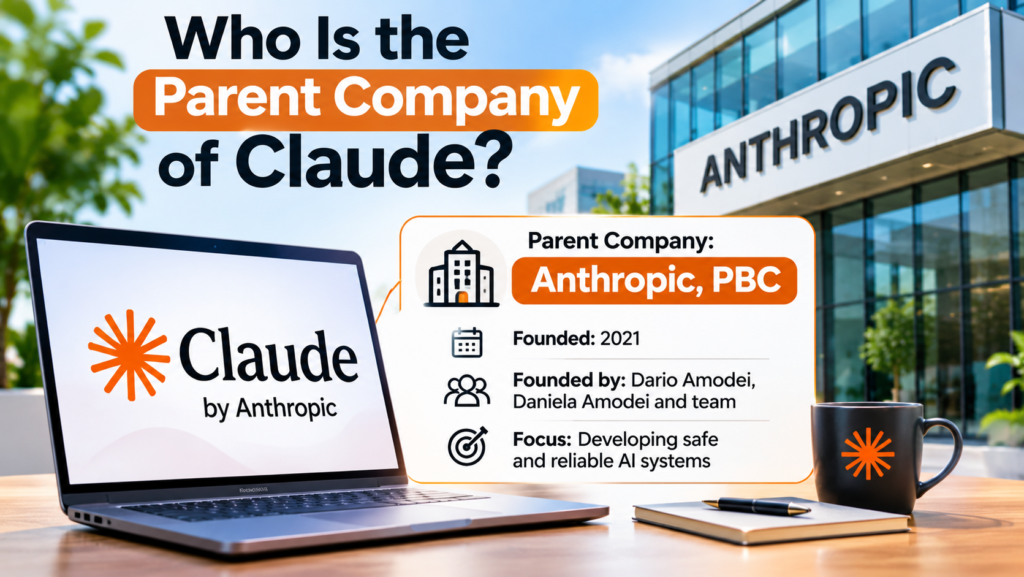
The parent company of Claude is Anthropic, PBC, which stands for Anthropic Public Benefit Corporation.
Anthropic is responsible for Claude’s underlying AI models, product development, and commercial operations. It offers Claude through its own products and provides access to its models through developer and business services.
Anthropic also makes Claude available through cloud computing platforms and partnerships. For example, businesses can access Claude models through Amazon Bedrock, while Google Cloud offers access through its Vertex AI platform. These arrangements allow organizations to use Claude within existing business systems without making Amazon or Google the company behind the model itself.
What Does Anthropic Do?
Anthropic works on advanced machine learning systems, including large language models (LLMs). These models learn patterns from training data and use those patterns to generate responses to questions, instructions, and other inputs.
Claude applies this technology to practical tasks such as:
- Writing, editing, and summarizing documents.
- Explaining complicated subjects in accessible language.
- Analyzing information and comparing documents.
- Generating, reviewing, and debugging computer code.
- Helping businesses process information and support internal workflows.
- Supporting research, planning, and content development.
Anthropic’s work also includes AI safety research. This involves studying how AI systems behave, identifying potential risks, and developing methods to make their outputs more reliable and controllable.
The company develops both the underlying models and the products through which people interact with them. Claude is one of its main commercial products, while its research programs help inform how future systems are designed.
Who Founded Claude AI?
Claude was created by Anthropic, which was founded in 2021 by a group of former OpenAI employees.
The company’s best-known founders are siblings Dario Amodei and Daniela Amodei. Dario Amodei is an AI researcher and executive, while Daniela Amodei has played a major leadership role in building and operating the company.
Anthropic has seven co-founders in total:
- Dario Amodei
- Daniela Amodei
- Tom Brown
- Jack Clark
- Jared Kaplan
- Sam McCandlish
- Christopher Olah
These founders brought experience in AI research, engineering, operations, and organizational leadership.
Their decision to establish Anthropic was closely connected to concerns about how increasingly powerful AI systems should be developed and controlled. Rather than treating AI safety as a separate consideration, the company incorporated it into its research mission.
Why Did Anthropic’s Founders Create Claude?
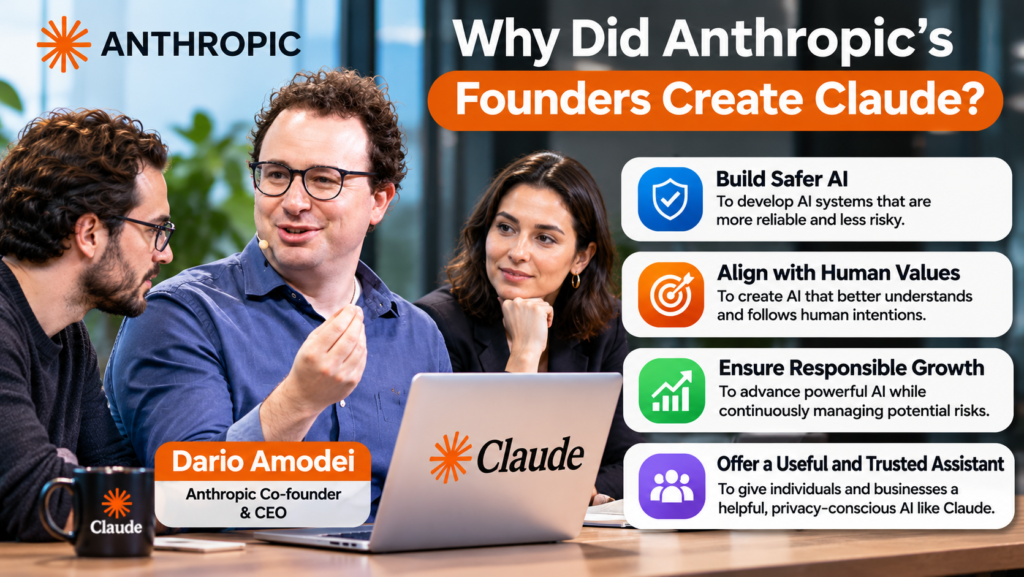
Anthropic was established to advance AI research while placing particular emphasis on the reliability, interpretability, and safety of advanced systems.
The founders believed that increasingly capable AI would create significant opportunities but could also introduce serious risks if developed without appropriate safeguards.
Claude became a practical expression of that mission. It combines large language model technology with methods intended to make AI systems more useful, understandable, and aligned with human intentions.
However, AI safety remains an ongoing research challenge. Claude can still produce inaccurate information, misunderstand instructions, or generate responses that require human review.
Anthropic’s stated mission should therefore be understood as a development objective rather than a guarantee that every Claude response is correct or safe.
Does Amazon Own Claude?
No. Amazon is a major investor and technology partner of Anthropic, but it is not Claude’s parent company.
Amazon announced a strategic investment partnership with Anthropic in 2023. The relationship subsequently expanded, including a further investment commitment announced in March 2024.
The partnership combines financial investment with access to computing infrastructure. Training and operating advanced AI models requires substantial computing capacity, specialized hardware, and reliable cloud infrastructure.
Amazon Web Services (AWS) provides Anthropic with cloud computing resources and supports the distribution of Claude models through Amazon Bedrock. These services allow businesses to integrate Claude into applications and workflows using Amazon’s cloud infrastructure.
Why Did Amazon Invest in Anthropic?
Amazon’s investment supports a strategic relationship in the competitive AI market.
The arrangement offers potential advantages to both companies.
For Anthropic:
- Access to substantial computing infrastructure.
- Financial resources for AI research and product development.
- Distribution opportunities through AWS.
- Access to specialized computing technology.
For Amazon:
- A closer relationship with a major AI model developer.
- More AI model options for AWS customers.
- Opportunities to expand its cloud computing business.
- A stronger position in the enterprise AI market.
Amazon’s involvement does not mean that Anthropic has stopped operating independently. The two companies have a commercial and investment relationship, but Anthropic remains the developer of Claude.
It is also important to distinguish a strategic partnership from corporate ownership. An investor can hold shares in a company without owning the entire business or having unrestricted authority over its products.
Does Google Own Claude AI?
Google does not own Claude outright. However, its parent company, Alphabet Inc., has invested in Anthropic.
Google’s relationship with Anthropic includes financial investment, computing infrastructure, and cloud distribution. These arrangements have helped Anthropic secure resources needed to train and deploy increasingly capable AI models.
Google Cloud provides access to Claude through Vertex AI, enabling organizations to use Anthropic’s models alongside other cloud-based tools and services.
Why Would Google Invest in a Competitor?
At first, Google’s investment in Anthropic might seem unusual because Google also develops its own AI models, including Gemini.
However, large technology companies often invest in businesses that operate in the same market. Such investments can provide financial returns, strengthen technology partnerships, and create opportunities for customers across their broader ecosystems.
In this case, the relationship connects Google’s cloud computing business with an independent AI developer.
The distinction matters because Google Gemini and Anthropic Claude remain different AI product families. Gemini is developed by Google, while Claude is developed by Anthropic.
Google’s investment does not turn Claude into a Google-owned product, just as access to Claude through Google Cloud does not make Google its developer.
Who Are Anthropic’s Major Investors?
Anthropic has raised money from a broad group of investors, including major technology companies, venture capital firms, and institutional investment organizations.
Amazon and Google are among its most significant corporate investors. Other investors have participated in funding rounds designed to support the company’s research, infrastructure, and commercial expansion.
In February 2026, Anthropic announced a $30 billion Series G funding round at a reported post-money valuation of $380 billion. The round was led by GIC and Coatue, with several other investment firms participating.
Some notable investors and investment organizations associated with Anthropic include:
| Investor | General role |
|---|---|
| Amazon | Strategic investor and cloud infrastructure partner |
| Strategic investor and cloud technology partner | |
| GIC | Institutional investment organization and Series G lead |
| Coatue | Investment firm and Series G lead |
| Menlo Ventures | Venture capital investor |
| Spark Capital | Venture capital investor |
| Sequoia Capital | Venture capital investor |
| Lightspeed Venture Partners | Venture capital investor |
| Fidelity Management & Research Company | Institutional investment organization |
| General Catalyst | Investment firm |
This list is not exhaustive, and the roles of individual investors can vary between funding rounds.
Does a $380 Billion Valuation Mean Investors Own Claude Equally?
No. A company’s valuation does not reveal how much of the company each investor owns.
The $380 billion figure was Anthropic’s reported post-money valuation following its February 2026 funding round. It represented the company’s valuation after that financing, rather than a statement that any one investor owned the entire business.
Investors may hold different numbers and classes of shares, with different economic and voting rights. Their ownership percentages can also change as a company raises additional capital or issues new shares.
For this reason, it would be misleading to assume that Amazon, Google, and other investors own equal portions of Anthropic.
The precise economic interests and voting rights associated with an investment depend on the relevant share class and corporate agreements.
Is Anthropic a Public Company?
As of November 2, 2026, Anthropic had filed for an initial public offering, but the IPO had not yet been completed.
An initial public offering is the process through which a company offers shares to public investors. Once an offering is completed and its shares begin trading, investors can generally buy and sell those publicly traded shares through the relevant market.
Anthropic’s October 2026 IPO filing provides information about its ownership, governance arrangements, business operations, and financial position. The filing also describes a corporate structure designed to balance shareholder interests with the company’s public-benefit mission.
What Would an IPO Mean for Claude?
If Anthropic completes its IPO, public investors may be able to purchase shares in the company through the stock market.
That would make Anthropic’s shares available to a broader group of investors, subject to the terms of the offering and applicable market rules.
However, buying Anthropic shares would mean investing in the company behind Claude, not purchasing ownership of Claude as a separate product.
An IPO would also not automatically mean that Amazon or Google had acquired Anthropic. Public companies can have multiple shareholders, including founders, institutional investors, employees, and members of the public.
The final ownership distribution would depend on the offering’s terms, the shares issued, and the interests retained by existing shareholders.
How Does Anthropic’s Ownership Structure Work?
Anthropic has an unusual corporate structure because it combines a for-profit business with a legally defined public-benefit purpose.
The company is incorporated as a Public Benefit Corporation (PBC) under Delaware law. This structure allows its directors to consider financial interests alongside the interests of people affected by its activities and its stated public-benefit mission.
What Is a Public Benefit Corporation?
A Public Benefit Corporation is a for-profit corporate form that has a legally specified public-benefit purpose.
Unlike a conventional business structure focused primarily on shareholder financial interests, a PBC has a legal framework that allows its directors to consider its stated public benefit when making decisions.
For Anthropic, that purpose involves the responsible development and maintenance of advanced AI for the long-term benefit of humanity.
This does not mean Anthropic is a nonprofit organization. It can raise investment, generate revenue, develop commercial products, and compensate employees while operating under its public-benefit framework.
What Is Anthropic’s Long-Term Benefit Trust?
Anthropic established the Long-Term Benefit Trust (LTBT) as another part of its governance structure.
The trust is designed to help ensure that the company continues to balance financial interests with its long-term mission.
Anthropic’s corporate documents describe a special class of shares through which the trust generally has the authority to elect and remove a majority of the authorized members of the board of directors.
These special shares are designed around governance rather than ordinary economic ownership. The trust’s role is therefore different from that of a conventional investor seeking financial returns.
This arrangement is important because it separates some aspects of corporate control from the economic interests associated with owning shares. It is intended to help preserve Anthropic’s public-benefit purpose as the business grows.
How Does Claude Make Money?
Claude generates business value through paid products, business subscriptions, and access to its AI models through developer and enterprise services.
Its commercial model allows individuals and organizations to use Claude for different purposes, depending on their requirements.
1. Individual Subscriptions
Anthropic offers Claude directly to individual users through its consumer products.
Depending on the plan and current availability, paid subscriptions may provide additional usage capacity or access to features beyond those available on a free tier.
The exact features, usage limits, and subscription prices can change, so users should check the company’s current product information before choosing a plan.
2. Business and Enterprise Services
Companies can use Claude to support tasks such as document analysis, internal knowledge assistance, software development, and business research.
Enterprise arrangements can provide organizations with access to Claude under business-specific terms and administration options.
For example, a company might use Claude to summarize lengthy reports, draft internal documentation, or help employees search through approved business information.
Such applications can save time, but employees should still review important outputs for accuracy and suitability.
3. API Access
Anthropic provides an application programming interface (API) that allows developers to integrate Claude models into their own software.
For example, a developer could build a customer-support assistant that uses Claude to draft responses based on a company’s approved documentation.
The application would communicate with an Anthropic model through the API rather than requiring every customer to visit Claude’s website.
API pricing and usage depend on the applicable model and current pricing structure.
4. Cloud Platform Distribution
Anthropic also distributes its models through cloud computing partners, including AWS and Google Cloud.
These channels help businesses access Claude within existing technology environments.
The arrangement expands the ways organizations can use Claude while allowing Anthropic to maintain its role as the model developer.
What Is the Difference Between Claude, Anthropic, Amazon, and Google?
These names are connected through technology and investment, but they serve different roles.
| Name | Role | Relationship to Claude |
|---|---|---|
| Claude | AI assistant and family of AI models | The product developed by Anthropic |
| Anthropic | AI research and technology company | Claude’s developer and parent company |
| Amazon | Technology company and investor | Invests in Anthropic and provides AWS infrastructure |
| Technology company within Alphabet | Invests in Anthropic and provides Google Cloud services | |
| Alphabet | Google’s parent company | Has an investment interest in Anthropic |
| Long-Term Benefit Trust | Anthropic governance body | Helps oversee the company’s long-term public-benefit mission |
This distinction is useful when evaluating AI products, researching their ownership, or deciding which company’s services to use.
For example, a business purchasing access to Claude through Amazon Bedrock is using Anthropic’s AI model through an AWS service. The business is not using a model developed by Amazon simply because it accesses the technology through Amazon’s platform.
Similarly, accessing Claude through Google Cloud does not make Claude part of Google’s Gemini product family.
The provider, model developer, infrastructure company, and investor can be different organizations.
Frequently Asked Questions
1. Who owns Claude AI?
Claude AI is developed and owned by Anthropic, PBC, an artificial intelligence company founded in 2021.
2. What is Claude’s parent company?
Anthropic, PBC, is Claude’s parent company. It develops Claude’s underlying models and operates its AI products and services.
3. Does Amazon own Anthropic?
Amazon is a major investor in Anthropic and a strategic technology partner. However, Anthropic is not simply an Amazon subsidiary.
4. Does Google own Claude?
No. Google’s parent company, Alphabet, has invested in Anthropic, but Claude remains an Anthropic product.
5. Who founded Anthropic?
Anthropic was founded in 2021 by seven co-founders, including siblings Dario Amodei and Daniela Amodei, who previously worked at OpenAI.
6. Is Claude owned by OpenAI?
No. Claude is developed by Anthropic, while ChatGPT is developed by OpenAI. The two companies are separate AI developers.
7. Can I invest in Claude?
Claude is a product rather than a separately traded company. Anthropic filed for an IPO in October 2026, but its offering had not been completed as of November 2, 2026. Any investment opportunity depends on the offering’s completion and the availability of its shares.
Conclusion
Understanding who owns Claude requires distinguishing the AI product from the company behind it and the investors supporting its development. Anthropic, PBC, is Claude’s parent company and the organization responsible for developing its AI models. Founded in 2021 by former OpenAI employees, Anthropic has built a business that combines advanced AI research, commercial products, and a stated commitment to responsible AI development.
Amazon and Google are important investors and technology partners, but neither is Claude’s parent company. Anthropic’s Public Benefit Corporation status and Long-Term Benefit Trust also give its governance structure a distinctive focus on its long-term mission. With an IPO filing submitted in October 2026, its ownership structure is receiving increased attention. The central point remains simple: Claude belongs to Anthropic, not Amazon, Google, or OpenAI.

1 comment on “Who Owns Claude? Everything You Need to Know”