


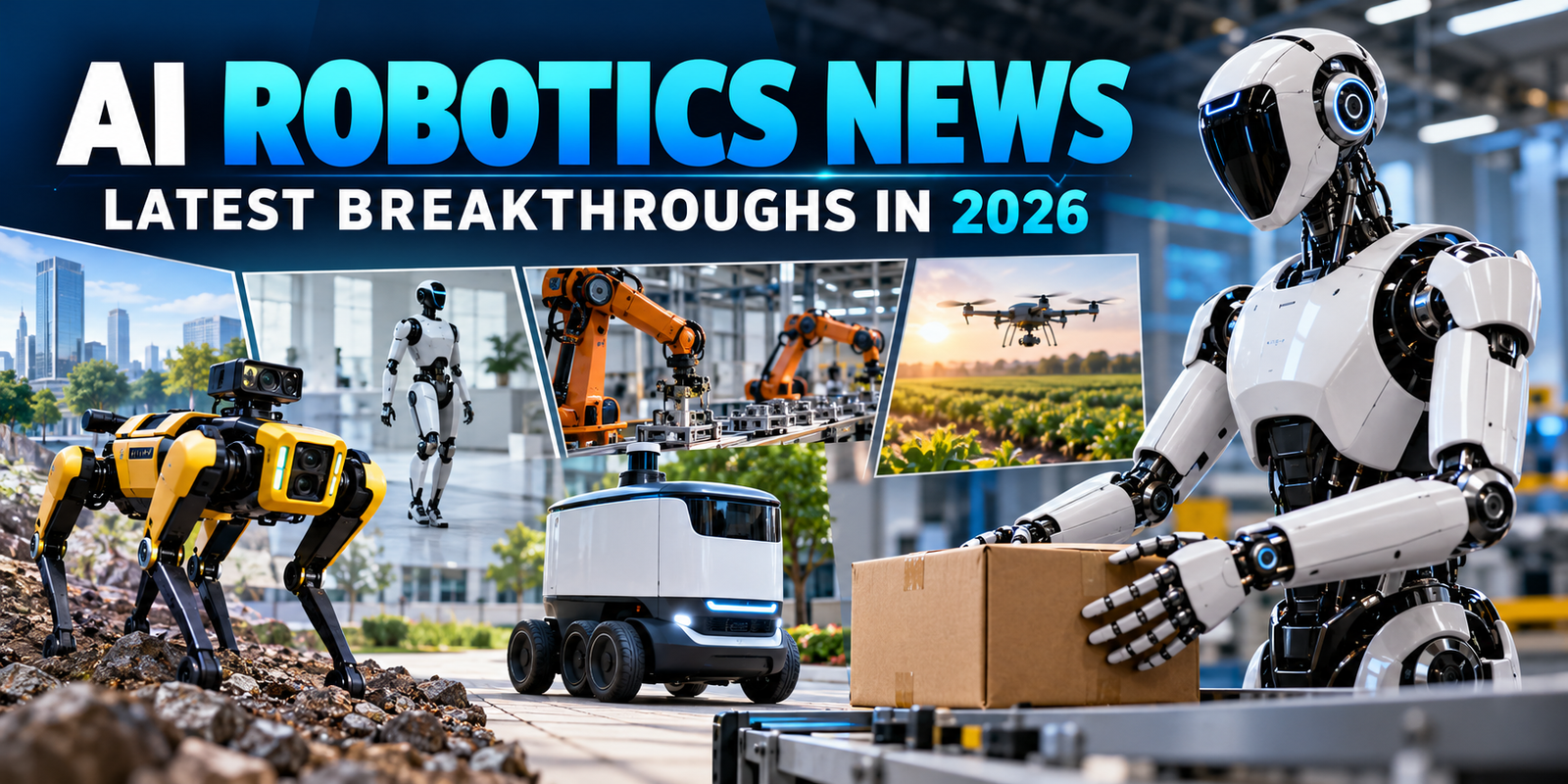
AI robotics news is increasingly focused on a major shift: robots are moving beyond fixed instructions and learning to understand their surroundings, respond to human commands, and perform more complex physical tasks. Developments in robotics foundation models, computer vision, machine learning, and real-time computing are helping researchers build machines that can adapt to changing environments.
Several important developments are shaping the field in 2026. Google DeepMind continues to develop Gemini Robotics models, NVIDIA is advancing its Isaac robotics platform and GR00T models, and robotics companies are exploring new applications for humanoid machines and autonomous systems.
These advances matter because robots could eventually handle a wider range of work in factories, warehouses, laboratories, and other environments. However, impressive demonstrations do not automatically mean a robot is ready for widespread commercial use. Understanding the latest breakthroughs requires looking at what the technology can actually do, where it still struggles, and how businesses are putting it to work.
Latest AI Robotics News and Major Developments in 2026
The latest AI robotics news shows that progress is happening across several areas at once. Researchers are improving robot intelligence, manufacturers are testing practical applications, and technology companies are investing in systems that can operate outside controlled laboratory settings.
Here are some of the most important developments to understand.
1. Google DeepMind Advances Robotic Intelligence
Google DeepMind is developing AI models designed to help robots understand their surroundings, follow instructions, manipulate objects, and plan physical tasks. Its Gemini Robotics research focuses on connecting advanced AI reasoning with the practical requirements of operating a robot.
The goal is to build systems that can handle more than one narrowly defined activity. For example, a robot might need to identify an object, determine how to pick it up, and move it to a specified location.
This approach could make robots more adaptable across different environments. However, performance depends on the task, the robot’s hardware, and the conditions in which it operates. Delicate manipulation, unfamiliar objects, and complex movements remain difficult challenges.
2. NVIDIA Expands Its Robotics Development Platform
NVIDIA is developing its Isaac platform to help robotics engineers build, train, simulate, and deploy intelligent machines. Its GR00T family focuses particularly on general-purpose humanoid robots, combining foundation models, training data, simulation tools, and computing hardware.
Simulation is especially valuable because testing every movement on a physical robot can be slow, expensive, and potentially dangerous. Engineers can test virtual robots in different conditions before transferring suitable behaviors to real hardware.
However, success in simulation does not guarantee success in the physical world. Real robots must deal with friction, changing lighting, sensor errors, unexpected obstacles, and objects that behave differently than expected.
3. Boston Dynamics Strengthens Its AI Leadership
Boston Dynamics is known for developing advanced mobile robots, including its quadruped robot Spot and humanoid Atlas. The company has helped demonstrate how sophisticated mechanical engineering can produce machines capable of walking, balancing, and navigating challenging environments.
The next major challenge is combining these physical capabilities with AI systems that can understand tasks and adapt to new situations.
A robot that can walk across uneven ground still needs a reliable way to recognize objects, interpret instructions, and decide what to do next. Integrating these capabilities could expand the practical applications of humanoid robots, although widespread commercial adoption will depend on reliability, cost, and safety.
4. Industrial Robotics Attracts Fresh Investment
Robotics companies are attracting investment as businesses explore automation beyond traditional production lines. One area receiving particular attention is general-purpose industrial robotics, where machines are designed to perform different tasks rather than repeat a single movement.
For example, a two-armed robot could potentially handle components, move materials, or support production processes that require several coordinated actions. Such flexibility may help businesses adapt existing workspaces without redesigning every process around specialized machinery.
However, investment and company valuations do not prove that a technology is commercially successful. Long-term adoption depends on customer demand, operating costs, reliability, maintenance, and measurable improvements in productivity.
5. AI-Powered Delivery Robots Enter Public Trials
Autonomous delivery robots are another important development in AI robotics. These small electric machines are designed to transport food, groceries, or packages over relatively short distances.
A delivery robot must detect obstacles, navigate sidewalks, respond to pedestrians, and reach its destination without creating unnecessary risks. It may combine cameras, other sensors, mapping software, and AI-based perception to make navigation decisions.
Public trials help companies evaluate these systems in real environments. However, crowded sidewalks, bad weather, construction work, and unexpected human behavior can create difficulties. Autonomous delivery is therefore best understood as an evolving application rather than a complete replacement for conventional delivery services.
What Is AI Robotics?
AI robotics combines artificial intelligence with machines that can sense, move, and interact with the physical world. Traditional robots often follow carefully programmed instructions. AI-powered robots can use learned patterns, sensor data, and decision-making systems to handle certain variations without requiring a new instruction for every situation.
For example, a conventional robotic arm might be programmed to pick up a component from a fixed position. An AI-powered version could use a camera to locate the component even if it has moved slightly, identify its orientation, and adjust its grip.
That flexibility is one of the main reasons researchers are developing more general-purpose robotic systems.
AI robotics brings together several technologies:
- Machine learning: Enables robots to learn useful patterns from data and experience.
- Computer vision: Helps machines identify objects, people, surfaces, and obstacles.
- Deep learning: Supports complex perception, prediction, and action-selection tasks.
- Natural language processing: Allows robots to interpret human instructions expressed in everyday language.
- Robotics control: Converts decisions into physical movements while managing balance, speed, force, and stability.
- Sensor fusion: Combines information from cameras, depth sensors, force sensors, and other hardware.
These components must work together. A robot might correctly identify a cup but still fail to grasp it because the cup is slippery or positioned awkwardly. Understanding an object and physically manipulating it are different problems.
How AI-Powered Robots Work
An AI robot generally follows a repeated cycle: perceive its environment, interpret the information, select an action, execute that action, and check the result.
1. Perception
Cameras and sensors collect information about the environment.
2. Reasoning and Planning
AI interprets the scene and selects an appropriate next action.
3. Movement and Control
The robot’s control system translates the action into motor commands.
4. Feedback and Correction
Sensors confirm the outcome and help the robot adjust if necessary.
Consider a robot instructed to place a bottle inside a box. It must locate both objects, estimate their positions, determine a safe movement, grip the bottle, and release it over the correct location.
If the bottle slips, the robot needs to detect the failure and attempt a suitable correction. A system that merely generates a plausible action without checking the result is less useful in real-world environments.
The process also depends on low-level control systems that manage rapid movements and physical stability. A large AI model should not be treated as a substitute for every specialized controller, sensor, or mechanical safety mechanism.
Why Robotics Foundation Models Matter
One of the biggest developments in AI robotics is the emergence of robot foundation models. These are models trained on broad collections of data to support a range of tasks rather than a single narrowly defined operation.
In conventional robotics, a team might develop separate software for object recognition, grasping, navigation, and task planning. A foundation model may help connect several of these capabilities through a shared learned representation.
What Is a Vision-Language-Action Model?
A vision-language-action (VLA) model takes visual information and language instructions and produces actions that a robot can execute. The exact action format depends on the model and its integration with the robot.
For example, a person might instruct a robot to pick up a red package and place it on a shelf. The model must connect the words to the correct object, interpret its surroundings, and generate appropriate actions.
This approach could make it easier to instruct robots without manually programming every step. Nevertheless, the model still needs appropriate training, compatible hardware, and reliable movement controls.
How Large Language Models Differ From Robot AI
A large language model (LLM) is primarily designed to process and generate language. A robotics model must also account for physical constraints, sensor information, movement, and the consequences of its actions.
| Technology | Main purpose | Example |
|---|---|---|
| Large language model | Understands and generates language | Explaining a maintenance procedure |
| Computer vision model | Interprets images or video | Identifying a damaged component |
| Vision-language-action model | Connects visual understanding and instructions to robot actions | Picking up a specified object |
| Robot control system | Executes and stabilizes physical movement | Controlling motor speed and joint position |
| Robotics simulation | Tests robot behavior in virtual environments | Evaluating a grasp before physical testing |
These technologies can be combined, but they are not interchangeable. An effective robot needs an appropriate balance of intelligence, reliable control, hardware capability, and safety measures.
Real-World Applications of AI Robotics
AI robotics is not limited to humanoid machines. Some of its most useful applications involve specialized robots designed for predictable tasks.
1. Manufacturing and Industrial Automation
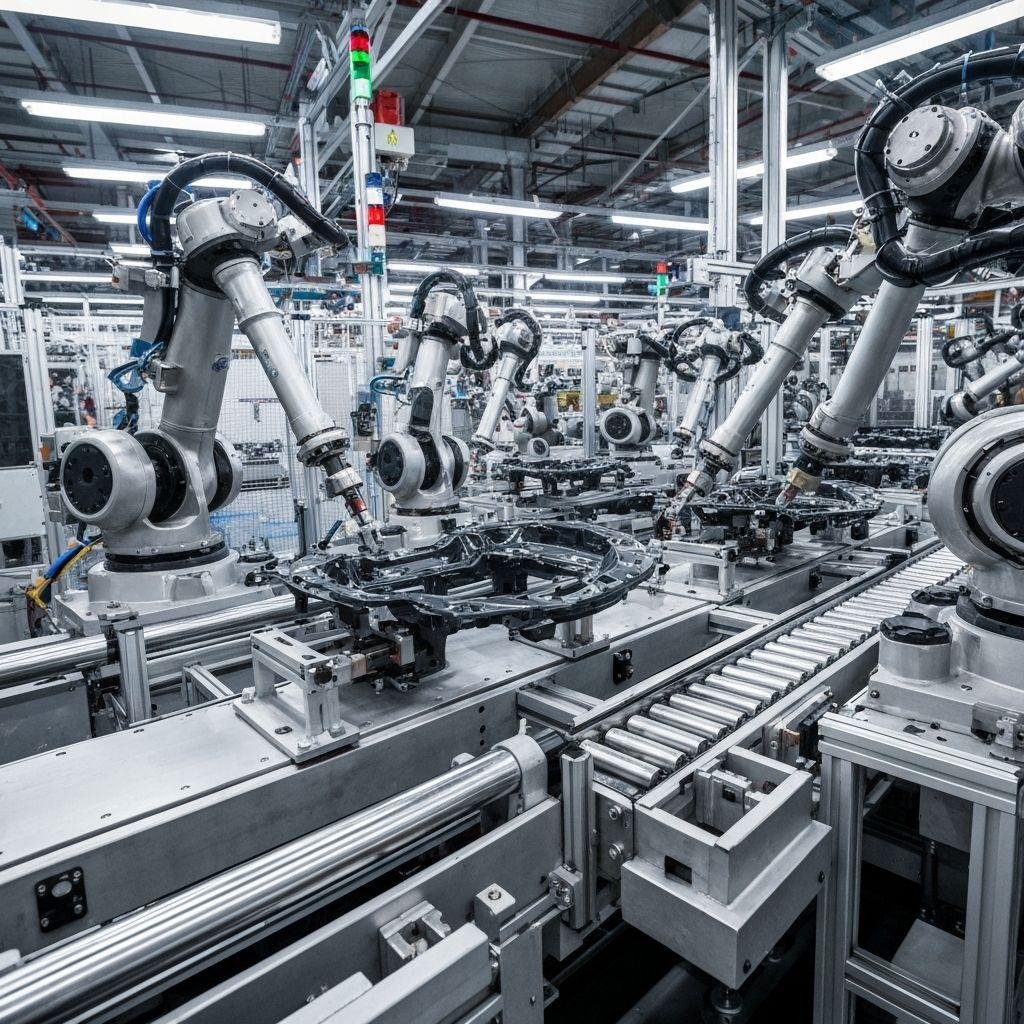
Factories use robots for assembly, welding, inspection, material handling, and packaging. AI can improve visual inspection and help systems cope with variations in object position or appearance. Conventional automation may still be the better choice when tasks are highly repetitive and tightly controlled.
2. Warehouses and Logistics
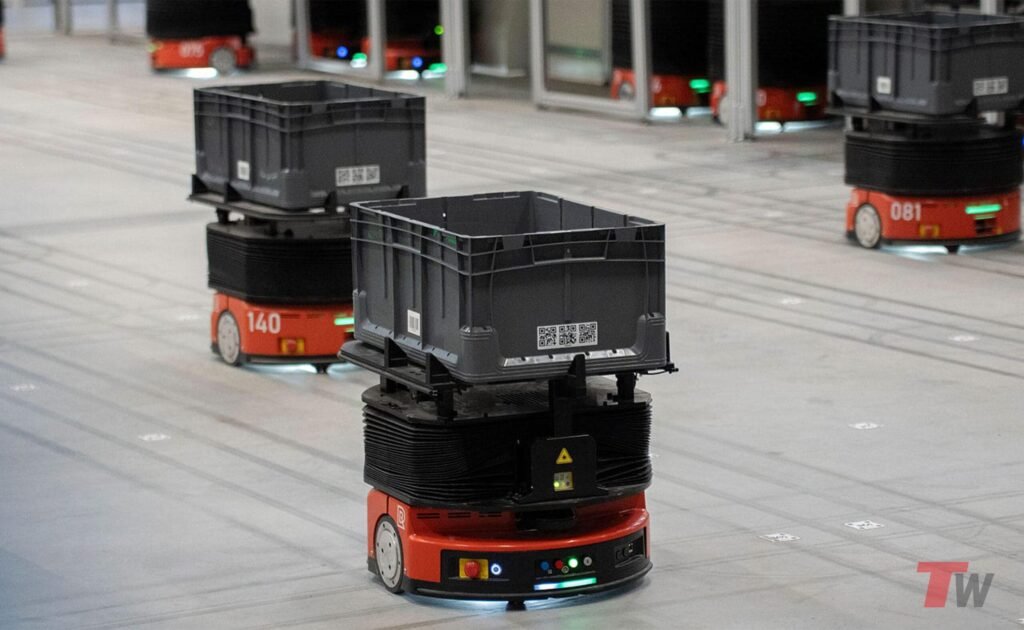
Autonomous mobile robots can transport goods, move inventory, and support order fulfillment. AI can help with navigation, obstacle avoidance, and task allocation. Reliable coordination with workers and other machines remains essential in busy facilities.
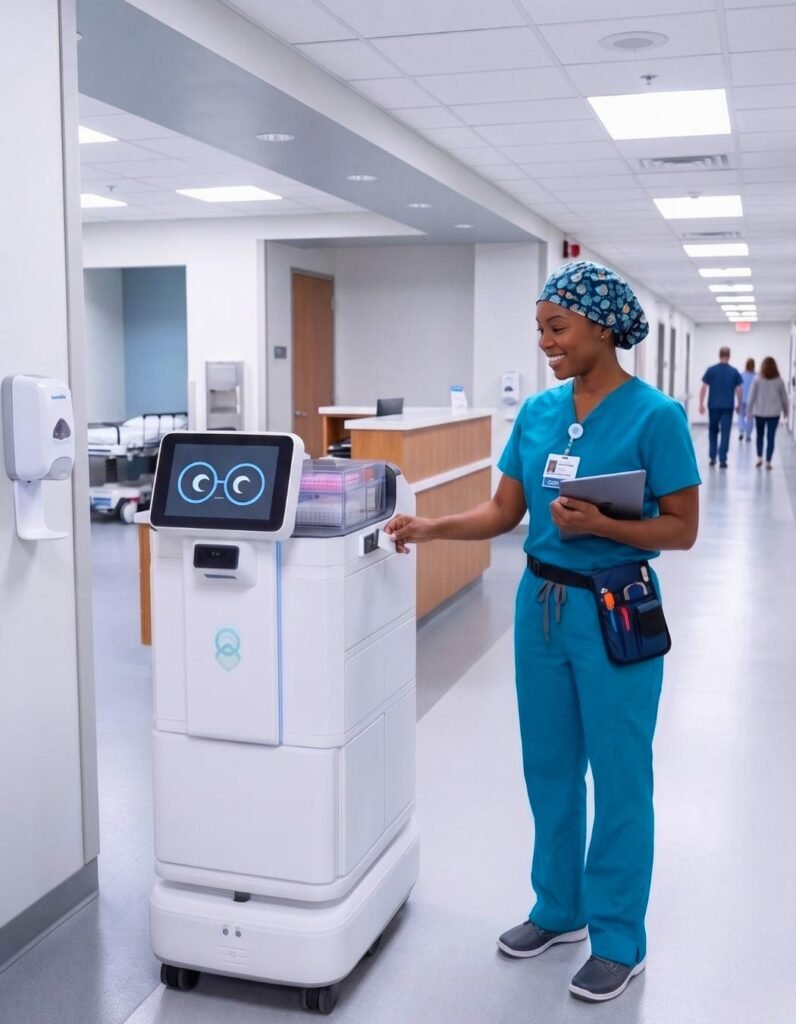
3. Healthcare
Robots can transport supplies, assist with certain rehabilitation tasks, and support clinical procedures through specialized systems. Medical applications require strict validation, appropriate supervision, and compliance with relevant regulations. General-purpose humanoid robots are not a replacement for trained healthcare professionals.
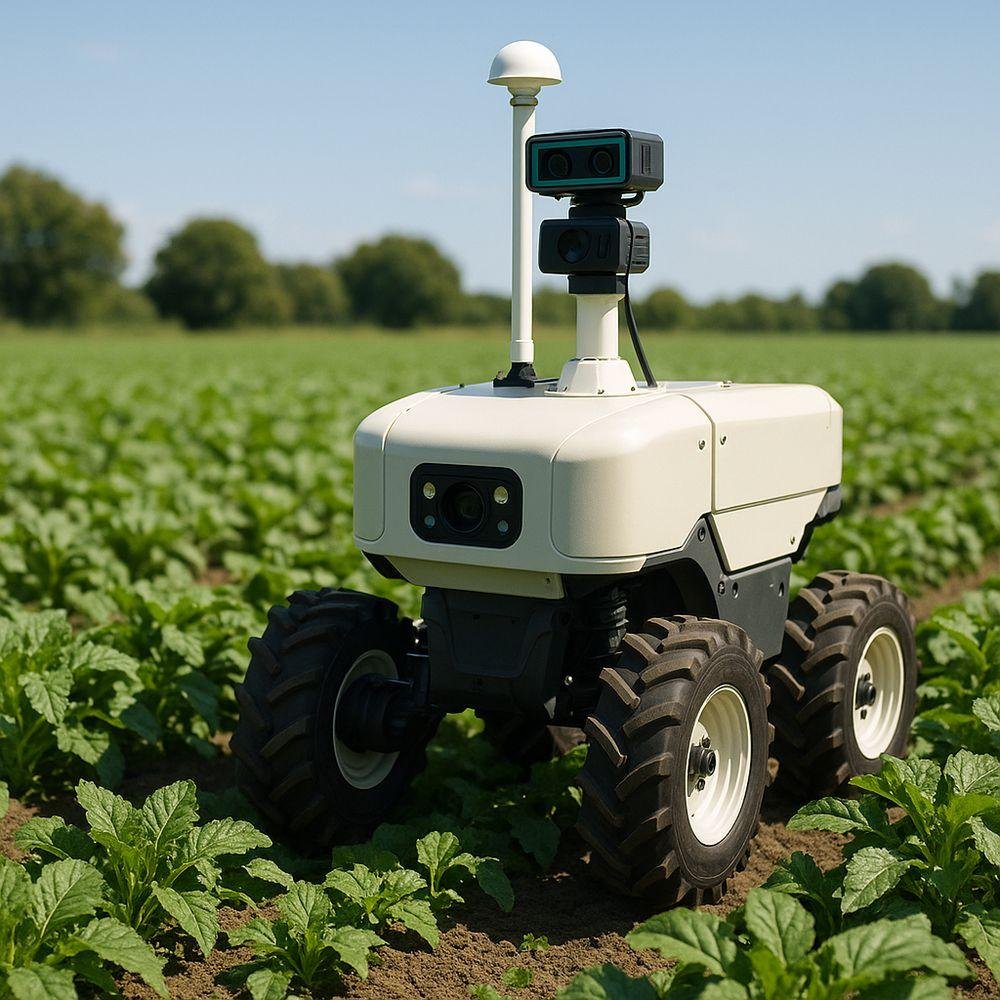
4. Agriculture
AI-enabled machines can help identify weeds, monitor crop conditions, and support targeted spraying or harvesting. Their effectiveness depends on weather, crop variety, field conditions, and the reliability of their perception systems.
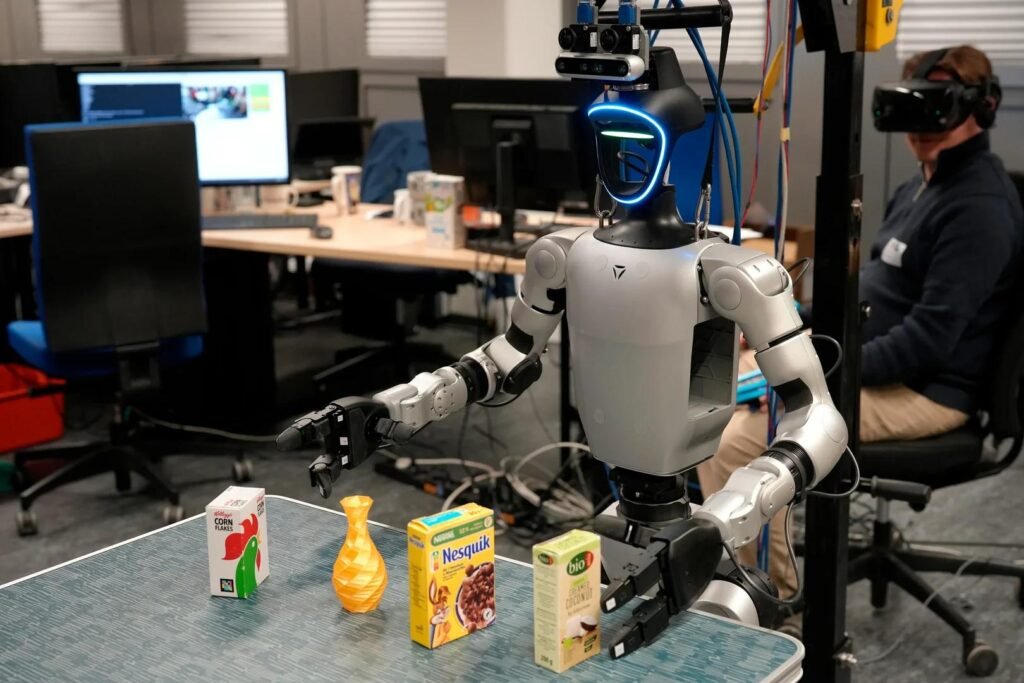
5. Homes and Personal Assistance
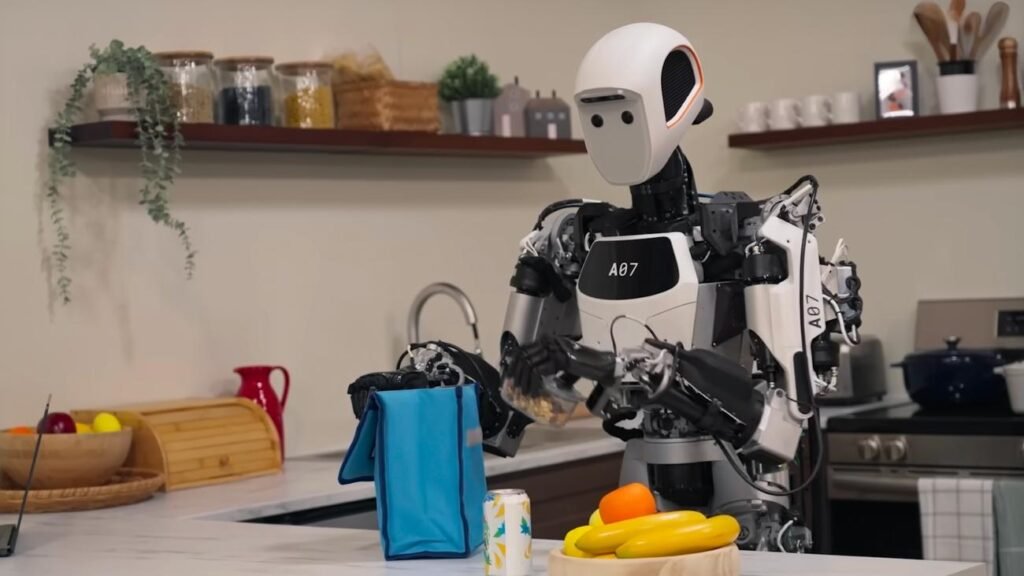
Researchers are exploring robots that can manipulate household objects and carry out multistep tasks. Domestic environments are challenging because furniture, lighting, objects, and human behavior change constantly. Broad, dependable household autonomy remains an important research challenge.
The best application is not necessarily the one with the most advanced-looking robot. A small machine that performs one valuable task reliably may provide more practical benefit than a humanoid that can demonstrate many skills but needs frequent assistance.
Benefits of AI Robotics for Businesses
AI robotics can help organizations improve productivity, consistency, and workplace safety when a task is suitable for automation.
The main potential benefits include:
- More consistent operations: Automated systems can repeat defined procedures with predictable timing.
- Reduced exposure to hazards: Robots can perform certain dangerous or physically demanding tasks.
- Flexible handling: AI-based perception may allow machines to handle objects in different positions or orientations.
- Continuous operation: Suitable robots can operate for extended periods when maintenance, charging, and supervision are properly managed.
- Improved inspection: Computer vision can help identify visible defects or unusual conditions.
- Better coordination: Connected robots can share task information and work within a coordinated workflow.
However, these advantages are not automatic. AI robotics can introduce new expenses involving integration, training data, hardware, maintenance, cybersecurity, and employee training.
A business should evaluate the entire workflow rather than assume that buying a robot will immediately reduce costs. Reliability and the value of the task matter more than the novelty of the technology.
Challenges and Risks in AI Robotics
Robots that interact with the physical world create different risks from software-only AI systems. A mistaken text response may be inconvenient, but an incorrect physical movement can damage equipment or injure someone.
Reliability in Unpredictable Environments
Robots often perform well in controlled demonstrations but struggle when objects, lighting, surfaces, or layouts change. A model trained on one type of environment may not generalize effectively to another.
This is known as a generalization problem. More diverse training data can help, but it does not eliminate the need for real-world testing.
Safety Around People
Robots operating near humans need dependable obstacle detection, safe movement limits, emergency stops, and appropriate physical safeguards. AI-based decision-making should be combined with independent safety mechanisms where required.
Safety also includes uncertainty management. If a robot cannot determine whether a task is safe, it should be able to stop and request human assistance rather than continue blindly.
Cost and Maintenance
A robotic system requires more than the robot itself. Cameras, sensors, computing hardware, grippers, software integration, spare parts, and technical support can all affect the total cost.
Businesses should also consider downtime. A machine that performs a task quickly but frequently requires intervention may deliver less value than a slower, more dependable alternative.
Privacy and Cybersecurity
Robots equipped with cameras and microphones may collect sensitive information about workers, customers, homes, or industrial facilities. Organizations need clear rules governing data collection, storage, access, and retention.
Connected robots can also be exposed to software vulnerabilities or unauthorized commands. Secure updates, restricted access, network protections, and tested recovery procedures are important parts of responsible deployment.
Employment and Workforce Changes
Automation can reduce demand for some repetitive tasks while increasing demand for technicians, robotics engineers, safety specialists, and maintenance workers.
The impact depends on the industry and the particular job. Businesses should plan for retraining and changes in responsibilities rather than assuming that every role will either disappear or remain unaffected.
Humanoid Robots vs. Traditional Industrial Robots
Humanoid robots attract attention because their human-like shape may allow them to work in spaces designed for people. Yet that design is not always the most efficient option.
| Factor | Humanoid Robots | Traditional Industrial Robots |
|---|---|---|
| Design | Human-like body, often with arms and legs | Usually specialized arms or fixed machinery |
| Best suited for | Tasks requiring mobility and varied physical interaction | Repetitive, well-defined operations |
| Flexibility | Potentially broad, depending on software and hardware | Often limited to a defined workflow |
| Installation | May require extensive testing and integration | Established solutions exist for many factory tasks |
| Main challenge | Reliable movement, dexterity, safety, and cost | Handling unexpected variation outside the designed task |
For instance, a factory that repeatedly welds the same component may gain little from installing a humanoid robot. A specialized robotic arm can often perform that task more efficiently.
A humanoid might be more attractive in an environment where equipment, storage, and workstations are already designed for human workers. Even there, its performance must be compared with wheeled robots, robotic arms, and other specialized machines.
The right choice depends on the task, not the shape of the robot.
What to Watch in Future AI Robotics News
Several developments are likely to remain important as the industry progresses.
More capable robot foundation models: Researchers will continue working on models that can handle more tasks without extensive retraining for each new environment.
Better dexterity: Manipulating flexible objects, using tools, handling fragile products, and coordinating multiple fingers remain difficult. Improvements here could expand the range of useful applications.
On-device AI: Running models directly on a robot can reduce dependence on network connectivity and improve response times. Local execution also introduces hardware and power constraints.
Multi-robot coordination: Different robots may eventually cooperate on workflows that are difficult for a single machine. Reliable communication, task allocation, and safety will be essential.
Simulation and synthetic data: Virtual environments can help generate training examples and test behavior before deployment. The challenge is ensuring that simulated experience transfers to real-world conditions.
Commercial performance: Watch for evidence of sustained deployments, completed tasks, reliability, maintenance requirements, and customer adoption. These measures are more useful than promotional videos alone.
The central question is whether robots can perform useful work repeatedly, safely, and at a reasonable cost. Progress in AI models matters, but so do motors, batteries, sensors, manufacturing capacity, and service infrastructure.
How to Evaluate AI Robotics News Before Believing a Claim
Robotics announcements often combine real technical progress with ambitious predictions. Readers can judge them more accurately by checking a few details.
- Identify what was actually demonstrated. Was the robot completing a task independently, following remote human instructions, or operating in a tightly controlled setup?
- Check the source. Company announcements are useful for understanding a product’s intended capabilities, while independent reporting and published research can provide additional context.
- Look for measured performance. Task success rates, failure cases, operating time, and test conditions help explain what a robot can actually do.
- Separate prototypes from products. A research model, early-access system, customer pilot, and commercially available robot are different stages of development.
- Check whether the result generalizes. Success on one object or in one laboratory does not establish reliable performance across many environments.
- Consider the economics. Hardware costs, supervision, maintenance, downtime, and integration can determine whether an apparently impressive system is commercially useful.
For example, if a video shows a humanoid folding clothes, the important questions include how many attempts succeeded, whether a human intervened, how long the task took, and whether the robot can handle different fabrics and clothing types.
These details turn robotics coverage from entertainment into useful technical reporting.
Suggested Internal Links
For a technology website covering AI and emerging innovations, these related articles could strengthen topical coverage:
- Latest Artificial Intelligence News — for broader AI industry developments.
- Best AI Tools for Automation — for software and automation tools that complement robotics.
- What Is Generative AI? — for readers who want to understand the AI models behind emerging systems.
- How Machine Learning Works — for a beginner-friendly explanation of how robots learn patterns from data.
Use these as descriptive anchor texts when linking to relevant articles already published on your website.
Frequently Asked Questions About AI Robotics News
1. What is the latest AI robotics news in 2026?
Recent developments include advances in Google’s Gemini Robotics models, NVIDIA’s robotics platform, industrial automation, humanoid robots, and autonomous delivery systems.
2. Which companies are leading AI robotics development?
Google DeepMind, NVIDIA, Boston Dynamics, and specialist robotics manufacturers are developing different parts of the field, from AI models and simulation tools to physical robots.
3. What is a robotics foundation model?
It is an AI model trained on broad data to support multiple robotic tasks. Depending on its design, it may help robots interpret instructions, understand visual information, and generate physical actions.
4. Will humanoid robots replace human workers?
Some robots may automate specific tasks, but widespread replacement is not inevitable. Costs, reliability, safety requirements, and the complexity of human work will influence adoption.
5. Are AI-powered robots available today?
Yes. Industrial robotic arms, warehouse robots, inspection machines, and delivery robots are already used in various settings. General-purpose humanoid robots remain at different stages of testing and deployment.
6. What is the biggest challenge in AI robotics?
Reliable performance in unfamiliar physical environments remains a major challenge. Robots must combine perception, planning, movement, and safety while dealing with uncertainty.
7. Where can I follow reliable AI robotics news?
Follow official AI research announcements, robotics company updates, academic research, and reputable technology publications. Compare demonstrations with independently reported results whenever possible.
Conclusion
AI robotics is moving toward machines that can understand instructions, respond to changing environments, and perform a wider variety of physical tasks. Developments in foundation models, whole-body control, simulation, and autonomous navigation show how software and hardware are increasingly being developed together.
Yet the most important measure of progress is not whether a robot looks human or performs an impressive demonstration. It is whether the machine can complete a useful task safely, consistently, and economically outside a controlled laboratory. Industrial automation and logistics already offer practical examples, while general-purpose humanoid robots still face significant technical and commercial challenges.
For anyone following AI robotics news, the best approach is to examine demonstrated capabilities, independent evidence, real deployment results, and remaining limitations. That perspective makes it easier to distinguish meaningful engineering advances from promises about what robots might achieve in the future.


1 comment on “AI Robotics News: Latest Breakthroughs in 2026”