


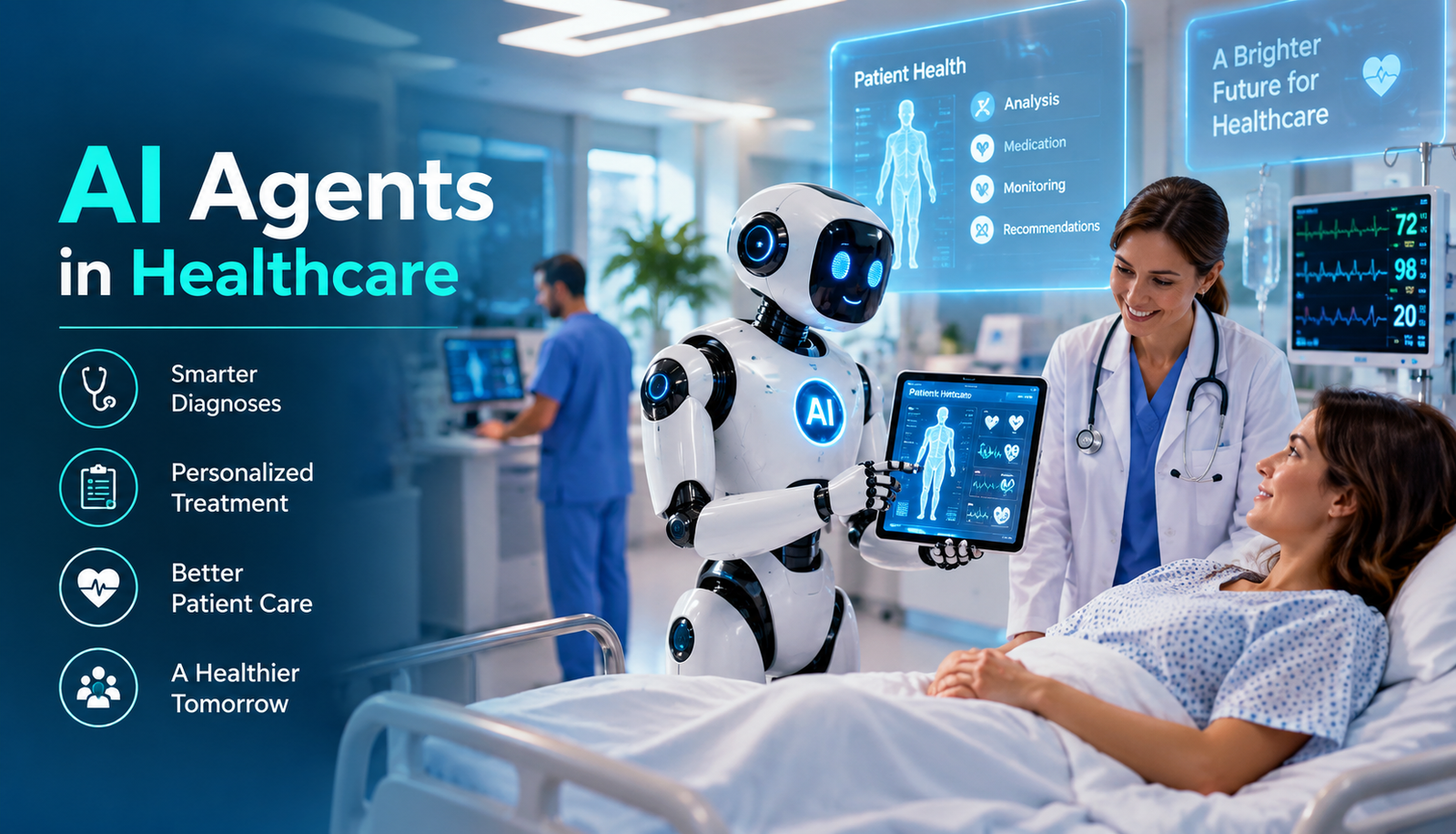
AI agents in healthcare are changing how medical teams manage information, routine tasks, and patient support. Unlike simple software, these intelligent systems can understand goals, process information, and complete several connected tasks. For example, an AI agent may review patient information, organize records, identify important details, and prepare a summary for a healthcare professional. These systems can also support appointment management, medical documentation, patient communication, and hospital operations. However, they are designed to support healthcare workers rather than replace professional judgment. As healthcare becomes more digital, AI agents offer a practical way to reduce repetitive work while helping medical teams spend more time on patients and important decisions.
What Are AI Agents in Healthcare?
AI agents in healthcare are software systems designed to perform tasks with limited human direction. They can receive information, understand a specific goal, choose suitable actions, and produce useful results. Many agents use artificial intelligence, natural language processing, machine learning, and large language models to complete these activities. A healthcare agent might organize clinical notes, answer basic patient questions, or help staff find information inside approved medical systems. The exact abilities depend on how the agent is built and what information it can access. Importantly, healthcare organizations must control these systems carefully because medical information is private and decisions can affect patient safety.
The main difference between an AI agent and a traditional digital tool is its ability to handle a workflow. A normal application may complete one defined function after a user clicks a button. An agent can potentially connect several steps together. For example, it could receive a request, gather approved information, summarize relevant records, and prepare an output for review. This makes AI agents useful for administrative and clinical support. However, autonomy should remain limited when tasks involve diagnosis, treatment, medication, or other high-risk decisions. Human oversight, clear permissions, reliable data, and appropriate validation are essential before these systems are used in real healthcare environments.
How AI Agents Work in Healthcare
AI agents generally follow a simple cycle: understand, plan, act, and check. First, the system receives a request or identifies a task. Next, it analyzes available information and determines which actions may be needed. It can then use approved tools, databases, or software systems to complete those actions. Finally, the agent produces a result or asks a human to review the work. This process allows healthcare organizations to automate connected tasks instead of relying on separate tools for every step. The agent’s permissions should be carefully limited so it can only access information and systems required for its assigned responsibilities.
A useful example is an appointment support agent. A patient may ask to schedule a follow-up visit. The agent could identify the patient’s request, check available appointment options, confirm basic information, and prepare the booking for approval. Another agent might help staff summarize non-urgent messages before they reach a healthcare professional. These examples show how AI agents can reduce manual work without making medical decisions independently. The safest approach is usually to automate low-risk, repetitive activities first. More sensitive workflows should include stronger verification, human review, audit records, and clearly defined rules for when the agent must stop.
Common Uses of AI Agents in Healthcare
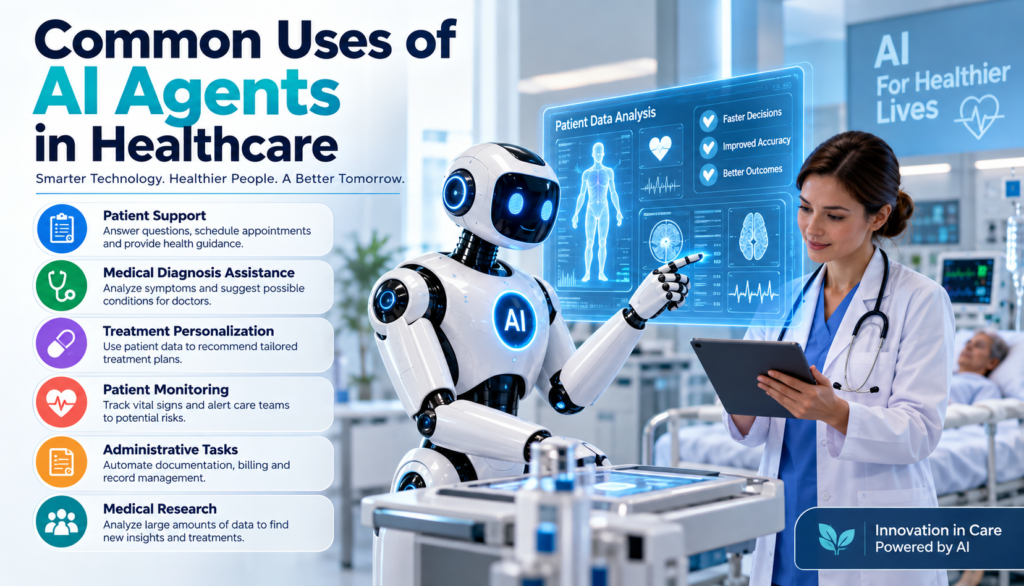
AI agents can support many areas of healthcare, particularly where employees spend time handling repetitive information or communication. Administrative tasks are one common example. An agent can help manage appointment requests, organize incoming messages, prepare reminders, or route questions to the appropriate department. Other systems can assist with documentation by turning approved information into structured summaries for review. Patient-facing agents may also answer common questions about appointments, general instructions, or healthcare services. These applications can reduce repetitive workload, but organizations should clearly explain when patients are interacting with an automated system rather than a human professional.
Clinical support is another developing area for AI agents in healthcare. An agent may help professionals locate relevant information, summarize records, organize clinical data, or prepare questions for review. In research environments, agents can assist with literature searches, data organization, and other research workflows. Hospitals may also use intelligent systems to support scheduling, resource coordination, and operational planning. However, these uses require careful testing because inaccurate information can create serious problems. The agent should therefore work within defined boundaries and provide information that professionals can verify. Its role should remain clear, especially when a task could influence diagnosis, treatment, or patient safety.
Benefits of AI Agents in Healthcare
One major benefit of AI agents in healthcare is their ability to reduce repetitive administrative work. Healthcare professionals often spend significant time processing messages, updating information, preparing documents, and coordinating routine activities. Automating suitable tasks can give staff more time for work that requires communication, empathy, and professional judgment. Agents can also operate consistently across large volumes of routine requests. This may help organizations manage growing workloads without adding the same amount of manual effort. However, the actual benefit depends on system quality, workflow design, staff adoption, and appropriate monitoring. Automation alone does not guarantee better healthcare or lower costs.
AI agents may also improve access to information and make certain workflows easier to manage. For example, a well-designed system can help staff find approved information more quickly or organize complex administrative requests. Patient communication can become more responsive when routine questions receive timely answers. Healthcare organizations may also gain better visibility into repetitive workflow problems by analyzing where agents frequently need human assistance. These benefits should be measured using practical outcomes, such as time saved, error rates, response times, staff workload, and user satisfaction. Organizations should compare results before and after deployment instead of assuming that an AI system automatically creates improvement.
AI Agents in Healthcare: Benefits Chart
The following chart shows where AI agents can provide support across common healthcare activities. It is important to remember that these are potential applications, not guaranteed outcomes. Actual results depend on system design, data quality, workflow integration, and human oversight.
| Healthcare Area | Potential AI Agent Role | Human Review |
|---|---|---|
| Appointment Management | Handle routine scheduling requests | Usually recommended |
| Documentation | Prepare summaries and drafts | Essential |
| Patient Communication | Answer approved general questions | Recommended |
| Clinical Support | Organize and summarize information | Essential |
| Research | Find and organize relevant information | Recommended |
| Hospital Operations | Coordinate routine workflows | Recommended |
| Billing Support | Organize administrative information | Recommended |
| Medication Workflows | Support information handling | Essential |
This chart highlights an important principle: the level of human oversight should increase with potential risk. A system answering a general question about clinic hours presents a different risk from one supporting medication information. High-impact tasks require stronger controls, verification, and professional involvement. AI agents should therefore be classified according to the consequences of an error. Healthcare organizations can create different permission levels for different workflows. They can also require approval before an agent takes certain actions. This risk-based approach helps organizations gain useful automation while keeping patient safety and professional responsibility at the center of implementation.
Challenges and Risks of AI Agents in Healthcare
Privacy is one of the most important concerns surrounding AI agents in healthcare. Medical records can contain highly sensitive personal information, so organizations must control how data is collected, processed, stored, and shared. Access should follow the principle of giving an agent only the information it actually needs. Security controls, authentication, monitoring, and appropriate data handling practices are also important. Another concern is accuracy. AI systems can produce incorrect or incomplete information, sometimes in convincing language. Healthcare workers must therefore verify important outputs, especially when those outputs could influence patient care, treatment, or clinical decisions.
Bias and poor-quality data can create additional problems. If an AI system is trained or evaluated using incomplete information, its results may not work equally well across different populations. Integration can also be difficult because hospitals often use multiple software systems that were not designed to communicate smoothly. Staff training is another major factor. Employees need to understand what an agent can do, what it cannot do, and when human review is required. Clear accountability is equally important. Organizations should know who owns the workflow, who checks results, and what happens when an agent produces an unsafe or unexpected response.
How Healthcare Organizations Can Implement AI Agents
Successful implementation should begin with a specific problem rather than the technology itself. A hospital might start with appointment requests, document preparation, or another repetitive workflow. The organization can then define the desired outcome, required data, system permissions, review process, and measurable success criteria. Starting with a narrow use case makes testing easier and limits potential risks. Teams should also involve healthcare professionals, technology specialists, privacy experts, and operational leaders. Their combined knowledge can identify problems that may not be visible from a technical perspective. A carefully selected pilot can reveal whether the system actually improves the workflow before wider deployment.
After a pilot, organizations should monitor performance continuously. Useful measures may include accuracy, response time, error frequency, staff workload, patient feedback, and the number of cases requiring human intervention. AI agents in healthcare should also have clear escalation rules. When information is missing, the request is unusual, or the risk becomes higher, the system should transfer the task to an appropriate professional. Regular audits can help identify unexpected behavior or performance changes. Organizations should update workflows as technology and regulations evolve. Treating an AI agent as an ongoing operational system, rather than a one-time software purchase, supports safer and more sustainable adoption.
The Future of AI Agents in Healthcare
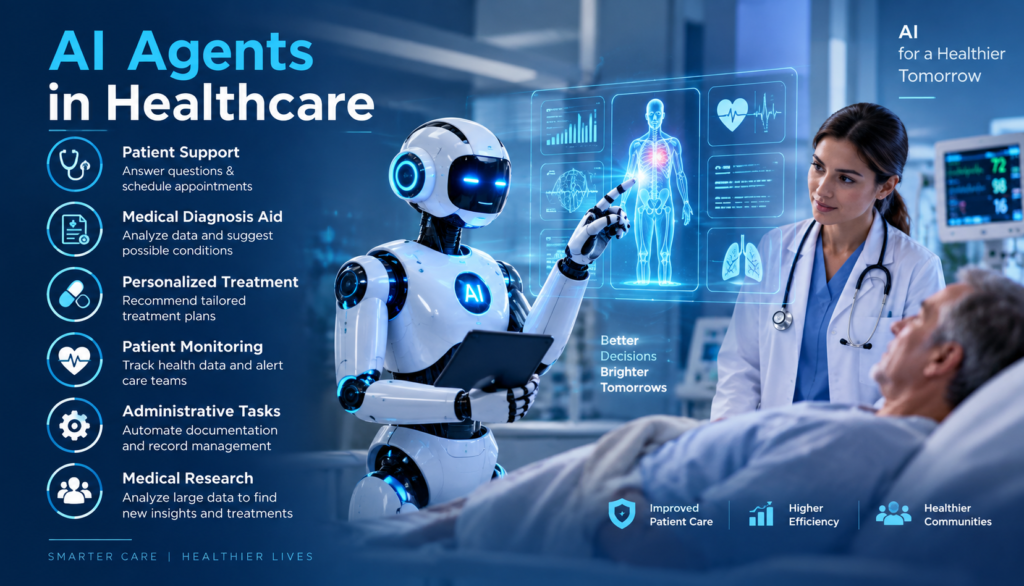
The future of AI agents in healthcare will likely involve deeper integration with digital health systems. Agents may become better at coordinating information across approved applications and handling longer workflows. Instead of performing one isolated task, they could support complete administrative processes from beginning to end while keeping people involved at important checkpoints. Improvements in language models may also make interactions more natural and useful. However, future progress will depend on more than model performance. Reliable data, secure infrastructure, responsible governance, interoperability, and strong evaluation methods will remain essential. Healthcare organizations will need to balance convenience with safety as these systems become more capable.
Another important development will be the move toward specialized agents. Rather than using one general system for every task, organizations may use separate agents for scheduling, documentation, research, patient communication, and operational support. These systems could work together under carefully controlled permissions. Such an approach may make it easier to audit actions and identify responsibility. At the same time, healthcare professionals will remain important because medicine involves context, communication, ethics, and judgment. The most useful role for AI agents is therefore likely to be collaborative. They can handle suitable digital work while professionals remain responsible for decisions that require expertise and human understanding.
AI Agents vs Traditional Healthcare Automation
Traditional healthcare automation usually follows fixed rules. For example, a system may send an appointment reminder when a specific date approaches. It performs the task according to predefined conditions. AI agents can potentially handle more flexible workflows because they can interpret natural language, evaluate available information, and decide which approved action should happen next. This flexibility can make agents useful for complicated administrative processes. However, flexibility also creates additional risks. A traditional rule-based system is often easier to predict, while an AI agent may produce different outputs depending on the information it receives. This is why testing and oversight remain important.
The two approaches can also work together. A healthcare organization does not need to replace every existing automated system with an AI agent. Simple, predictable tasks may continue using traditional automation because those systems can be reliable and easy to audit. Agents can then support workflows that require language understanding or flexible information handling. For example, a rule-based system may trigger an appointment reminder, while an agent helps organize a patient’s response. Combining technologies can create practical workflows without giving unnecessary autonomy to an AI system. This balanced approach may help organizations use artificial intelligence where it offers clear value while retaining dependable traditional processes.
What Patients Should Know About AI Agents in Healthcare
Patients may increasingly encounter AI agents when communicating with hospitals, clinics, insurers, or digital health services. These systems can help answer routine questions, organize requests, or provide general information. Patients should understand that an automated response is not necessarily the same as professional medical advice. When a question involves symptoms, diagnosis, treatment, medication, or an emergency, appropriate healthcare professionals should remain involved. Organizations should make it clear when a patient is communicating with an automated system. Transparency helps people understand the system’s role and decide when they need to request human assistance.
Patients should also pay attention to privacy and information sharing. Before providing sensitive information through an automated service, users should understand what information is being requested and why. Healthcare providers should establish appropriate safeguards for personal data and explain relevant practices clearly. AI agents can make digital healthcare interactions faster, but convenience should not come at the expense of safety or privacy. Patients can also ask for human assistance when an automated response seems unclear or incorrect. Clear communication between patients, healthcare professionals, and technology providers will remain important as AI becomes more common in everyday healthcare services.
Frequently Asked Questions About AI Agents in Healthcare
What are AI agents in healthcare?
AI agents in healthcare are intelligent software systems that can perform connected tasks using approved information and tools. They may support scheduling, documentation, communication, research, and clinical information management. Their role is generally to assist healthcare professionals and improve workflows rather than independently replace medical judgment or professional responsibility.
How can AI agents help doctors?
AI agents can help doctors by organizing information, preparing summaries, supporting documentation, and reducing repetitive administrative work. They may also help locate relevant information within approved systems. Important clinical outputs should be reviewed by qualified professionals because AI systems can produce inaccurate or incomplete information.
Are AI agents safe for patients?
AI agents can be used safely when organizations apply appropriate security, testing, monitoring, privacy controls, and human oversight. Safety depends on the specific system and task. Higher-risk activities require stronger safeguards and professional review. Patients should also have a clear way to reach a human healthcare professional.
Can AI agents replace healthcare professionals?
AI agents are better understood as support tools rather than complete replacements for healthcare professionals. Healthcare involves clinical expertise, communication, ethics, physical examination, and judgment. AI can assist with suitable digital tasks, while professionals remain responsible for decisions requiring medical knowledge and human interaction.
What is the future of AI agents in healthcare?
The technology is likely to become more integrated with healthcare software and specialized workflows. Future systems may coordinate several approved tasks while maintaining human checkpoints. Their growth will depend on reliable data, strong security, responsible governance, effective evaluation, and clear rules for human oversight.
Conclusion
AI agents in healthcare offer a practical way to support modern medical workflows. They can help with scheduling, documentation, communication, research, information management, and other repetitive activities. Their greatest value comes when they solve clear problems without removing appropriate human oversight. Healthcare organizations should begin with focused use cases, measure real outcomes, protect sensitive information, and create strong escalation processes. Patients should also understand when they are interacting with an automated system and when professional help is needed. As technology develops, the goal should not be automation for its own sake. The focus should remain on safer workflows, better experiences, responsible innovation, and meaningful support for healthcare professionals.



1 comment on “AI Agents in Healthcare: The Future of Smarter Care”